Visiting Southern Vietnam in the Rainy Season
What is the rainy season like in southern Vietnam?
The southern rainy season runs roughly from May to November and is dominated by short, intense downpours in the late afternoon rather than all-day rain. Mornings are usually clear, the south does not see the typhoons that hit central and northern Vietnam, and most sightseeing, day trips and river travel continue as normal around the storms.
Understanding the Rainy Season Pattern
Southern Vietnam runs on a two-season climate, not four, and this is the single most important thing to understand before planning a trip around the rainy months. The wet season stretches roughly from May through November, and the dry season covers the rest of the year. That is the whole picture. There is no autumn, no cool winter, and none of the seasonal machinery that shapes travel further north.
Travelers arriving with expectations shaped by Hanoi or the central coast often bring the wrong mental model. In the north and center, the rainy months can bring typhoons, sustained multi-day rain, and a genuinely cool, grey winter stretch. None of that applies here. Ho Chi Minh City and the Mekong Delta sit in the far south, well outside the typhoon belt that periodically batters the central coast, and the region simply does not experience a cold season at any point in the year. If a guidebook or forum post describes a southern Vietnam winter as chilly, or warns of typhoon risk in Saigon, it is describing somewhere else.
What the wet season actually looks like, day to day, is a rhythm rather than a wall of water. Mornings tend to be clear or lightly clouded, humidity builds through midday, and then a short, intense downpour arrives in the late afternoon or early evening. It typically lasts under two hours before clearing. This pattern repeats often enough that residents plan around it instinctively — an errand run before 3pm, a coffee break during the downpour, dinner plans unaffected by 7pm. It is not the all-day, saturating rain that “rainy season” implies to visitors from temperate climates.
Why This Matters for Trip Planning
Because the rain is predictable in timing rather than in whether it happens at all, most of what fills a southern Vietnam itinerary keeps working through these months. Morning activities in District 1 — Ben Thanh Market, a walk past the Reunification Palace, the War Remnants Museum — sit comfortably before the typical downpour window. Boat excursions on the Saigon River or the Mekong’s canals are, if anything, unaffected in kind: the water is already there, and light rain on a covered sampan is a minor inconvenience rather than a trip-ending one.
Where the rainy season does change the calculus is in scheduling outdoor time with a buffer. A half-day tour of Cu Chi Tunnels, for instance, benefits from an earlier start so the walking and crawling sections at Ben Dinh or Ben Duoc fall before the afternoon system builds. The Cao Dai Holy See at Tay Ninh holds its midday ceremony well within the dry window regardless of season, so that particular stop on a Cu Chi and Cao Dai day trip is essentially season-proof.
a five-day loop through Ho Chi Minh City and the southern provinces is a reasonable way to absorb a wet-season trip without over-planning any single day, since a multi-day structure naturally has slack for one afternoon washout without reshuffling the whole trip.
The Mekong Delta in the Wet Months
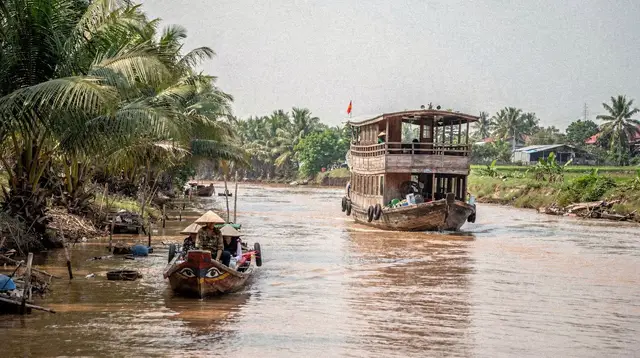
The Mekong Delta is, in a sense, built for water. Its identity — canals, orchards, floating trade — does not change character because more rain falls; if anything, the wet season is when the delta’s greenery is at its fullest and the canals around Cai Be and Vinh Long run fuller and more scenic. The Cai Rang floating market near Can Tho trades at dawn, well ahead of the typical afternoon rain, so the market experience itself is essentially unaffected by which half of the year a visit falls in.
a hands-on cooking class in Can Tho paired with lunch works well as an indoor-leaning addition to a Mekong day, giving the itinerary a built-in slot that does not depend on outdoor conditions at all.
Orchard stops around Sa Dec and My Tho can have muddier paths after a downpour, which is a footwear consideration rather than a reason to skip them — sturdy sandals or closed shoes with grip serve better than anything meant to stay pristine. Further out, Chau Doc and the Tra Su cajuput forest are, again, water landscapes by nature, and a wet-season visit shows them at their most vivid rather than at any disadvantage.
For a full day dedicated to this region, combining a Can Tho market morning with a cooking class or booking a broader Mekong Delta day trip from Saigon both accommodate the season without adjustment.
The Coast, the Dunes, and Cat Tien
Along the coast, Vung Tau and the quieter stretches at Ho Tram and Long Hai see the same late-afternoon pattern as the city, and a morning at the beach followed by a covered lunch during the shower is a natural rhythm rather than a workaround. The Con Dao archipelago is a partial exception worth flagging: because it sits roughly 230 km offshore and is reached only by air or fast ferry, its access depends on sea and wind conditions that are worth checking independently, separately from the mainland’s predictable afternoon rain.
To the north-east, Mui Ne and Phan Thiet sit on the south-central coast, not in the Mekong Delta — a distinction worth holding onto, since the two regions are frequently confused despite having different landscapes entirely. The white and red sand dunes are best visited early, which suits the rainy season’s own logic of front-loading outdoor time before the afternoon system arrives.
a three-day route linking Saigon, Mui Ne and the Mekong is one way to see all three regions on a single trip, with the built-in variety meaning a rained-out afternoon in one place rarely affects the itinerary as a whole.
Inland, Cat Tien National Park is at its greenest and most active for wildlife during these months — the Bau Sau wetlands are, unsurprisingly, wetland habitat that benefits from more water rather than less, and night walks for birds and primates continue through the season.
Practical Notes That Do Not Change With the Rain
None of Vietnam’s provincial reshuffling from July 2025 changed place names or how these regions are visited, so nothing about the rainy season interacts with that administrative history — it is mentioned elsewhere only to explain why some province names in older material may look unfamiliar. Similarly, Tet is a separate seasonal consideration tied to the lunar calendar rather than to weather, and does not overlap in any fixed way with the rainy season’s May-to-November span; the two are covered in separate guides because they are genuinely separate topics.
Traffic in Ho Chi Minh City continues at its usual dense, motorbike-heavy pace regardless of season, and a sudden downpour tends to thin the streets briefly as riders pull over to wait it out under awnings — a useful cue for a traveler to do the same rather than push on through poor visibility. Getting around the city via ride-hailing apps remains the most weather-proof option, since a covered car avoids the worst of an afternoon shower entirely.
For travelers weighing when to go at all, it helps to compare this season directly against its counterpart in the dry season guide and to think in terms of how many days suit a first visit to the city, delta and coast together — the rainy season does not shorten that calculus, it just adds a predictable afternoon pause to the daily rhythm.
a full-day Mekong Delta excursion from the city remains one of the most reliable ways to experience the region’s canals and orchards regardless of which half of the year a trip falls in, precisely because the delta’s character is defined by water in every season.
Indoor and Covered Options When the Rain Arrives
Even during the driest stretch of a wet-season trip, it helps to have a mental list of stops that do not care about the sky. Ben Thanh Market operates under a covered roof and continues to trade through a downpour, the Bitexco Financial Tower’s observation deck gives an indoor vantage point over the city that a shower does nothing to spoil, and the Central Post Office and the Reunification Palace are experienced mostly from inside regardless of the weather outside.
Notre-Dame Cathedral Basilica of Saigon has been under a long-running restoration, so travelers visiting now should not expect the exterior to be fully on display — that has more to do with ongoing works than with any season, wet or dry. Further from the center, Landmark 81 functions the same way as Bitexco: a tall, enclosed building that turns a rainy afternoon into a viewing opportunity rather than a wasted one. Across Cholon, the Jade Emperor Pagoda and the markets and temples of Chinatown are covered or semi-covered enough that a wet-season browse through them loses little compared to a dry-season one.
Cu Chi, Tay Ninh and Ba Den Mountain
The Cu Chi and Tay Ninh route already benefits from an early start in the wet season, and that logic extends to Ba Den Mountain, the Black Virgin Mountain and the highest point in the south at roughly 986 meters. Most visitors reach the summit by cable car rather than on foot, which makes the mountain one of the more weather-tolerant stops on this route: a cable car cabin is no less usable in light rain than in full sun, and the views from the top are simply better on a clear morning than in the middle of an afternoon system. Combining Ba Den with the Cao Dai Holy See and the Cu Chi Tunnels in a single long day works the same way in the rainy season as in the dry one, provided the tunnels themselves — the more physically demanding, ground-level part of the day — are scheduled first, before the afternoon system has a chance to build.
a combined Cu Chi Tunnels and Mekong Delta day trip is worth considering for travelers who want to pair the north-west route with a delta stop on the same day, since both halves of that itinerary are, for different reasons, largely indifferent to an afternoon shower.
Weighing the Delta Against the Coast in the Wet Months
Not every region in this territory responds to the rainy season the same way, and it helps to think about the difference before committing a full day to one over another. The Mekong Delta is, by its nature, a water landscape, so more rain changes very little about what a visitor actually experiences there beyond fuller canals and greener orchards.
The coast is a different case: Vung Tau, Ho Tram and Long Hai follow the same predictable late-afternoon pattern as the city, but a beach day depends more on sun than a delta day does, so travelers prioritizing swimming and sunbathing may want to build in flexibility that a canal or temple day does not need. Con Dao sits apart from both, since its ferries and flights are governed by open-sea conditions rather than by the mainland’s afternoon rhythm, and that distinction is worth keeping in mind when a wet-season itinerary tries to fit the archipelago in alongside the mainland.
a small-group Mekong Delta day trip is one way to keep the delta portion of a wet-season trip flexible, since a smaller group can adjust its pace around a passing shower more easily than a large one.
Packing for the Daily Rhythm
Because the rainy season in the south is really a pattern of clear mornings and short, heavy afternoon downpours rather than continuous rain, packing for it looks different from packing for a genuinely wet climate. A light rain jacket or poncho that packs down small is more useful than a full rain suit, since it only needs to cover the hour or two around the downpour itself. A dry bag or a simple plastic sleeve for a phone, passport and cash is worth carrying at all times, not just on days with an obvious risk of rain, since a shower can arrive with little warning.
Footwear that dries quickly matters more than footwear that claims to be waterproof — sturdy sandals or quick-drying shoes cope better with a sudden downpour and the occasional muddy path around an orchard or temple than heavy boots do. It is also easy to forget, given the focus on rain, that the sun between showers is still strong; sun protection remains part of a sensible daily kit through the wet season, not just the dry one.
Rainy Season Southern Vietnam: Frequently Asked Questions
Does it rain all day during the rainy season in Ho Chi Minh City?
No. The typical pattern is a clear or partly cloudy morning followed by a short, heavy downpour in the late afternoon that usually clears within an hour or two, leaving the evening free.
Is the rainy season the same as the season in northern Vietnam?
No. The south runs on a two-season pattern of dry and wet, not the four-season pattern of the north. There is no cool winter here, and the typhoons that periodically strike central and northern Vietnam are rare in the far south.
Can day trips from Ho Chi Minh City still run during the rainy season?
Yes. Cu Chi, Tay Ninh, the Mekong Delta and the coast are all reached by road, and Mekong boat trips continue on the rivers and canals. A short afternoon downpour rarely cancels a tour; it usually just shifts the timing of an outdoor stop.
Is the Mekong Delta harder to visit in the wet season?
Not particularly. The delta’s canals and rivers are used to water year-round, and the floating market at Cai Rang trades at dawn, before the afternoon rain typically arrives. Paths at orchard stops can be muddy, so sturdy sandals help more than an umbrella.
Should I avoid Con Dao during the rainy season?
Con Dao sits offshore and its sea conditions are worth checking independently of the mainland’s rain pattern, since flights and ferries depend on wind and swell rather than on the same afternoon showers that affect the mainland.
What should I pack for the rainy season in southern Vietnam?
A light rain jacket or poncho, a dry bag or plastic sleeve for a phone and documents, and quick-drying rather than heavy footwear. Many riders and pedestrians simply wait out the shower under a café awning rather than carrying full rain gear all day.
Is the rainy season a bad time to visit Ho Chi Minh City?
Many travelers find it a practical time to visit: mornings are workable for sightseeing, greenery in the delta and at Cat Tien is at its lushest, and the afternoon downpour is predictable enough to plan around rather than something that derails a whole day.
Seasonal Guide
Verified deep-linked GetYourGuide tours. Book through these links and we earn a small commission at no cost to you.
GetYourGuide does not provide a product photo for this activity — the image shows the meeting point, photographed by us.