Where My Tho Fits in the Mekong Delta
Of every town covered under the Mekong Delta heading on this site, My Tho sits closest to Ho Chi Minh City, on the most direct road running south-west out of the city toward the coast. That proximity, more than any single sight, is what makes it the default first stop for visitors who want a taste of the delta without committing a full multi-day itinerary to it. Day tours built around Cu Chi and the delta, city tours looking to add a river component, and cruise passengers docking at Phu My Port with limited hours ashore all gravitate toward My Tho for the same reason: it is the delta town that asks the least of a traveler’s schedule.
That ease of access has made My Tho something of a victim of its own convenience. Because it is the delta town most people visit first — and often the only one they visit — it has become, in a lot of secondhand retellings, a stand-in for “the Mekong Delta” as a whole. Details that belong to other towns get pinned onto it by mistake. The most persistent of these mix-ups involves the delta’s best-known sight.
My Tho Is Not Where the Floating Market Is
The single most common confusion about My Tho is the assumption that its river program includes a floating market, usually because the traveler is thinking of the Cai Rang floating market and has heard it described loosely as “the Mekong floating market” without a specific town attached. Cai Rang belongs to Can Tho, the delta’s largest city, well south of My Tho and reached by a longer road run. The Cai Rang floating market trades at dawn, with sampans loaded high with produce hung from tall poles so buyers can spot each boat’s cargo from a distance — a genuinely commercial scene, not a staged one.
My Tho has no equivalent of its own. Its river program runs instead to the islands and channels of the Tien River, closer to town, and built around a gentler set of stops: an orchard, a workshop, a narrower canal paddled by hand rather than powered. It is a different kind of morning on the water, not a smaller version of Cai Rang.
Anyone who has specifically come south to see a floating market needs to be looking toward Can Tho, or further along the delta toward Cai Be and Vinh Long, which run their own smaller river markets on their stretch of the delta. A side-by-side look at how the two towns actually compare for a first delta visit is covered in a dedicated comparison of My Tho and Can Tho as delta departure points.
The River Islands and What a Boat Trip From My Tho Looks Like
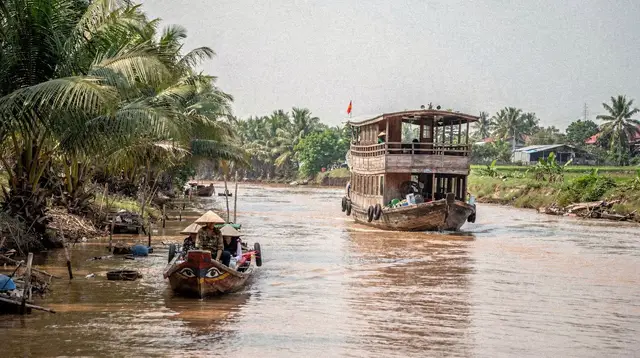
The stretch of the Tien River around My Tho holds a scatter of low, green islands, several of which are built into the standard river program: an orchard walk under fruit trees, a stop where coconut candy is worked and cut by hand or where honey tea is poured from a beekeeping operation, and usually a shift from a larger tourist boat onto a smaller wooden sampan for a stretch of narrower canal, paddled rather than powered, with the vegetation closing in from both banks. It is a slower, quieter register than the open-water crossings further into the delta, and that suits its role as an introduction rather than a deep dive.
Because this river program is the actual reason most visitors come to My Tho, and because operators package it in a wide range of ways — some as a half-day add-on to a longer itinerary, others as the centerpiece of a full day — the detail of what each boat route covers, how the stops differ from one operator to another, and how My Tho’s river program compares with the fuller excursions further south is worked through on this site’s dedicated Mekong cruises page rather than repeated here. That page is the better reference for choosing between the river-based options; this page exists to place My Tho correctly on the map of the delta and clear up what it is and isn’t.
My Tho and Ben Tre, Treated as One Stop
Directly across the river from My Tho sits Ben Tre, coconut country in its own right, and in practice the two are rarely visited as separate destinations. A river crossing links them naturally, and most operators fold Ben Tre’s coconut-grove villages and workshops into the same outing as My Tho’s river islands, so a visitor booking “a My Tho day trip” is very often booking a combined My Tho–Ben Tre itinerary without the name always making that explicit. A dedicated look at how that pairing works, and at My Tho and Ben Tre as a single tour, is the more detailed reference if the itinerary is still being pieced together.
a higher-comfort day tour covering both My Tho and Ben Tre is the version built for travelers who want the river-island program without a large group, while a version built around the day cooling into evening runs as a My Tho and Ben Tre outing that continues after dark to watch fireflies along the riverbank.
Combining My Tho With Cu Chi
Because My Tho sits south-west of Ho Chi Minh City and the Cu Chi Tunnels sit north-west, the two are not on the same road, but they are close enough in overall distance from the city that a number of operators combine both into one long day, looping out to Cu Chi in the morning and down to the delta in the afternoon, or the reverse.
It makes for a full day rather than an easy one, but it suits travelers who have only a single day free and want to see both the tunnel network and a slice of the delta rather than choosing between them. A four-day itinerary that pairs Cu Chi with the Mekong Delta is built for travelers who would rather spread the two across separate, less rushed days.
Anyone still deciding how to structure that combination should also look at the half-day versus full-day comparison for Cu Chi and the site’s broader Cu Chi and Mekong Delta day trip guide, both of which deal with the trade-offs in more depth than fits here.
Who My Tho Suits, and Who Should Look Further South
My Tho works best for a specific kind of traveler: someone with a single free day or half-day, someone breaking a longer Ho Chi Minh City stay with one river excursion, or someone arriving via a cruise call at Phu My Port with only a few hours ashore. For that traveler, the short run out of the city and the gentle river program deliver a real taste of the delta without eating into the rest of a trip.
Travelers with more time, or anyone whose main goal is specifically to see the Cai Rang floating market, are usually better served heading further south to Can Tho instead, or building a longer loop that takes in Sa Dec and its flower village, Vinh Long’s orchards, and Can Tho’s market in a single multi-day run. The site’s two-day Mekong Delta itinerary built around Can Tho and Cai Rang and the broader three-day Saigon, Cu Chi and Mekong classic route both go into that fuller version of the delta.
A more general read on whether a single delta day trip is worth building into a short Ho Chi Minh City stay at all, versus giving the region more time, sits in the is a Mekong Delta day trip worth it guide, and the trade-offs between a single day and a two-day version are laid out in the Mekong Delta day trip versus two-day tour comparison.
For a broader group program that treats the river crossing as one stop among several cultural activities, a My Tho-area eco-tourism day combining folk games with the river program is aimed at groups and families rather than a quieter pace, while a more open-ended option is simply booked as a general Mekong Delta tour and matched to whichever departure point suits the rest of the itinerary — a decision covered in full in the choosing a Mekong Delta departure point guide.
Getting There and Practical Notes
My Tho is reached by road, like effectively every delta and coastal destination covered on this site apart from Con Dao. Independent travel by public bus or private car is possible, since My Tho sits directly on a main route, but the river-island program that is the actual point of a visit is boat-based and almost always arranged through a local boat operator or tour rather than improvised on arrival. Most visitors book the river component as part of a packaged day trip that also handles the road transfer, which removes the need to negotiate boat access locally.
As with the rest of the delta, cash remains the more reliable way to pay for anything outside a booked tour — small stops, workshop purchases, and roadside stalls along the way generally expect Vietnamese dong rather than cards. The dry season, roughly December through April, gives the most reliably clear days for the river crossing, though the wet season’s rain in this part of the country tends to arrive as a short afternoon downpour rather than a day lost to steady rain, so a wet-season visit is still very workable if it’s the only date available.
Frequently Asked Questions About My Tho
Is the Cai Rang floating market at My Tho?
No. Cai Rang is at Can Tho, the delta’s main city further south. My Tho’s own river program is built around the river islands, orchards and coconut workshops of the Tien River, not a floating market.
Why is My Tho usually the first delta stop from Ho Chi Minh City?
My Tho sits closer to the city than any other Mekong Delta town covered on this site, on the most direct road route south-west out of Ho Chi Minh City, which is why so many day tours use it as the delta entry point.
Can My Tho be combined with Ben Tre in one visit?
Yes, and it usually is. Ben Tre sits just across the river from My Tho and shares the same river-island program, so the two are treated as a single excursion area rather than two separate destinations.
Does a My Tho day trip include Cu Chi Tunnels?
Some itineraries combine My Tho with the Cu Chi Tunnels in a single long day, since both lie in roughly the same direction out of the city, though Cu Chi is north-west and My Tho is south-west, so the route loops rather than running in a straight line.
What does a river excursion from My Tho actually involve?
Typically a boat out to one of the river islands, a walk through an orchard or a workshop producing coconut candy or honey tea, and a smaller sampan paddled along a narrower canal. The full range of boat-based options is covered on this site’s dedicated Mekong cruises page.
Is My Tho worth visiting if the itinerary already includes Can Tho?
Many travelers with more time skip My Tho in favor of going straight to Can Tho and the Cai Rang market, since the two towns offer a similar river-and-orchard experience and Can Tho adds the floating market. My Tho mainly earns its place through proximity and ease, not through offering something Can Tho lacks.
Is My Tho reachable without a tour?
It sits on the main road south-west of Ho Chi Minh City and can be reached independently, though the river-island program itself is boat-based and almost always arranged through a local operator or tour rather than done solo.