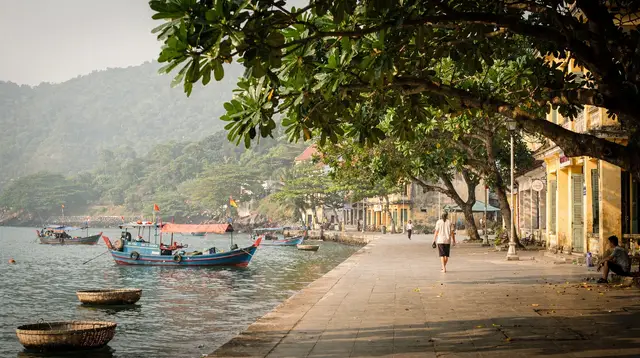
Most visitors picture the coast near Saigon as a single strip running from Can Gio to Vung Tau and beyond. Con Dao breaks that pattern entirely. It is not a stretch of mainland shoreline but a scattered archipelago sitting well out in the sea, and that single geographic fact shapes everything about how — and whether — a trip here comes together.
An archipelago, not a coastal town
The most common misconception about Con Dao is also the simplest to correct: there is no road to get there. Can Gio, Vung Tau, Ho Tram and the deep-water port at Phu My all sit on the mainland and are connected to Ho Chi Minh City by ordinary highway, which is why they slot naturally into single- or multi-day drives out of the city. Con Dao does not. It is a cluster of islands off the southern coast, and the only ways in are by air, on a short flight from Ho Chi Minh City, or by ferry from the mainland coast. There is no route that involves a car, a coach or a bridge, at any point.
This is not a minor detail for planning purposes. It means Con Dao cannot be tacked onto a day-trip itinerary built around Vung Tau or Ho Tram, however close those places look on a map of the wider region. It also means the practical logistics — flight schedules, ferry crossings, onward transport once you land — deserve their own research rather than being folded into a generic “southern coast” plan. For the day-to-day mechanics of getting across, the dedicated guide to the Con Dao archipelago goes into more depth than a destination overview can.
Because of this separation, Con Dao tends to work best as a stopover in its own right: a few nights built around the islands themselves, rather than a stop threaded between other coastal destinations. Travelers piecing together a longer route through the south sometimes fold it into an extension at the end of a trip, an approach covered in the Con Dao island extension itinerary, or as one stage of a broader loop through the Mekong and the islands.
A national park more than a resort strip
Con Dao’s identity rests on the fact that most of its land and surrounding waters fall inside a national park. Unlike the built-up beach towns closer to the mainland, development here has stayed comparatively light, and a large share of the archipelago’s forest, coastline and reefs sits under protection. That protected status is the reason Con Dao reads so differently from Vung Tau or Ho Tram: fewer hotels crowding the shoreline, longer stretches of undeveloped coast, and a sense of a place still organized around its wildlife rather than around visitors.
The forested interior supports hiking routes through lowland and hill forest, some leading to viewpoints and old growth trees rather than to any single headline attraction. A walk to Bai Bang and Dat Tham, for instance, moves through jungle terrain toward a quiet bay, and travelers who want a longer, tree-focused route often combine it with a visit to one of the archipelago’s heritage Sao Den trees — centuries-old specimens that have become informal landmarks in their own right. Both make for a more physically active day than most people expect from an island trip.
For the specifics of which beaches reward a half-day of lounging, which coves are better suited to snorkeling, and how Con Dao’s shoreline compares with the mainland options, the beaches and islands section carries that detail rather than repeating it here — Con Dao’s beaches are only one part of what draws people out to the archipelago, and treating them in isolation would miss the bigger picture of forest, reef and history working together.
Offshore islands, reefs and marine life
Con Dao’s national park extends well beyond the main island itself. A scatter of smaller islands and islets ring the archipelago, several of them protected specifically for their reefs, seagrass beds and nesting beaches. Bay Canh and Hon Cau are among the more frequently visited of these satellite islands, reachable by boat trips that combine a short crossing with time in the water or on a quiet shoreline that sees a fraction of the mainland coast’s foot traffic.
The waters here support healthy coral in patches, along with seagrass meadows that draw dugongs — one of the reasons Con Dao’s marine zone carries real conservation weight, not just scenic value. Snorkeling and canoe trips around these outer islands are pitched at a wide range of comfort levels: a guided canoe trip requires no prior experience, while more committed itineraries pair a boat crossing to Ba Island with a hike up to Love Peak for a wider view over the archipelago. Certified divers have more serious sites to explore further into the park’s marine boundaries, a subject the dedicated diving and snorkeling guide treats on its own terms.
Con Dao is also one of the country’s more significant sea turtle nesting sites. In season, some of the smaller islands host nightly nesting activity, and a limited number of guided programs let visitors take part in returning hatchlings to the sea under close supervision — a genuinely different kind of wildlife encounter from anything on offer along the nearer stretches of coast.
| Activity type | What it involves |
|---|---|
| Forest hiking | Trails through lowland and hill jungle, including heritage tree routes |
| --- | --- |
| Island boat trips | Crossings to Bay Canh, Hon Cau and Ba Island for snorkeling and reef viewing |
| --- | --- |
| Canoeing | Guided paddling around sheltered island coves, suitable for beginners |
| --- | --- |
| Turtle conservation | Seasonal guided release of hatchlings on protected nesting beaches |
| --- | --- |
| Historical visits | The former prison complex and its associated memorial sites |
A few of the above can be booked directly rather than arranged locally once you land. A guided walk through the jungle to Bai Bang and Dat Tham is one option worth locking in ahead of time with a hiking route to Bai Bang and Dat Tham, and travelers drawn to the archipelago’s older trees can pair it with a hike to one of Con Dao’s heritage Sao Den trees.
For the water-based side of a visit, a boat trip out to Ba Island combined with the climb to Love Peak covers both a crossing and a viewpoint in one outing, while a gentler alternative is a guided canoe trip around Ba Island’s coves. Travelers visiting during the nesting season sometimes build an evening around a supervised release of baby turtles into the sea.
A prison history that shaped the whole archipelago
Con Dao’s other defining thread is a heavier one. Long before it became a nature destination, the archipelago was the site of one of French Indochina’s largest and most severe prison systems, later continued under South Vietnamese administration. Political prisoners were held here across decades, in conditions that included the cramped, roofless enclosures now remembered as the “tiger cages.” The former prison grounds are preserved today, and walking through them is a markedly different experience from the beach and forest side of an island stay — solemn, direct, and central to how Vietnam remembers this period.
Because the historical material here is substantial enough to deserve its own treatment, the fuller context — how the prison system developed, what remains on site today, and how it connects to the broader story of resistance and imprisonment across the south — sits in the war and history section rather than being compressed into a paragraph or two on a destination page. Many visitors set aside a separate stretch of a Con Dao stay specifically for this, distinct from the days given over to hiking and the water.
Planning a stay around the archipelago
Because getting to Con Dao already takes more effort than a coastal day trip near Saigon, most itineraries are built to make that effort worthwhile with a multi-night stay rather than a rushed overnight. A typical visit blends a day or two on the water — a boat trip to the outer islands, some time snorkeling or paddling around a quiet cove — with at least one day given to the forest trails and heritage trees, and time set aside for the historical sites. Travelers should not expect the density of restaurants, shops or nightlife found in Ho Chi Minh City or even in Vung Tau; the appeal of Con Dao is precisely that it has stayed smaller and quieter than the mainland coast.
Anyone weighing Con Dao against the closer, easier-to-reach parts of the coast will find that comparison laid out directly in the guide on choosing a beach near Saigon, which sets the archipelago’s trade-offs — a longer journey in exchange for a wilder, less developed setting — against Vung Tau and Ho Tram. For travelers still shaping how many days to spend across the wider south, how many days you need in southern Vietnam is a useful place to work out where an island stopover like Con Dao fits against time in the city, the Mekong Delta and the rest of the coast.
Whichever route in you choose, keep in mind the one point worth repeating: there is no overland option to Con Dao, at any stage of the journey. Every itinerary that includes it has to plan around a flight or a ferry, not a highway, and building that into your route from the start avoids the confusion that sends some travelers looking for a road that simply does not exist.
Flights, the ferry and the airport at the other end
Most visitors arrive by air, on a short flight from Ho Chi Minh City departing from Tan Son Nhat, the same airport used for onward trips across the rest of southern Vietnam and beyond — the guide to the airport transfer covers the mainland side of that connection. Con Dao’s own airport, at Co Ong, sits some distance from the main town, and travelers who would rather not negotiate transport on arrival can arrange a private transfer from Co Ong Airport into the Con Dao town center ahead of time.
The ferry option runs from the mainland coast rather than from central Ho Chi Minh City itself, which is why most itineraries built around the city treat the flight as the default and the ferry as a slower alternative for travelers already positioned along the southern coast. Either way, the crossing — by air or by water — is the one fixed cost of visiting Con Dao, and it is the reason the archipelago rewards a multi-night stay far more than a fleeting stop.
Best time to visit and what the seasons bring
Con Dao follows the same broad dry-and-rainy pattern as the rest of southern Vietnam, and the dry season, running roughly from December to April, is generally considered the easier window for calm seas, reliable boat trips to the outer islands and comfortable hiking conditions.
The guide to the dry season across southern Vietnam and its counterpart on the rainy season both apply to Con Dao as much as to the mainland coast, though sea conditions around an offshore archipelago can shift faster than weather on land, which is worth factoring in when booking water-based activities close to the shoulder seasons. Turtle nesting season falls within a narrower window than the dry season overall, so travelers hoping to combine a hatchling release with calm boat conditions should plan around both calendars rather than just one.
Rounding out a longer stay: more islands and more history
Beyond Bay Canh, Hon Cau and Ba Island, Con Dao’s national park takes in a wider scatter of smaller islands that reward travelers with a few extra days on the archipelago. Boat-based day trips reach further-flung spots such as Bay Canh and Hon Tai islands or, on a different route, Bay Canh and Hon Cau together, both pitched at travelers who have already done the more central island crossings and want to see more of the park’s outer edges.
A faster option covers more ground in less time with a speedboat tour to Hon Tre Lon Island with snorkeling, while a quieter, wildlife-focused alternative is a birdwatching and snorkeling trip around Hon Trung.
Divers with more time to spend can go beyond an introductory snorkel with a half-day scuba diving and snorkeling outing, a subject the dedicated diving guide treats in more depth. On the historical side, travelers who want the prison complex and its memorial sites covered in a single guided outing, rather than pieced together independently, can book a tour of Con Dao’s historic sites and spiritual heritage.
For travelers weighing whether a multi-day stopover is worth the flight in the first place, a three-day tour from Ho Chi Minh City by high-speed boat bundles the crossing with the islands themselves, for those who would rather arrive by water and still see the archipelago properly rather than rushing it.
Con Dao for families and travelers new to the water
Con Dao is not built around large resorts or a dense strip of family attractions the way parts of the mainland coast are, but the mix of easy boat trips, sheltered coves and seasonal wildlife activities gives it a different kind of family appeal — one closer to what the guide to southern Vietnam with kids describes for the region more broadly, where slower, nature-based days often work better than packed sightseeing schedules.
A guided canoe trip or a turtle-release evening tends to suit older children well, while the prison memorial sites are generally better suited to adults and older teenagers given the weight of the subject matter. Travelers who prefer to plan out a full multi-day route that fits an island stopover like this against city time, the delta and the rest of the coast can also work from the ten-day ultimate south Vietnam itinerary, which treats Con Dao as one stage among several rather than the sole focus of a trip.