Ho Chi Minh City’s Closest Big Day Trip
For most visitors staying in Ho Chi Minh City, the Cu Chi Tunnels are the first big excursion that comes to mind, and often the only one they have room for. The tunnels sit to the north-west of the city centre, on the way toward Tay Ninh and the province beyond, but they are not some distant province of their own — Cu Chi is a district of Ho Chi Minh City itself, administratively part of the same sprawling metropolis whose downtown core is District 1.
That single fact resolves most of the confusion travellers arrive with: a trip to Cu Chi does not require leaving the city’s own boundaries, even though it feels, once the road opens out into rice paddies and rubber plantations, like a different world from the traffic of downtown Saigon.
This page treats Cu Chi as the pivot for the whole north-western corner of the site’s territory. From here, the same road continues on to Tay Ninh, to the Cao Dai Holy See, and to Black Virgin Mountain, the highest point in the south. Each of those has its own detailed page; this one stays focused on the tunnels themselves — what the network actually was, how the two visitor sites differ, how much time to give the visit, and how to get there — while pointing onward to the rest of the region rather than repeating it.
What the Tunnel Network Actually Was
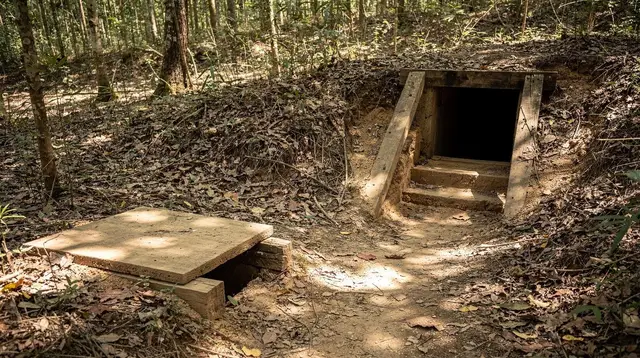
The tunnels at Cu Chi began as a modest network dug during the first Indochina war and were expanded enormously during the war against the United States, evolving into a many-layered underground system that ran for a considerable distance beneath the district. They were not a single tunnel but an interconnected web at several depths, linking living quarters, kitchens with cleverly diffused smoke vents, meeting halls, workshops, hospitals, and firing positions. Whole sections of the local population and armed units used the network to move, hide, and operate largely out of sight of forces above ground, which is central to why Cu Chi became such a heavily fought-over district throughout the conflict.
Guides at both visitor sites walk groups through reconstructed sections of this layout: a war-era generation used narrow shafts, false entrances disguised in the forest floor, and air holes hidden inside termite mounds to keep the network concealed. Static displays along the visitor paths show how folding trapdoors were built to blend into leaf litter, how kitchens funnelled smoke through vents some distance from the actual cooking area, and how different levels of tunnel were reserved for different purposes.
None of this needs to be taken in as a list of facts memorised beforehand — a guide walks each group through it in sequence, and the experience of crouching through a short stretch of tunnel does more to convey the scale of the original engineering than any description can.
The wider guide to how the tunnel network worked goes deeper into the layout and its history for readers who want more than the overview given here, and the Saigon war sites walking tour pairs well with a Cu Chi visit for anyone building out a fuller picture of the city’s wartime history, alongside the War Remnants Museum back in the centre.
Two Sites, One Network: Ben Dinh and Ben Duoc
Visitors are shown the tunnels at one of two separate, purpose-built sites rather than at a single entrance, and the two feel noticeably different despite preserving parts of the same underlying network.
Ben Dinh sits closer to the city and is where the overwhelming majority of standard group tours are taken, simply because it shortens the drive. That popularity comes with a trade-off: paths and tunnel sections here see a heavier flow of visitors, and it can feel more like a well-worn attraction than a quiet historical site.
Ben Duoc lies further out along the river, and receives a much lighter, more spread-out crowd. Its grounds are larger, and a nearby memorial temple adds another layer to the visit beyond the tunnels themselves. Private tours and visitors with more flexible time often choose Ben Duoc for exactly this reason — more room to walk, and a calmer pace inside the tunnel sections.
Neither site is objectively “better” than the other; they are two doors into the same history, and the choice mostly comes down to how a given tour is routed and how much a traveller values quiet over convenience. The dedicated comparison at Ben Duoc vs Ben Dinh walks through the trade-offs in more depth, and the related piece on choosing between the two covers much the same ground from a slightly different angle for readers weighing up a private itinerary.
How Long to Spend at Cu Chi
A visit to either site can be handled comfortably within a half day once travel time to and from the city is included, which is why the tunnels are the default half-day or morning add-on for visitors who also want to fit in central Saigon sights on the same trip. Group tours built around a half day typically bundle in one tunnel site plus a short stop or two along the way, then return to the city in time for the afternoon.
A fuller day allows for a calmer pace at the tunnels themselves, room to see more of the surrounding grounds at Ben Duoc, or a combination trip that folds in Tay Ninh and the Cao Dai temple, or Black Virgin Mountain, on the same outing. Because all three destinations sit along the same general corridor north-west of the city, stacking them into one long day is common, though it makes for a full and fairly tiring day rather than a relaxed one. Travellers who prefer a slower pace tend to split the tunnels and the Tay Ninh sights across two separate visits instead.
The dedicated comparison at half day vs full day at Cu Chi sets out the trade-offs for readers still deciding, and the broader question of how many days to give southern Vietnam is worth reading before locking in an itinerary that includes Cu Chi alongside the Mekong Delta or the coast.
Getting There From Ho Chi Minh City
The tunnels are reached by road, heading north-west out of the city centre through Cu Chi district’s outer edges before the route opens into a more rural landscape of paddies and plantations. Almost every visitor travels by one of three methods:
| Method | What it involves |
|---|---|
| Group day tour | A shared coach or minibus with a fixed itinerary, a guide, and a set tunnel site (usually Ben Dinh) |
| --- | --- |
| Private car or private tour | A dedicated vehicle and guide, more flexible timing, and often routed to the quieter Ben Duoc site |
| --- | --- |
| Independent transport | Self-driven or hired transport, with no guide included at the site unless arranged separately |
Group tours are by far the most common approach, since they remove the need to arrange transport and typically include a knowledgeable guide who narrates the tunnel network’s history along the route and at the site itself. A private option gives more control over pacing, which site is visited, and whether the day extends onward toward Tay Ninh. Independent travel is possible but uncommon, since the practical benefit of a guide’s explanation is a large part of what makes the tunnels worth visiting rather than just walking through.
For visitors who want the tunnels explained by a guide who has led the walk many times before, the standard Cu Chi Tunnel day tour covers the essentials with a group. Travellers who would rather set their own pace, choose the quieter site, or combine the visit with other stops along the way often prefer a private guided visit to the tunnels instead. For anyone trying to stitch together a wartime history theme with the city itself, a combined city and tunnels full-day tour folds central Saigon sights and the Cu Chi visit into a single outing.
Anyone weighing a shared group departure against arranging a private car should also read group tour vs private tour in southern Vietnam, which applies just as directly to Cu Chi as it does to the Mekong Delta trips covered elsewhere on this site. And for travellers arriving with military history specifically in mind, the veteran-led guide tours page covers a distinct style of visit worth knowing about before booking.
Cu Chi, Tay Ninh, and the Rest of the Region
The single most common mix-up among first-time visitors is treating Cu Chi, Tay Ninh, and the Cao Dai Holy See as interchangeable names for the same trip. They are not. Cu Chi is a district of Ho Chi Minh City, and the tunnels sit within it. Tay Ninh is a separate area further along the same road, outside the city’s own boundaries, and it is where the Cao Dai Holy See and Black Virgin Mountain are actually located — not at Cu Chi. A visitor who books “a Tay Ninh tour” expecting to see the tunnels, or a “Cu Chi tour” expecting the Cao Dai temple, is likely to be disappointed unless the specific itinerary spells out both stops.
Because the two areas sit along the same corridor out of the city, they are frequently packaged together into a single long day, and this page exists precisely to sit at that junction: it covers the tunnels in full, and hands off to dedicated pages for what lies further down the road.
- The Cao Dai Holy See at Tay Ninh is the spiritual centre of the Caodaist religion, with its own distinctive architecture and a midday ceremony open to visitors.
- Black Virgin Mountain, also known as Nui Ba Den, is the highest point in the south, reached on foot or by cable car from its base near Tay Ninh.
- The Tay Ninh destination page covers the wider area around both of these sights.
Readers planning to combine the tunnels with Tay Ninh in one day should go straight to the Cu Chi Tunnels and Cao Dai Temple day trip guide, which lays out how the combined route typically runs, or the more general Tay Ninh and Black Virgin Mountain day trip for a version centred more on the mountain. The Cao Dai Temple Tay Ninh guide covers the temple itself in the depth this page deliberately leaves out.
Booking Choices Beyond a Standard Tour
Not every visitor wants the standard coach-and-guide format. A few alternative approaches have become popular enough to deserve a mention here, with fuller detail on their own pages:
- Combining the tunnels with a stretch of the Saigon River by boat, for travellers who would rather arrive by water than by road for at least part of the journey.
- Pairing Cu Chi with an early departure toward the Mekong Delta on the same day, for visitors trying to cover the region’s two signature day trips without adding an extra day to their stay.
- Choosing a private guide with a specific interest in military history over a general-purpose group tour, as covered on the veteran guide tours page.
Whichever format is chosen, the practical shape of the day stays similar: a road journey out of the city, time spent walking and crouching through restored tunnel sections at one of the two sites, and a return journey that either heads straight back to Ho Chi Minh City or continues on toward Tay Ninh.
Where This Fits Into a Longer Itinerary
For visitors building a longer stay around Ho Chi Minh City rather than a single day trip, the one-day Cu Chi Tunnels itinerary shows how a standalone day built around the tunnels typically unfolds, while the three-day Saigon, Cu Chi and Mekong classic itinerary shows how the tunnels sit alongside the city and the Mekong Delta as the three anchor experiences of a short stay in the south.
Travellers curious about the region’s other main draws beyond Cu Chi and Tay Ninh should head from here to the Mekong Delta pages, or back to the things to do around Cu Chi Tunnels hub for a fuller list of tours and activities based at this specific destination.
Frequently Asked Questions About Visiting the Cu Chi Tunnels
Is Cu Chi its own province, separate from Ho Chi Minh City?
No. Cu Chi is a rural district that belongs to Ho Chi Minh City itself, on its north-western edge. It is not a separate province, and it is not the same place as Tay Ninh, which lies further out and is administered on its own.
Is the Cao Dai Holy See located at the Cu Chi Tunnels?
No. The Cao Dai Holy See, the centre of the Caodaist religion, is in Tay Ninh, a further stretch beyond Cu Chi. The two are commonly combined into a single long day trip, but they are separate destinations with separate sites to visit.
What is the difference between the Ben Dinh and Ben Duoc tunnel sites?
Both sites preserve and display sections of the same underground network, restored and widened for visitors to explore. Ben Dinh sits closer to Ho Chi Minh City and draws far more visitors on typical group tours, while Ben Duoc lies further along the river and sees a quieter, more spread-out crowd.
Can the tunnels at Cu Chi be visited independently, without a tour?
Independent visits are possible with a private car or a motorbike, but almost every visitor arrives as part of an organised group or private tour, since the site is reached by road outside the city and most tours bundle in a guide who explains the network’s history along the way.
Should Cu Chi be combined with Tay Ninh and the Black Virgin Mountain in the same day?
Many visitors combine all three, since Cu Chi sits on the same north-westerly road as Tay Ninh and Nui Ba Den, the Black Virgin Mountain. Doing all three in one day makes for a long day out from Saigon; splitting them across two visits allows more unhurried time at each.
Are the tunnel passages at Cu Chi the original size?
No. The passages shown to visitors have been enlarged from their original wartime dimensions so that a wider range of visitors can pass through them; some short original-scale sections are also displayed for comparison rather than for crawling through.
What should a visitor wear or bring to the Cu Chi Tunnels?
Because part of the visit involves crouching or crawling through narrow underground passages in a hot, humid forest setting, closed shoes, light clothing that can get dusty, and a willingness to feel a little claustrophobic underground are the main practical considerations.