Why Can Tho matters more than its name suggests
Most visitors to southern Vietnam hear about a floating market long before they hear the name Can Tho. They picture wooden boats stacked with pineapples and dragon fruit, drifting past each other at first light, and they assume that scene belongs to whichever Mekong Delta town their itinerary already mentions — often My Tho or Cai Be, because those are the delta names most travelers encounter first on a short trip out of Ho Chi Minh City. That assumption is wrong, and it is wrong often enough that it deserves stating plainly: the market in question, Cai Rang, belongs to Can Tho.
Can Tho is the largest city in the Mekong Delta and, in practical terms, its capital in everything but name. Where My Tho and Vinh Long feel like river towns you pass through, Can Tho feels like a small city in its own right — bridges over branching canals, a riverside promenade, university students, markets that serve residents as much as visitors. It sits further from Ho Chi Minh City than the closer delta towns, which is exactly why it rewards travelers who give it more than a rushed afternoon.
This page treats Can Tho as a hub in its own right: how to get there, what the Cai Rang floating market actually is and where it actually sits, how much time the city and its surroundings reasonably deserve, and where Can Tho fits alongside Sa Dec, Chau Doc, Soc Trang, Rach Gia and Ca Mau further down the delta.
Getting to Can Tho from Ho Chi Minh City
Can Tho is the delta’s furthest major town from Ho Chi Minh City, further than My Tho, Ben Tre or Vinh Long, but it is also the best connected by road. A dedicated expressway now links the two cities directly, which has made Can Tho considerably faster to reach than it used to be and turned what was once a full-day slog into a comfortable half-day drive by coach, private car or “limousine” minibus.
There is no rail option worth considering and no direct flight that makes sense for a trip already based in Ho Chi Minh City — Can Tho does have its own small airport, but it mainly serves domestic connections from further north, not travelers already in the south. The realistic choices are a seat-in-coach bus, a shared minibus, or a private car with driver, and most delta-focused tours from Ho Chi Minh City that include Can Tho or Cai Rang build the road transfer into a longer, multi-stop itinerary rather than a straight there-and-back run.
Because of the distance involved, Can Tho is one of the few delta destinations where an overnight stay genuinely changes the experience rather than simply adding convenience — a point covered in more depth below.
Cai Rang floating market — and why it isn’t in My Tho
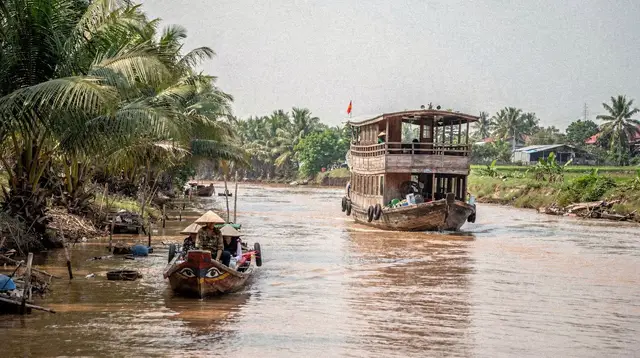
The single most useful fact on this page is also the most commonly garbled one: the Cai Rang floating market is on the river just outside Can Tho, not in My Tho and not in Cai Be. My Tho and Cai Be have their own boat trips through narrow coconut-palm canals, and those trips are genuinely worthwhile, but they are a different experience from Cai Rang — narrower waterways, smaller sampans, an emphasis on orchards and cottage industry rather than wholesale trade.
Cai Rang, by contrast, is a genuine wholesale market that happens on open water: wooden boats loaded with produce, each one hanging a sample of its cargo from a tall pole so buyers can identify it from a distance, trading directly with smaller boats and with the traders who motor between them selling drinks and noodle soup straight off the water. It is a working market first and a photogenic scene second, which is part of why it has become the delta’s signature image — and part of why getting the location right matters if a trip is being planned around it.
Because Cai Rang trades on the river rather than from fixed stalls, timing and approach matter more than they do at a land-based market. Most visitors reach it by boat directly from Can Tho, usually as part of an early departure, and several operators pair the market with a wider look at the surrounding canals and orchards.
a dawn boat trip out to the Cai Rang floating market is the single most useful booking for anyone building a Can Tho stop around this scene, and pairing it with a slower look at the backwaters is easy to arrange locally once in the city.
How much time Can Tho deserves
Can Tho is not a place to see on the way past. Because it sits further from Ho Chi Minh City than the closer delta towns, a same-day round trip leaves very little time actually in the city or on the water once the road transfer is accounted for both ways. Travelers who treat Can Tho as a quick stop tend to leave having seen the market from a moving boat and little else.
An overnight change this considerably. Staying in Can Tho means being on the water for the floating market at the hour it is genuinely active, rather than arriving after the best of the trading has already happened, and it leaves a free stretch afterward to explore the city itself — its riverside promenade, its central market, its canal-side neighborhoods — at an unhurried pace rather than racing back toward the expressway.
For travelers who cannot spare an overnight, Can Tho still works as a long single day from Ho Chi Minh City, provided expectations are set around the market and perhaps one canal excursion rather than a full tour of the city. Multi-day Mekong Delta itineraries that continue toward Chau Doc, Rach Gia or the Cambodian border almost always route through Can Tho as a stopover for exactly this reason — it is the delta’s natural midpoint for anyone heading deeper south or west.
Beyond Can Tho: the deep delta
Can Tho functions as a hinge point for the deeper reaches of the Mekong Delta, the places that sit beyond a comfortable single day from Ho Chi Minh City and that most travelers only reach by treating Can Tho as a base or a waypoint.
To the north-west, Sa Dec is known for its flower-growing village and its riverside colonial-era houses, a quieter counterpart to the market towns closer to the city. To the west, Chau Doc sits near the Cambodian border, a jumping-off point for Sam Mountain and the Tra Su cajuput forest, and a common overland or river route toward Phnom Penh. To the south, Soc Trang is home to a significant Khmer community and a cluster of Khmer pagodas unlike anything closer to Ho Chi Minh City. Further still, Rach Gia opens onto the Gulf of Thailand and toward Phu Quoc, while Ca Mau, at the very southern tip of the country, is the delta’s most remote major town, bordered by the U Minh Ha forest.
None of these places are quick add-ons to a Can Tho stop — each deserves its own planning — but knowing that Can Tho is the practical gateway toward all of them helps explain why it carries more weight in delta itineraries than towns that are individually closer to Ho Chi Minh City.
What to do in and around Can Tho
Beyond the floating market, Can Tho’s appeal is mostly about pace: canals to move through slowly, a working city to wander, and a regional food culture that draws heavily on the delta’s abundance of fish, rice and tropical produce. Cycling through the orchards and villages on the city’s outskirts is a popular way to see rural life at ground level rather than from a boat, and a handful of operators run half-day and full-day routes through the backroads around the city.
Food is arguably as strong a reason to linger in Can Tho as the market itself. The city’s markets, street stalls and family-run restaurants serve a distinctly delta repertoire — freshwater fish, hotpots built around local greens, rice noodle dishes that differ from their counterparts in Ho Chi Minh City — and a guided walking tour is a practical way to sample widely without guessing which stall is worth the stop.
a guided food walk through Can Tho’s markets and street kitchens covers a wide cross-section of this in one outing, while a hands-on cooking class built around delta ingredients suits travelers who want to take a skill home rather than just a meal.
For the countryside side of a Can Tho stay, a cycling route through the orchards and canal-side villages outside the city is a low-key way to fill an afternoon, and travelers with an interest in birdlife can look at a visit to a bird sanctuary in the wetlands around Can Tho as a quieter alternative to the market circuit.
Where Can Tho fits in a Mekong Delta trip
Because it sits further out than My Tho, Ben Tre, Cai Be or Vinh Long, Can Tho is rarely the first delta stop on a short trip from Ho Chi Minh City — it is more often the destination that decides whether a delta visit stays a single day or grows into two. Travelers deciding between the closer towns and Can Tho are really deciding between convenience and the genuine floating-market experience, a trade-off worth thinking through before booking.
For a first, short taste of the delta close to the city, the shorter routes through My Tho and Ben Tre remain the easiest option. For travelers who want the market that actually appears in most photographs of the Mekong Delta, and who are willing to build in the extra travel time or an overnight, Can Tho is the destination that delivers it — and the natural base for continuing on toward Chau Doc, Rach Gia or Ca Mau afterward.
Booking a Can Tho tour: day trip, overnight or multi-day
Because Can Tho sits further out than the closer delta towns, most travelers reach it through an organized departure rather than piecing together buses and boats independently. The options generally split into three shapes: a long single-day tour from Ho Chi Minh City built around the floating market and one canal stop, a two-day tour with an overnight in or near Can Tho that allows a proper dawn departure onto the water, and a multi-day loop that continues on toward Chau Doc or the deep delta afterward.
a one-day Mekong Delta tour from Ho Chi Minh City covering the floating market suits travelers who cannot spare a night away, while a two-day Mekong Delta tour with an overnight and the floating market at its most active matches the pacing described above for anyone who can.
For a closer look at how the timing of a Cai Rang visit actually plays out, see Can Tho and the Cai Rang floating market at sunrise. Travelers still weighing which delta town to build a trip around should read choosing a Mekong Delta departure point and My Tho versus Can Tho for the Mekong Delta, both of which cover the same convenience-versus-authenticity trade-off from a different angle. The broader question of whether a single day is enough anywhere in the delta is addressed in Mekong Delta day trip versus two-day tour and is a Mekong Delta day trip worth it.
Travelers continuing past Can Tho toward the border or the coast will find more detail in Khmer temples of the Mekong Delta, which covers the Soc Trang pagodas mentioned above, and in a deep Mekong Delta loop for itineraries that treat Can Tho as a waypoint rather than an endpoint. Those planning the whole trip in one pass may prefer to start from how many days to spend in southern Vietnam or one of the ready-made itineraries, such as two days: Mekong Delta, Can Tho and Cai Rang or the longer seven days: Mekong and islands.
Frequently asked questions about visiting Can Tho
Is the floating market in Can Tho or in My Tho?
It is in Can Tho. The Cai Rang floating market trades on the river just outside the city. My Tho and Cai Be have their own canal boat trips through narrower waterways lined with orchards, which is a genuinely different and smaller-scale experience, not the same market under a different name.
Can Can Tho be visited as a day trip from Ho Chi Minh City?
Yes, though it is the furthest major delta town covered on this site and the expressway drive takes up a meaningful part of the day in both directions. A long single day is workable if the plan centers on the floating market and perhaps one canal excursion; travelers who want to see more of the city comfortably usually add an overnight instead.
Why do people confuse Can Tho with My Tho or Cai Be?
The names sound similar in a language most visitors do not speak, and both My Tho and Cai Be are commonly featured on shorter, cheaper day trips from Ho Chi Minh City, which puts them ahead of Can Tho in many travelers’ first exposure to the delta. That earlier exposure, plus the name similarity, is largely why the floating market gets misattributed to them.
How is Can Tho different from the closer delta towns like Vinh Long or Ben Tre?
Can Tho is a genuine city — bridges, a riverside promenade, a university, markets serving residents rather than only visitors — while towns like Vinh Long and Ben Tre feel more like river settlements built around orchards and canals. Can Tho is also the delta’s transport hub, which makes it the natural base for reaching Chau Doc, Sa Dec, Soc Trang, Rach Gia or Ca Mau.
Does an overnight in Can Tho really change the floating market visit?
Yes. Staying overnight allows a genuinely early departure onto the water, which puts a visitor among the trading boats while activity is still building, rather than arriving by road that same morning and reaching the market later in its cycle. It also removes the pressure of a same-day return drive to Ho Chi Minh City.
Is Can Tho a good base for reaching Chau Doc or Ca Mau?
Yes. Can Tho sits at a natural midpoint for the deeper delta, and most multi-day itineraries that continue toward the Cambodian border near Chau Doc, the Khmer pagodas of Soc Trang, the coast at Rach Gia, or the far south around Ca Mau route through Can Tho as a stopover rather than attempting those distances directly from Ho Chi Minh City.
What kind of food is Can Tho known for?
Can Tho’s food culture reflects the delta’s abundance of freshwater fish, rice and tropical produce, with dishes and preparations that differ noticeably from what is common in Ho Chi Minh City. A guided food walk or a cooking class are both practical ways to get an overview without guesswork, especially for a short stay.
Do I need a Mekong Delta tour to visit Can Tho, or can it be done independently?
Both are possible. Independent travel works well for the city itself and for arranging a local boat trip to the market, but a guided tour or transfer removes the logistics of arranging the road journey and the early-morning boat separately, which matters more here than in the delta towns closer to Ho Chi Minh City.