A delta town with a border on its doorstep
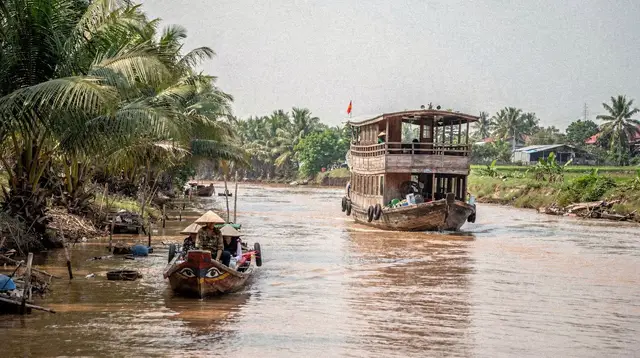
Most stops in the Mekong Delta sit deep inside Vietnam, hours from any frontier. Chau Doc is different. The town spreads along the Bassac River, one of the two main branches the Mekong splits into before reaching the sea, and the Cambodian border lies close enough that it shapes almost everything about the place — its markets, its mix of Vietnamese, Khmer and Cham communities, and the boats that leave for Phnom Penh.
Travelers who have already visited My Tho, Ben Tre or Vinh Long sometimes assume Chau Doc is more of the same delta scenery further along. It isn’t. Those towns are inland river ports with no direct route out of the country. Chau Doc is the delta’s edge, and it is usually visited precisely because of what lies beyond it.
This page assumes some familiarity with the delta already covered on the Mekong Delta hub page — its orchards, its floating markets, its network of canals — and focuses instead on what sets Chau Doc apart from every other town in that region.
The border, and why it matters here specifically
Chau Doc’s position on the Bassac River puts it a short ride from the Vinh Xuong or Tinh Bien border crossings into Cambodia, and river routes from town connect onward toward Phnom Penh. This single fact reorganizes how people plan around Chau Doc compared with the rest of the delta. A trip built around Can Tho or Sa Dec is a there-and-back journey from Ho Chi Minh City. A trip built around Chau Doc can be one-way, continuing into Cambodia rather than looping back.
That difference is worth being explicit about, because the confusion runs the other way too: some travelers assume any delta town might offer a Cambodia connection, or that Chau Doc’s border access extends to nearby towns like Chau Doc’s neighbors along the Bassac. It doesn’t. The direct crossing is specific to Chau Doc’s location on the river, not a general feature of the delta. If a Cambodia leg is part of the plan, Chau Doc is the town to build it around, and the multi-day Mekong cruise combining Chau Doc and Cambodia is the standard way this is packaged for travelers heading onward by boat.
For those staying within Vietnam, an overnight route through Can Tho before continuing on to Chau Doc covers the delta’s two most distinct river towns without requiring a border crossing at all.
Sam Mountain and the town’s pilgrimage side
A short distance from central Chau Doc rises Sam Mountain, a solitary outcrop that breaks up the flat delta landscape and has drawn pilgrims for generations. Its slopes and summit are dotted with temples and shrines, the best known dedicated to the Lady of the Realm, and the mountain functions as a genuine local pilgrimage site rather than a staged attraction — worshippers arrive with offerings, and the temple complex is as much about ongoing religious practice as it is about the view over the surrounding rice fields and the border beyond.
This pilgrimage layer gives Chau Doc a different texture from the orchard-and-market rhythm of Cai Be or Vinh Long. Travelers drawn to Vietnam’s religious and folk-belief traditions, rather than purely to river life, tend to find Sam Mountain the more memorable stop, and it pairs naturally with the town’s Cham and Khmer heritage described below.
Tra Su and the cajuput forest
North-west of town, the Tra Su cajuput forest offers a very different landscape from the open river channels most delta itineraries revolve around — a flooded forest of cajuput trees, reached by small boat, with birdlife concentrated in its canopy and waterways. It is one of the delta’s better spots for bird watching and gives Chau Doc a nature-focused excursion that towns like Rach Gia or Soc Trang don’t offer in quite the same concentrated form. The forest is covered in more depth on its own Tra Su cajuput forest guide.
A private itinerary such as the heritage and nature tour through An Giang province covering Chau Doc typically works Tra Su into the same day as Sam Mountain and the town’s floating villages, which suits travelers who want the natural and cultural sides of Chau Doc without splitting them across separate outings.
Floating villages and a mixed river community
Chau Doc’s stretch of the Bassac River is known for its floating houses and fish farms, where families live directly on the water and raise fish in submerged cages beneath their homes. This floating community sits alongside distinct Cham and Khmer neighborhoods on the outskirts of town — a reminder that the delta’s population, especially this close to the Cambodian border, is not ethnically or religiously uniform. Cham communities here maintain their own mosques and weaving traditions, visible from the river in a way that few other delta towns display so openly.
This mix is part of what separates the Mekong Delta’s ethnic communities as a broader theme from the more homogenous river-and-orchard image some travelers bring with them. A slow boat past the floating houses, arranged as part of a wider itinerary or through a kayaking and cycling route through the delta’s waterways, is usually the best way to see this side of Chau Doc without disturbing residents going about daily life.
Chau Doc’s market, mam and everyday food
Central Chau Doc has its own market, smaller and less photographed than Cai Rang but worth a slow walk in its own right. Stalls sell dried fish, rice-paper, palm sugar and above all mam — the fermented fish paste the town is known for across southern Vietnam.
Chau Doc’s Cham and Khmer neighborhoods and its Cambodian trade links have shaped the local kitchen in ways that set it apart from the coconut-and-orchard food culture of Ben Tre or Cai Be: expect Khmer-influenced sour soups, freshwater fish raised in the river cages seen from the water, and Cambodian ingredients that rarely appear on menus further downstream. Travelers curious about how the delta’s kitchens differ by region can read more on the Mekong Delta’s ethnic communities and on southern Vietnamese cuisine more broadly.
None of this requires a special detour — the market sits within walking distance of most guesthouses in town, and it is the easiest way to see Chau Doc’s layered identity (Vietnamese, Cham and Khmer, with a visible Cambodian influence) without booking any excursion at all.
Where to stay and how long to spend
Chau Doc’s own hotels and guesthouses are simple compared with what is available in Can Tho or Ho Chi Minh City, and most travelers treat the town as a one- or two-night stop rather than a base for a longer stay. One night is enough to cover Sam Mountain and a boat past the floating villages; two nights allow time to add Tra Su without rushing, or to rest before an early departure toward the Cambodian border. Travelers unsure whether to build their whole delta trip around Chau Doc or around Can Tho instead can weigh the two using the My Tho versus Can Tho for the Mekong Delta comparison and the broader choosing a Mekong Delta departure point guide, both of which apply the same logic to Chau Doc’s position at the delta’s edge.
For travelers building a longer loop through the deep delta rather than stopping at Chau Doc alone, a four-day route from Ho Chi Minh City through Chau Doc, Can Tho and on to Ca Mau or a four-day, three-night itinerary linking Chau Doc, Can Tho, Ca Mau and Bac Lieu both use Chau Doc as an early stop rather than an endpoint, continuing on toward Ca Mau at the southern tip of the country.
Travelers who prefer to keep the itinerary closer to Ho Chi Minh City, without pushing on toward Ca Mau, can instead look at a three-day route through My Tho, Ben Tre, Chau Doc and Can Tho, which covers Chau Doc alongside the delta’s closer towns rather than its farthest ones.
How Chau Doc compares with the rest of the delta
| Town | Defining feature | Cambodia access |
|---|---|---|
| Chau Doc | Border town, Sam Mountain, floating villages, Cham and Khmer communities | Direct river and road crossings |
| --- | --- | --- |
| Can Tho | Delta’s main city, Cai Rang floating market | None direct; onward travel via Chau Doc |
| --- | --- | --- |
| My Tho / Ben Tre | Closest delta towns to Ho Chi Minh City, coconut country | None |
| --- | --- | --- |
| Vinh Long / Cai Be | Orchards, brick kilns, homestays | None |
| --- | --- | --- |
| Sa Dec | Flower village | None |
The table underlines the point worth repeating: Chau Doc’s border access is not shared by its neighbors. Anyone planning to reach Cambodia by land or river from the Vietnamese delta should route through Chau Doc specifically, not assume any nearby town will serve the same purpose.
Getting to Chau Doc and moving on
Chau Doc is reached by road from Ho Chi Minh City, generally as part of a multi-day route through the delta rather than a standalone day trip, given the distance involved. Many travelers combine the approach with a stop in Can Tho, breaking the journey and taking in the Cai Rang floating market en route, an approach covered in the choosing a Mekong Delta departure point guide. Others arrive by river, having started their delta trip further downstream.
From Chau Doc, options split three ways: return to Ho Chi Minh City by road, continue by boat into Cambodia toward Phnom Penh, or extend the trip deeper into the delta toward Ca Mau and the far south. Which of these makes sense depends entirely on whether Cambodia is part of the itinerary — a question worth settling before booking transport, since the routes diverge sharply from Chau Doc onward. The Ho Chi Minh City, Cu Chi and Mekong Delta multi-day tour and dedicated three-day Mekong Delta route with meals included both use Chau Doc as a natural endpoint for the Vietnam portion of a longer journey.
Chau Doc, Chau Doc: an easy border town — frequently asked questions
Is Chau Doc the only place to cross into Cambodia from the Mekong Delta?
Chau Doc is the delta’s main and most commonly used crossing point, thanks to its position on the Bassac River close to the border. Other delta towns covered on this site, including Can Tho, My Tho, Ben Tre, Cai Be, Vinh Long and Sa Dec, do not have a direct crossing and are not set up as departure points for Cambodia.
Do I need a separate visa to continue from Chau Doc into Cambodia?
Cambodia requires its own visa or visa exemption, entirely separate from Vietnam’s entry requirements. Rules change and vary by nationality, so check Cambodia’s official immigration guidance or your government’s travel advisory before planning a border crossing at Chau Doc.
Can I visit Chau Doc as a day trip from Ho Chi Minh City?
Chau Doc is considerably further from Ho Chi Minh City than delta towns like My Tho or Ben Tre, and it’s normally visited as part of a multi-day delta itinerary rather than a single-day round trip. Combining it with Can Tho along the way is the usual approach.
What is Sam Mountain and is it worth visiting?
Sam Mountain is a solitary hill near Chau Doc covered in temples and shrines, most notably one dedicated to the Lady of the Realm, and remains an active pilgrimage site for Vietnamese visitors. It’s a strong choice for travelers interested in religious and folk traditions rather than purely river scenery.
What is Tra Su and how does it differ from the rest of the delta?
Tra Su is a flooded cajuput forest north-west of Chau Doc, explored by small boat and known for concentrated birdlife within its flooded canopy. It offers a nature-focused experience distinct from the open-river and market scenery found elsewhere in the delta.
Are the floating villages near Chau Doc similar to floating markets elsewhere in the delta?
No — the floating houses and fish farms near Chau Doc are residential communities where families live on the water, not trading markets like Cai Rang near Can Tho. They reflect the everyday life of the river rather than commerce.
Does Chau Doc have Cham and Khmer communities, and can they be visited respectfully?
Yes, Chau Doc has notable Cham and Khmer communities on its outskirts, including Cham mosques and weaving traditions visible along the river. Visiting respectfully as part of a guided river excursion, rather than wandering independently into residential areas, is the better approach.