How the water trade at Cai Rang actually works
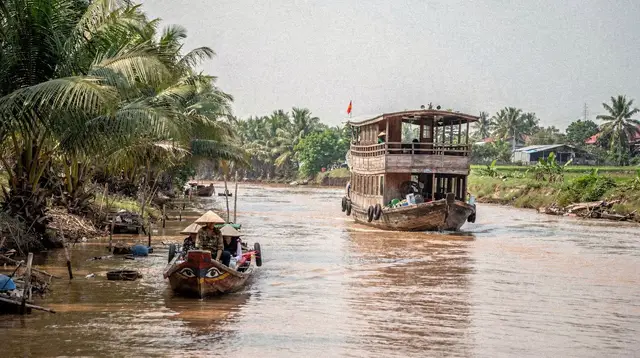
Cai Rang is not a market you walk into. It exists entirely on a wide stretch of river, where wholesale boats loaded with produce anchor in loose clusters and smaller craft weave between them to buy, sell and simply pass through. There is no single moment when it “opens” — the boats that trade here live on and near the water, and the density of activity builds and fades gradually rather than switching on and off.
What a visitor sees is a working commodity market, not a display arranged for tourists: growers and wholesalers from across the Mekong Delta bring produce here because Cai Rang is where the volume is, and the boats that call here are doing real business with each other long before any tour boat arrives.
The single detail that identifies each cargo boat is the bung beo — a tall pole lashed upright near the bow, hung with a sample of whatever that boat is selling. A few pineapples on the pole means pineapples in the hold; a bundle of green squash or a cluster of watermelons signals the same. Buyers scanning the river from a distance read these poles the way a shopper might read shelf signage, and it is this system, more than anything else, that gives Cai Rang its particular visual rhythm: a river dotted with vertical markers rising above low wooden hulls, each one advertising a single crop.
Around the wholesale boats, smaller craft do a different kind of business. Some are floating cafés and noodle stalls, serving strong coffee and simple bowls to boat crews and to each other, boat pulling alongside boat rather than stall next to stall. Others are the small vendor boats — often paddled or poled by a single person — that sell fruit, drinks or snacks directly to visitors’ boats as they pass. This layered structure, wholesale trade on the outside and smaller, more personal transactions moving through the middle of it, is what gives Cai Rang its texture: it is loud with engines and quiet with the slap of water at the same time, commercial and domestic in the same frame.
Reading the scene from a tour boat
Most visitors experience Cai Rang from a hired boat that moves slowly through the anchored trading vessels rather than mooring at any single point. The best vantage is usually from slightly outside the densest cluster, where the pattern of hulls, poles and reflected colour reads clearly, before moving in closer to see individual transactions — a sack of produce swung from one boat to another, a coffee vendor passing out plastic cups, a family boat with laundry drying on a line strung between the wheelhouse and the cargo. Because everything here happens on moving water, the light changes constantly, and the atmosphere shifts with it: flat and pale on an overcast morning, sharp-edged and reflective when the sun breaks through.
It is worth watching the boats themselves as much as the trade. Many are family homes as well as workplaces, with a small altar near the bow, potted plants on the roof, and a dog or a child visible somewhere on deck. The floating market is not a set piece built for visitors; it is a slice of how a significant part of the Mekong Delta’s produce economy still moves, and the households living aboard these boats are the market’s real subject.
Timing a visit for the best light and least crowding
Cai Rang is at its busiest and most photogenic early in the morning, before the trading boats that make up the wholesale market begin to disperse. This is when the greatest number of cargo boats are still anchored together, when the bung beo poles are at their most legible against the water, and when the light is softest for photography. Arrive later in the morning and the same stretch of river can feel noticeably thinner, with many of the wholesale boats already having sold their loads and moved on.
The dry season adds a second, separate advantage: calmer water and clearer skies make for easier photography and a steadier boat ride, though it is worth being clear that Cai Rang itself is not seasonal in the way a festival or a harvest is — the wholesale trade continues year-round, and a visit in the wetter months still shows the market working as it always does, just under greyer light and with a higher chance of a shower passing through. Travellers planning a trip around weather more broadly can cross-check the timing against this site’s guides to visiting southern Vietnam in the dry season and visiting southern Vietnam in the rainy season.
Because the market itself has no opening or closing time in the way a museum does, the practical scheduling question is really about the boat, not the market: departing early enough from a Can Tho dock to reach Cai Rang while the water is still crowded is what separates a memorable visit from a thin one, and this is the single biggest variable a visitor controls.
Not Cai Be, and not Phong Dien
Cai Rang is frequently confused with two other floating markets in the delta, and the confusion causes real disappointment when travellers arrive expecting one and find the other.
Cai Be, further up the Mekong near Vinh Long, is a smaller, calmer market with a more retail character — individual boats selling directly to individual buyers, in a setting that feels domestic rather than industrial. It sits within easier reach of My Tho and Vinh Long, and many shorter Mekong itineraries stop there instead of at Cai Rang simply because of where they are already travelling.
Phong Dien, closer to Can Tho itself, is smaller again and trades on a more local, neighbourhood scale. It draws far fewer visitor boats, and travellers who go looking for the scale and bustle described in most Cai Rang write-ups will not find it there.
Neither Cai Be nor Phong Dien has the density of wholesale trading boats, the bung beo signage system in full effect, or the sheer breadth of the river given over to commerce that defines Cai Rang. They are worthwhile destinations in their own right, quieter and in some ways more intimate, but they are not substitutes for Cai Rang, and a booking for one should never be assumed to deliver the other. Anyone choosing between delta departure points and market stops benefits from working through the differences before committing to an itinerary — a comparison covered in this guide to choosing a Mekong Delta departure point.
Getting onto the water
Access to Cai Rang is entirely by boat, and the practical side of arranging that boat — where it departs from, what kind of vessel is used, and how it fits into a wider Can Tho or Mekong Delta stay — is covered in this site’s river cruises coverage rather than here. In short, most visitors join a boat from a dock in or near Can Tho, since the city functions as the practical base for reaching the market; travellers weighing up Can Tho against other delta bases can compare the two in My Tho versus Can Tho for the Mekong Delta.
a half-day boat outing focused specifically on Cai Rang is the most direct way to see the market without folding it into a longer itinerary. Travellers who want the market as one stop within a fuller day on the water often prefer a full-day Mekong Delta boat trip that also takes in Cai Be and Vinh Long, which usefully illustrates the contrast between Cai Rang’s scale and the calmer character of the smaller markets described above.
Choosing between the different Cai Rang boat trips
Because so many operators run boats out to Cai Rang, the practical choice for most travellers is less about whether to go and more about which style of trip fits the rest of a Can Tho stay. For a straightforward early start focused purely on the market, a Can Tho boat tour to Cai Rang that includes breakfast on the water keeps the morning simple: out to the market while the trading boats are still dense, breakfast taken on the boat itself, and back before the heat of the day sets in.
Travellers who want a guide to explain the bung beo system, the produce being traded and the layout of the river as they go, rather than working it out from a boat brochure, are usually better served by a guided Cai Rang floating market tour from Can Tho. And for those who want to extend the morning past the market itself and see how the same produce moves on land, a Cai Rang floating market and Tan Phong Island cycling trip pairs the boat with a slower ride through orchards on one of the delta’s river islands, echoing the land-based options mentioned above without duplicating them.
None of these substitutes for the others — a breakfast boat trip, a guided cultural tour and a cycling extension answer different questions about how a morning should be spent — but any one of them delivers the market at the time of day when it is worth seeing.
Beyond the market itself
Cai Rang rarely stands alone on an itinerary. Because it depends on a boat and a base near Can Tho, most visitors combine it with time on the Saigon River canals, a stop in Chau Doc further along the delta, or a slower loop through Sa Dec and its flower village. Those who want to stay on the water longer rather than treating the market as a single stop should look at sampan canal excursions in the Mekong Delta, which move through narrower channels away from the main river trade.
Travellers building a longer delta stay sometimes pair the market with an overnight stay in a family home, which is covered separately in this site’s guide to Mekong Delta homestays, or extend the trip toward the Cambodian border on a multi-day Mekong cruise to Chau Doc.
For a broader look at whether a delta detour is worth the effort at all, this site’s is a Mekong Delta day trip worth it guide weighs the market against other delta highlights, and the dedicated Can Tho and Cai Rang sunrise guide goes deeper into planning a visit around the market specifically.
Cyclists and slower travellers sometimes combine the market with time on land. a two-day Can Tho cycling and cooking trip that includes the delta’s back roads gives a useful counterpoint to a morning spent entirely on water, and travellers interested in a more active, hands-on delta experience can look at a kayak, bike and cooking day in the Mekong Delta as an alternative way to spend the rest of the day once the market has quietened.
Those planning a two-day loop rather than a single excursion can structure the whole trip around this two-day Mekong Delta itinerary covering Can Tho and Cai Rang, which sequences the market alongside other delta stops without doubling back.
What Cai Rang is not
It is worth being explicit about what the market does not offer, since expectations shaped by photographs alone can mislead. It is not a fixed structure that can be visited on foot, has no ticketed entrance, and is not a place where a visitor “arrives” in the way one arrives at a temple or a museum — the experience is entirely defined by moving through it on a boat. It is not a craft market or a souvenir bazaar; what changes hands here is mostly fresh produce, in quantities aimed at other traders rather than at individual buyers. And it should not be confused with the calmer, smaller-scale markets at Cai Be or Phong Dien, which offer a gentler, more accessible introduction to delta river life but a fundamentally different scene.
Cai Rang Floating Market: frequently asked questions
Is Cai Rang the biggest floating market in the Mekong Delta?
Yes. Among the delta’s floating markets, Cai Rang stands out for the volume and density of wholesale trading boats gathered on the river, well beyond the scale of smaller markets such as Cai Be or Phong Dien.
Can I walk around Cai Rang market?
No. Cai Rang exists entirely on the water, with boats anchored and moving across a stretch of river. The only way to see it is from a boat, moving among the anchored vessels.
What is the pole sticking up from each boat for?
That pole is called a bung beo, and it displays a sample of whatever the boat is selling — a pineapple, a squash, a bunch of bananas — so buyers scanning the river can identify each boat’s cargo without pulling alongside it.
Is Cai Rang the same as the floating market near Cai Be?
No, and this is a common mix-up. Cai Be, near Vinh Long, is a smaller, quieter, more retail-oriented market further up the Mekong. Cai Rang, near Can Tho, is larger, busier and organised around wholesale trade between boats.
Do I need to arrange transport to Cai Rang separately from Can Tho?
Access is by boat, typically from a dock in or near Can Tho, and the details of arranging that boat are covered in this site’s river cruises section rather than on this page, since Can Tho functions as the practical base for reaching the market.
Is Phong Dien worth visiting instead of Cai Rang?
Phong Dien is a smaller, more local market that some travellers prefer for its quieter, less touristed atmosphere, but it does not replicate Cai Rang’s scale or the density of wholesale trading boats. The two are complementary rather than interchangeable.
Can Cai Rang be combined with other Mekong Delta stops in one trip?
Yes. It is commonly combined with canal excursions, a stop in Sa Dec or Chau Doc, or a longer stay built around Can Tho, and several of this site’s itineraries and guides sequence the market alongside these other delta destinations.