Cai Rang Floating Market: Sunrise on the Water Near Can Tho
What is the Cai Rang floating market and where is it?
Cai Rang is a wholesale floating market on the water near Can Tho, in the heart of the Mekong Delta, where farmers and traders sell fruit and vegetables from sampans in the early morning. It is not at My Tho or Cai Be, which have their own smaller markets, and it is visited by small boat rather than on foot.
Why Cai Rang Is the Delta’s Best-Known Market
Every guide to the Mekong Delta mentions a floating market sooner or later, but only one market gets the full treatment here: Cai Rang, on the water near Can Tho, the delta’s main city. If another page on this site talks about a floating market in passing, in My Tho or Cai Be, it is pointing back to this page rather than describing its own — those towns have their own, smaller markets, and Cai Rang is the one nearly everyone means when they picture boats stacked with fruit at sunrise.
The confusion is common enough to be worth stating plainly: Cai Rang is at Can Tho, not at My Tho and not at Cai Be. Travelers who read about a floating market on a My Tho day trip and then arrive expecting the scale of Cai Rang are usually disappointed, because the two are different markets, different towns, and different boat rides. If a floating market is the one thing you want to see in the delta, the route runs through Can Tho.
What the Market Actually Looks Like
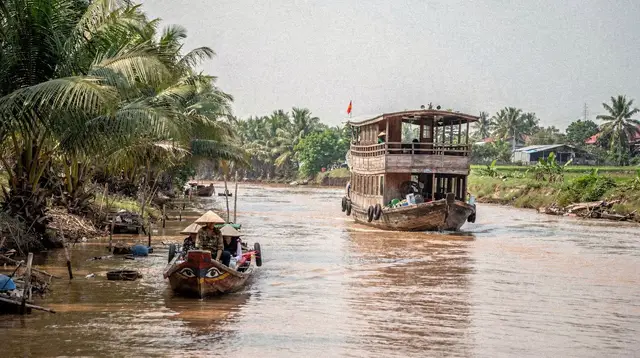
Cai Rang is a wholesale market first, a photogenic spectacle second. Farmers and traders bring produce down from orchards and fields across the delta and sell it, boat to boat, on a stretch of water rather than from stalls on land. Pineapples, watermelons, dragon fruit, cabbages, pumpkins and sacks of rice are piled onto sampans, and each seller ties a sample of the goods to a tall bamboo pole — a rough green pineapple lashed at the top of a pole tells buyers what is on board long before the boat is close enough to see the deck.
Between the larger trading boats, smaller craft move through selling directly to other boats and to visitors: coffee brewed on a portable stove, bowls of noodle soup passed hand to hand, fresh fruit cut on the spot. The result is a floating economy in motion rather than a static display, which is why a boat among the sampans gives a completely different experience from a photo taken from the bank.
Why Sunrise, and Why by Boat
Cai Rang trades early. The boats that supply the market and the boats that buy from it are working to a rhythm set by the produce and by the rest of the delta’s supply chain, not by tourist schedules, so the market is busiest and most visually dense in the early morning. This page does not pin a departure time or a duration on the outing, because operators vary and the details are covered where a specific tour is booked — but the working principle everywhere is the same: get out onto the water while it is still cool and the trading is in full swing.
There is no way to see Cai Rang properly from land. It sits on open water, and the whole point is being close enough to the sampans to see what each one is carrying, hear the outboard motors and exchange a wave with a trader. Visits leave from a jetty in or around Can Tho on a small wooden boat, sometimes a larger shared passenger boat, and thread a path between the working vessels rather than mooring at a fixed dock.
Getting There From Can Tho and Beyond
Can Tho itself is the delta’s largest city, reached from Ho Chi Minh City on the expressway; details on the road journey, including how it compares with a stop in My Tho or Vinh Long on the way, are covered on the Can Tho destination page and on the page comparing My Tho and Can Tho as delta departure points. Cai Rang itself is only a short hop by boat from central Can Tho, which is what makes a sunrise visit and a return to the city for breakfast an easy morning rather than a full expedition.
Several ways to structure the outing exist. A dedicated sunrise run out to the market and back is the simplest option, and it is joined on the water by boats that continue past Cai Rang into the quieter canals beyond — past orchards, a rice-paper or rice-noodle workshop, and sometimes a rural bridge market — before looping back into Can Tho. Cyclists sometimes pair an early boat to the market with a bicycle ride through the orchards and villages on the riverbanks once back on land, and food-minded visitors combine the same morning with a cooking class built around what is bought straight off the boats.
| Way to see Cai Rang | What it adds |
|---|---|
| Sunrise market boat, out and back | The market itself, nothing else |
| --- | --- |
| Market plus canal loop | Orchards, workshops, quieter waterways after the market |
| --- | --- |
| Market plus bicycle ride | A land-based follow-up through delta villages |
| --- | --- |
| Market plus cooking class | Produce bought at the market cooked the same morning |
Whichever version is booked, the market itself is the anchor, and the add-ons happen after it rather than before — the boats are already on the water and trading hardest in the first hour or two of daylight, so nothing productive is gained by delaying the start.
Other Ways Onto the Water
Beyond the standard sunrise run, a handful of variations on the same stretch of water suit different pockets and paces. Travelers who want the market with breakfast built into the trip, eaten on the boat while the trading is still busy, can look at a Cai Rang floating market boat tour with breakfast. Smaller groups or anyone who prefers a private schedule rather than a fixed group departure can look at a small-boat trip from Can Tho out to the floating market, which keeps the boat and the pace to a smaller party.
A few operators also frame the same outing as a day trip from Ho Chi Minh City itself rather than from a Can Tho base, folding the road transfer, the boat and a stop at an old house or garden into one long day: an authentic boat trip to Cai Rang floating market from Ho Chi Minh City and a private one-day Cai Rang floating market and My Tho boat tour both work this way, useful for travelers based in the city without a separate overnight in Can Tho. A similar full-day format built around an old house stop on a nearby island is available as a one-day Mekong tour combining Cai Rang floating market with an ancient house.
Cai Rang is not the delta’s only working market on the water. A smaller, more rural market at Phong Dien, further from Can Tho along the canals, trades later in the morning than Cai Rang and draws far fewer visitors; routes that link the two make for a longer look at how the wholesale trade moves once the big boats at Cai Rang have thinned out, available as a Cai Rang and Phong Dien floating market exploration of the Mekong Delta. This page still treats Cai Rang as the main event; Phong Dien is worth knowing about mainly as an add-on for travelers who have already seen Cai Rang once and want a quieter second look at the same kind of trade.
What to Bring and What to Expect on the Boat
Because the whole outing happens before and around sunrise, a light layer for the early cool of the morning is worth having even in a hot climate, along with a hat and sun protection for once the sun clears the horizon and the light on the water turns harsh. Sampans and passenger boats sit low and can rock in the wake of larger trading vessels, so anything that should stay dry — a phone, a camera — is best kept in a bag rather than loose on a lap. Life jackets are standard on tourist boats; wearing one is not optional even for a short crossing.
The pace on the water is unhurried rather than rushed: boats drift close enough to the sampans for a good look and a photograph, sometimes close enough to buy fruit directly off a trading boat, then move on to the next cluster. There is no walking involved once the boat leaves the dock, which makes the outing accessible to travelers who would struggle with an uneven market on land, though getting into and out of a small boat at the jetty still takes a steady step. Coffee and simple snacks bought straight from the smaller vendor boats are part of the experience rather than a detour from it, and cash in small denominations makes those on-water purchases easier than trying to pay for a single coffee with a large note.
Booking a Boat to Cai Rang
Several operators run the same stretch of water with different boats, group sizes and add-ons. A straightforward morning on the water covering the market and the nearby canals is available as a Cai Rang floating market and canals boat trip, and travelers who prefer a guide narrating what each sampan is selling can look at a guided sunrise outing to the floating market.
For a more active version of the same morning, a floating market visit combined with a bicycle ride through the surrounding orchards pairs the boat with time on land once the market has been seen. Cooks and food-curious travelers can instead look at a floating market and canals outing built around a cooking session, which uses produce bought straight from the market boats.
This page deliberately stops at the single sunrise outing. Travelers planning to continue from the delta on a longer river journey toward the Cambodian border should look at the pages covering multi-day Mekong cruises to Chau Doc and Cambodia rather than expecting that itinerary here — Cai Rang is a morning, not a multi-day trip.
Fitting Cai Rang Into a Wider Delta Visit
Cai Rang is usually one stop within a longer look at the delta rather than a destination on its own. Travelers deciding how much of the Mekong Delta to see, and from where, can start with the comparison of My Tho versus Can Tho as a departure point, which sets out why Can Tho — and by extension Cai Rang — sits further from Ho Chi Minh City but delivers a larger, more working market than the closer towns.
Those weighing whether the whole delta detour is worth the time from the city can read whether a Mekong Delta day trip is worth it, and travelers still choosing where to start their delta morning from can compare options on the page about choosing a Mekong Delta departure point. A broader, slower look at the region, including towns further from Can Tho, sits on the Mekong Delta day trip from Saigon guide and the Mekong Delta two-day tour page for those with more time.
Travelers building a full southern Vietnam itinerary around a Cai Rang morning can also look at the itineraries covering multiple days through the delta, and destination pages for Vinh Long, Sa Dec and Chau Doc for what else the delta offers beyond Can Tho and its market. The Cai Rang floating market destination page gathers the practical basics on the market itself in one place, alongside the Can Tho page for the city it launches from.
Anyone comparing a two-day version of the delta against a single sunrise outing can read the two-day Mekong Delta tour guide, which covers overnight options that let a Cai Rang sunrise sit alongside Chau Doc, Sa Dec or the Cambodian border rather than a single morning back to Ho Chi Minh City.
Frequently Asked Questions About Cai Rang Floating Market
Is Cai Rang the same as the floating market at My Tho or Cai Be?
No. Cai Rang is its own market, on a stretch of water near Can Tho, and it is the largest and busiest of the delta’s floating markets. My Tho and Cai Be have their own, smaller markets, and pages about those towns describe their own version rather than this one.
What will I actually see on the water?
Sampans loaded with pineapples, watermelons, dragon fruit, cabbages and other produce, each boat hanging a sample of what it sells from a tall bamboo pole so buyers can spot it from a distance. Smaller boats weave between the traders selling coffee, noodle soup and snacks directly to visitors and to other boat crews.
Do I need to get up early?
Yes. Cai Rang is a trading market first and a sightseeing stop second, so the boats are on the water and doing business early in the morning, well before the heat of the day builds. Most visits start from a jetty in or near Can Tho while it is still cool.
How do I get out onto the market?
By small boat from a dock in Can Tho, usually a wooden sampan or a slightly larger passenger boat, threading between the trading vessels rather than mooring at a fixed pier. This is a water-borne market, so there is no way to see it properly on foot.
Can I combine Cai Rang with other stops in the delta?
Yes, many boat routes continue past Cai Rang into the surrounding canals, past orchards, rice-noodle workshops or a rural bridge market, before returning to Can Tho. It is also commonly paired with other Can Tho sights on the same morning.
Is this the place for a multi-day boat trip toward Chau Doc?
No. Cai Rang is a single sunrise outing near Can Tho, not a multi-day river cruise. Longer boat journeys that continue from the delta toward Chau Doc and the Cambodian border are a different kind of trip, covered on their own pages.
Does the market trade all day?
Trading is concentrated in the early hours and thins out as the morning goes on, which is why boats head out at sunrise rather than later. Exact hours and how quickly the market empties out vary, so this page does not pin down a fixed schedule.
Is Cai Rang crowded with tourists?
Tourist boats share the water with working trading vessels, and the balance between the two has shifted over the years as some wholesale trade has moved onto the roads. It remains the best-known and most visited floating market in the Mekong Delta.
Mekong Delta Cruises and Floating Markets
Verified deep-linked GetYourGuide tours. Book through these links and we earn a small commission at no cost to you.
GetYourGuide does not provide a product photo for this activity — the image shows the meeting point, photographed by us.