A river town of villas, not a market town
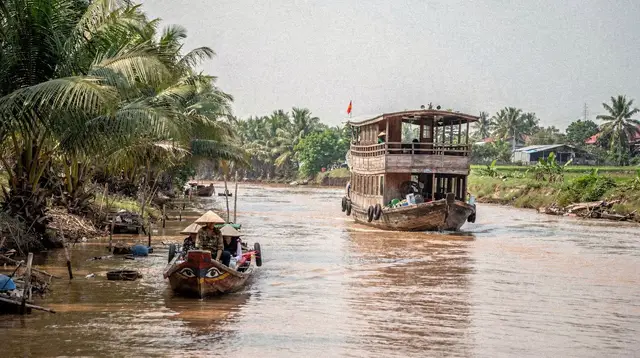
Most first-time visitors arrive in the Mekong Delta expecting a floating market and a boat ride, and plenty of towns along the river deliver exactly that. Sa Dec is a different kind of stop. It sits on a tributary of the Mekong in what was, until the 2025 provincial merger, its own province, and its identity was built by generations of river merchants rather than by market traders.
Walk its old quarter and the pattern becomes obvious: tile-roofed shophouses along the water, a scattering of grand family villas set back behind iron gates, and, spreading out from the edge of town, kilometre after kilometre of flower beds. Sa Dec is worth visiting for its architecture and its gardens, on their own terms, and it does not need a floating market to justify the stop.
The town’s merchant houses date mostly from the early twentieth century, when Sa Dec was a trading post of real consequence on the river network that fed goods toward what is now Ho Chi Minh City. Chinese, Vietnamese and French influences sit stacked on top of each other in the same building line: carved wooden screens, tiled courtyards, French shutters, ancestor altars. The best-known of these houses opens to visitors and is worth the short detour on foot from the riverfront; it is not staged for tour groups the way some delta stops are, and it repays unhurried attention rather than a quick photo stop.
Just as important, and easy to overlook if a visit is planned around the villas alone, is the flower-growing land on the town’s edges. Sa Dec is one of the delta’s principal centres for ornamental flowers and bonsai, and growers here supply markets across the south, not just the local town. Walking or cycling out along the canals between plots of marigolds, chrysanthemums, roses and miniature trees gives a completely different texture from the villa quarter: open sky, working greenhouses, and a rhythm of rural labour rather than heritage tourism.
A short guided outing built around exactly this pairing — a day trip that runs from Ho Chi Minh City to the flower village and on to the Cai Be area — is a practical way to see both sides of Sa Dec in one stop; the itinerary is covered by the Sa Dec flower village and Xeo Quyt forest day trip.
Sa Dec is not Vinh Long, and the two towns feel nothing alike
The single most common mix-up in this stretch of the delta is treating Sa Dec and Vinh Long as interchangeable, or worse, as two names for the same stop. They are neighbouring towns on the same general river system, and itineraries sometimes lump them together in a single sentence, but they are not the same kind of place and they do not offer the same day.
Vinh Long is the more urban, more commercially active of the two: a working delta city with a busier waterfront, more boat traffic, and easier access to island orchard tours and homestays that put visitors directly on the water. It functions as a transit and activity hub for the central delta, in the way that My Tho does further upriver and Can Tho does further south. Sa Dec, by contrast, is residential and horticultural rather than commercial. There is no equivalent to Vinh Long’s island-hopping boat circuit here; the pace is set by walking or cycling between a heritage house and a flower plot, not by a boat schedule.
The practical consequence is that these two towns answer different questions. A traveller who wants boats, orchard tastings and an island homestay experience should look toward Vinh Long or the wider stretch of river around it. A traveller who wants architecture, gardens and a slower, more contemplative half-day should choose Sa Dec. Combining both in a single multi-day route through this part of the delta is entirely workable, but they should be planned as two distinct stops with two distinct purposes, not as a single destination under two names.
For a wider comparison of delta departure points and what each one is actually good for, see the guide to choosing a Mekong Delta departure point and the dedicated comparison of My Tho versus Can Tho for the Mekong Delta, both of which set out the same kind of distinction that applies here.
Where Sa Dec sits in a wider delta route
Sa Dec is rarely, if ever, a stand-alone destination on an itinerary out of Ho Chi Minh City. It works best as one stop within a broader loop through the delta, most naturally alongside Cai Be and its orchard country, or as an extension of a route that also touches Vinh Long. Because the town itself asks for only a few hours — enough time for the old quarter, one or two villa visits, and a walk or cycle through the flower plots — it pairs naturally with a fuller day built around a neighbouring stop rather than carrying a whole day on its own.
Travellers assembling a longer route through the delta, whether that means a farmstay extension, a cycling day, or a broader loop that eventually reaches Chau Doc near the Cambodian border, will find Sa Dec fits as a quieter interlude between busier hubs.
A multi-day option built specifically around Sa Dec and the surrounding Dong Thap countryside, including farmstay time, is covered by the Dong Thap and Sa Dec three-day tour with farmstay and nature time, which gives the flower village and the villa quarter more room to breathe than a single afternoon allows. Anyone still weighing up how much of the delta to see in one push versus splitting it over several days should read the general comparison of a Mekong Delta day trip versus a two-day tour before committing to a route.
The flower village, the gardens, and what to actually do there
The flower-growing area on Sa Dec’s outskirts is not a single formal attraction with a gate and a ticket booth; it is a working landscape of family plots, nurseries and canals that visitors move through on foot, by bicycle, or occasionally by small boat where the canals allow it. The appeal is cumulative rather than built around one headline sight: rows of potted chrysanthemums and marigolds staged for sale, bonsai specimens trained over years, greenhouses of orchids, and the everyday business of loading flowers onto boats and trucks bound for markets elsewhere in the south.
Because this is agricultural land and not a park, the experience rewards a guide who knows which growers welcome visitors and which paths connect the plots without doubling back on a main road. It also sits close to other agricultural activity worth folding into the same outing, including the cacao plantations that have developed in the wider Dong Thap countryside; a focused visit to one of these, with a tasting included, is covered by the Alluvia cacao farm tour and tasting.
For travellers who want the flower village combined with cycling and a hands-on cooking stop elsewhere in the delta rather than as an isolated visit, the broader Mekong Delta kayak, bike and cooking experience is built around exactly that kind of mixed, active day.
For the fuller range of craft, farming and hands-on activities available across this part of the delta — cacao, coconut candy, rice-paper making, and similar small-scale production that visitors can watch or take part in — the craft workshops category page brings those options together in one place rather than repeating them stop by stop here. Sa Dec’s flower plots sit alongside that broader set of experiences rather than apart from it.
Getting a feel for the town itself
Beyond the flower village, Sa Dec’s own streets are worth unhurried time. The old quarter along the riverfront keeps a compressed, layered version of the delta’s trading history: shophouses with living quarters above and storefronts below, a market building with the settled, permanent feel of a town that has been trading in the same spot for a very long time, and the villa that draws the most attention from visitors, set inside a walled garden a short walk from the water. None of this is arranged for a tour-group pace; it holds up to slow walking and to sitting for a while at a riverside café watching the boat traffic go by.
This kind of neighbourhood-level, walkable exploration is the same approach that works well across many of the delta’s smaller towns, and readers planning a similar slow visit elsewhere in the region — in Cai Be, in Vinh Long, or further along the river — will find the same logic applies: pick one town, walk it properly, and resist the urge to stack too many stops into a single day.
The neighbourhoods category page collects this kind of walkable, area-by-area detail for towns across the site, and the Mekong Delta activities hub does the same for the region as a whole, including the broader set of things to do around Cai Be that pairs so naturally with a Sa Dec stop.
Staying longer: farmstays and a slower delta pace
Because Sa Dec’s appeal is residential and horticultural rather than event-driven, it is one of the better bases in the delta for travellers who want to slow down rather than tick off a list of stops. A farmstay night in the surrounding countryside — waking up among the same flower plots and orchards visited the day before, rather than driving back to Ho Chi Minh City in the evening — changes the character of the visit considerably.
It suits travellers who have already done a fast-paced delta day trip elsewhere and want a genuinely different rhythm on a second visit to the region. The general case for and against this kind of overnight stay, and what a homestay night in the delta actually involves, is set out in the guide to a Mekong Delta homestay.
Travellers building a longer delta loop that reaches further south, toward Can Tho and beyond, or further toward the Cambodian border near Chau Doc, should treat Sa Dec as an early or mid-route stop rather than a final one — its slow pace sits more comfortably at the start of a trip than squeezed in at the end of a long driving day.
Sa Dec questions: villas, gardens and getting there
Is Sa Dec the same place as Vinh Long?
No. They are neighbouring towns in the same general stretch of the Mekong Delta, but Sa Dec is a residential, garden-focused town built around merchant villas and flower growing, while Vinh Long is a busier, more commercially active river city with boat tours and island orchard visits. Treat them as two separate stops with two different purposes.
What is the main thing to see in Sa Dec?
The two anchors are the old merchant quarter, including its best-known ancestral villa, and the flower-growing village on the town’s edges, where family plots and nurseries supply ornamental flowers and bonsai across the south. Neither needs the other to be worthwhile, but seeing both gives the fullest picture of the town.
Can Sa Dec be visited as a stand-alone day trip from Ho Chi Minh City?
It can, but it is more commonly combined with a neighbouring stop such as Cai Be, since the town itself asks for closer to half a day than a full one. Multi-stop day trips and multi-day routes through the surrounding Dong Thap countryside make better use of the drive out from the city.
Is there a floating market in Sa Dec?
Not in the way that Can Tho has the well-known Cai Rang floating market. Sa Dec’s identity rests on its architecture and its horticulture rather than on a market circuit, which is part of what distinguishes it from other delta stops.
What is the best way to see the flower village itself?
On foot or by bicycle, ideally with local guidance, since the growing area is a working agricultural landscape of family plots rather than a signposted park. Combining it with a nearby craft or farm visit, such as a cacao tasting, makes for a fuller half-day.
Is a farmstay near Sa Dec worth it compared to a normal hotel stay?
For travellers who have already done a fast-paced delta day trip and want a slower second visit to the region, yes — a farmstay night puts the flower plots and orchard land right outside the door rather than ending the day with a drive back to the city. It is not necessary for a first, shorter visit.
Does Sa Dec belong on a first-time Mekong Delta itinerary?
It can, especially for travellers with a specific interest in architecture or gardens, but a first-time, time-limited visit to the delta more commonly prioritises Cai Be, Vinh Long or Can Tho. Sa Dec suits a second, slower pass through the region, or a route that already has room for a quieter, less crowded stop.
How does Sa Dec compare to Cai Be for a delta day trip?
Cai Be is built more around river and orchard activity, with boats and floating-market history close by, while Sa Dec is built around walking, architecture and flower gardens on dry land. The two are often paired precisely because they offer contrasting textures within the same short drive from each other.