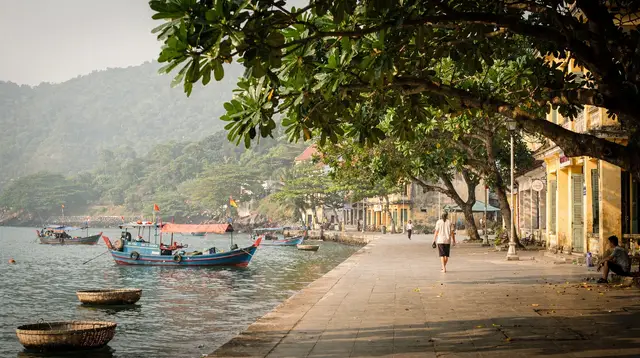
Con Dao Archipelago: The Complete Guide
How do you get to Con Dao and what makes it different from other coastal spots near Ho Chi Minh City?
Con Dao is an offshore archipelago reached only by air or by fast ferry, never by road, which sets it apart from mainland stops like Vung Tau or Ho Tram. It combines a national park, a set of nesting-turtle beaches and a cluster of colonial-era prison sites that draw Vietnamese and international visitors for very different reasons.
An archipelago, not a beach town on the mainland
Most of the coast covered on this site sits on the mainland, connected to Ho Chi Minh City by a coach, a private car or a minibus. Vung Tau and Ho Tram both work that way: you get in a vehicle, you drive, you arrive. Con Dao does not. It is a genuine offshore archipelago in the East Sea, and there is no road, no bridge and no drivable route to it from anywhere. The only ways in are by air or by fast ferry from the coast, and that single fact shapes almost everything else about visiting — the pace, the crowd, the cost, and the sense that you have actually left the mainland behind rather than just driven a bit further along it.
It is a confusion worth stating plainly, because it comes up constantly when people plan a coastal add-on from Ho Chi Minh City: Con Dao is not a further-flung version of Vung Tau, and it is not accessible the way Phu My Port or the beaches near it are. It is a separate landmass out to sea, with its own airstrip, its own ferry terminal, and a character that owes more to its isolation than to anything resort developers have added.
This page does not give flight schedules, ferry timetables, ticket prices or trip durations, all of which change too often to print reliably — check current options directly with an airline, a ferry operator or a travel agent before booking. What follows instead is the shape of the place: what the archipelago is, why it looks and feels the way it does, and what a visit generally covers.
Geography: one main island, several smaller ones
Con Dao is not a single island but a cluster — a main island where the small town, the airport and almost all accommodation are located, plus a scatter of smaller islands and islets around it. Much of the archipelago and the surrounding waters are protected as Con Dao National Park, which covers forest-clad hills on the main island as well as marine habitat around the outer islands. That dual identity, a national park wrapped around a settled town, is part of what makes Con Dao feel different from a conventional beach destination: development is limited, forest comes right down to the coastline in places, and a good part of any stay is spent moving between the town and quieter corners of the park rather than between resorts.
Boat trips out to the smaller islands are a normal part of a Con Dao visit, and several of the bookable activities on this page are built around exactly that: a canoe outing along the coastline of one of the outer islands, a boat excursion that takes in more than one island in a day, or a hike that starts from a landing point reachable only by water. None of this is interchangeable with a day at a mainland beach — it depends on calm conditions and a boat, and it is worth planning with some flexibility built in.
a canoe trip along the coast of Ba Island is a common way to see the shoreline of one of the outer islands at a slower pace than a standard boat tour allows, paddling close to cliffs and coves that a larger boat cannot reach.
The memorial sites: a place people come to remember, not just to see
Con Dao’s history is central to why many Vietnamese visitors come at all, and it sits alongside the natural side of the archipelago rather than apart from it. The islands held a prison complex that operated through the French colonial period and continued through the war years, and the site is still associated with the cells known as the tiger cages, used to hold political prisoners in conditions that are now presented at memorial sites on the main island. These places are treated with real solemnity by Vietnamese visitors in particular, and they are worth approaching the same way: as places of remembrance, not simply another stop on a sightseeing list.
This page keeps that history brief and factual rather than descriptive, because the memorial sites deserve to be experienced directly and because attendance figures, opening arrangements and the exact layout of exhibits are the kind of detail that is better checked on arrival or through a dedicated guide than printed here and left to go stale. What matters for planning is that a visit to Con Dao that skips the memorial sites is skipping a large part of why the archipelago is significant, not just a footnote to the beaches.
Nature: forest, coastline and nesting turtles
The national park side of Con Dao is built around lowland and hill forest on the main island, a coastline of small bays and headlands, and marine habitat around the outer islands that supports coral and a range of marine life. One of the archipelago’s more distinctive features is that it is a nesting site for sea turtles, and conservation programs on the islands work directly with that: monitoring nests, protecting hatchlings, and in season involving visitors in releasing baby turtles into the sea under supervision.
joining a supervised release of baby turtles into the sea connects a visit directly to that conservation work, timed around the nesting and hatching season rather than available year-round.
Away from the turtles, the park’s forested interior is reached on foot, with trails that range from short walks near the town to longer hikes that climb through hill forest to viewpoints over the coast and outer islands.
a hike through the park to Bai Bang and Dat Tham covers one of the longer trail routes, moving from forest into more open coastal terrain over the course of the walk. A shorter, more accessible option runs through stands of old-growth trees closer to the town.
a walk among the heritage Sao Den trees takes in some of the largest and oldest trees on the main island, a route suited to visitors who want forest scenery without a full-day hike.
Boat-based excursions extend the same nature focus out to the smaller islands, where reef, coastline and bird life are the main draw.
a boat trip out to the Bay Canh and Hon Cau islands is a typical way to see two of the outer islands in a single excursion, combining time on the water with stops on land.
What this page leaves to its own pages
Con Dao’s reefs are a genuine draw for diving and snorkeling, but the logistics involved — operators, gear, sites and seasonal conditions — are covered in full on their own page rather than repeated here; see the diving and snorkeling guide for that side of a visit.
Likewise, this page is not the place for the beach towns on the mainland: Vung Tau’s beaches and the quieter stretches around Ho Tram are separate destinations, reached by road, and shouldn’t be planned as a substitute for or a warm-up to Con Dao — they are a different kind of coastal trip entirely. A broader comparison of the coastal options near Ho Chi Minh City, including how Con Dao fits alongside them, is laid out in the guide to choosing a beach near Saigon.
Cruise passengers arriving through Phu My Port sometimes ask whether Con Dao is workable as a shore excursion; given that the archipelago is reached only by air or ferry and not by road, it does not fit the kind of short, land-based excursion that works from that port. The overview of Phu My as a cruise port and the guide to the coast reachable from Phu My cover what does work for a single day from the ship; Con Dao is better planned as a standalone trip with its own dedicated time.
Table: Con Dao at a glance versus the mainland coast
| Con Dao archipelago | Vung Tau / Ho Tram (mainland) | |
|---|---|---|
| Access | Air or fast ferry only, never by road | Road from Ho Chi Minh City |
| --- | --- | --- |
| Setting | Offshore islands, national park | Coastal towns on the mainland |
| --- | --- | --- |
| Main draws | History and memorial sites, forest trails, turtle nesting, outer-island boat trips | Beaches, resorts, day-trip ease |
| --- | --- | --- |
| Diving and snorkeling | Covered separately, its own page | Not a primary draw |
| --- | --- | --- |
| Feel | Quiet, preserved, slower pace | More developed, easier logistics |
Planning a Con Dao trip from Ho Chi Minh City
Because the archipelago cannot be reached by road, a Con Dao trip is planned as its own block of time rather than tacked onto a mainland itinerary the way a Vung Tau or Ho Tram day trip can be. Most visitors treat it as a short standalone getaway from the city, built around the flight or ferry rather than around a driving route, and it pairs more naturally with time back in Ho Chi Minh City before or after than with the other coastal stops on the mainland.
For a longer combined trip, the five-day Con Dao island extension itinerary sets out one way to build the archipelago into a wider southern Vietnam trip, while the two-day Saigon and Vung Tau coast itinerary is a useful point of comparison for what a short mainland coastal trip looks like instead — useful precisely because the two are not interchangeable. A day out on the Saigon River or a straightforward Vung Tau day trip from the city are both far simpler outings than a Con Dao trip, and worth keeping separate when comparing options for limited time.
Things to do on Con Dao
Beyond the memorial sites and the national park’s trails, a broader range of activities on and around the archipelago — boat trips, walks, cultural stops and more — is gathered on the dedicated Con Dao things-to-do page, which is a useful next stop once the basic shape of a visit is clear.
One more boat-based option worth knowing about combines a longer excursion with one of the archipelago’s peaks.
a boat trip to Ba Island paired with the Love Peak trek combines time on the water with a hike to one of the higher points on the outer islands, giving a fuller sense of the archipelago’s mix of sea, forest and elevation in a single outing.
Con Dao Archipelago: frequently asked questions
Can you drive to Con Dao from Ho Chi Minh City?
No. Con Dao sits offshore in the East Sea, and there is no road or bridge connection to the mainland. Every visitor arrives by air or by fast ferry from the coast, which is the single most important planning fact about the archipelago.
Is Con Dao the same as Vung Tau or Ho Tram?
No, and mixing them up is common. Vung Tau and Ho Tram are mainland coastal towns reachable by road. Con Dao is a separate archipelago well out to sea, with its own airport and ferry terminal, and a noticeably different pace and atmosphere.
What is Con Dao known for besides its beaches?
Its wartime history. The archipelago held a prison complex used through the French colonial period and the war years, including the cells known as the tiger cages, and several sites are treated as places of remembrance rather than ordinary sightseeing stops.
Is Con Dao part of a national park?
Much of the archipelago and its surrounding waters fall within Con Dao National Park, which protects forest, coastline and marine habitat across the group of islands, not just the main island where most visitors stay.
Do people visit Con Dao for diving and snorkeling?
Yes, the surrounding reefs are a draw, but that side of a trip is planned separately with its own logistics and season considerations, covered on its own page rather than repeated here.
Is Con Dao busy with tourists?
It has a much quieter, more preserved feel than the mainland coast, shaped by its limited transport links and its history as a former prison island rather than a resort town, though exact visitor numbers vary and are not something to rely on for planning.
How many islands make up the Con Dao archipelago?
Con Dao is a group of islands and islets off the south-eastern coast, anchored by one main island where the town, airport and most accommodation are located, with the smaller islands reached by boat trips arranged locally.
Vung Tau, Ho Tram and the Con Dao Islands
Verified deep-linked GetYourGuide tours. Book through these links and we earn a small commission at no cost to you.
GetYourGuide does not provide a product photo for this activity — the image shows the meeting point, photographed by us.