Two Deserts, Not One: Untangling Mui Ne’s Red and White Dunes
Almost every mention of “the Mui Ne sand dunes” treats them as a single attraction, and that is where the confusion starts. There are, in fact, two distinct dune fields along this stretch of the Binh Thuan coast, and they are not next to each other, not the same color, and not the same experience. The red dunes sit close to town, compact and steeply sculpted, easy to fold into an evening out.
The white dunes lie well apart from them, spread over a much larger and flatter expanse of pale sand that genuinely reads as desert rather than beach dune. Mixing the two up is the single most common misunderstanding travelers carry into Mui Ne, and it shapes expectations badly: someone who books a quick stop expecting the compact red dunes can be caught off guard by how much more there is to see, or move, at the white dunes, and vice versa.
This page exists to separate the two clearly, describe what each one actually looks and feels like, and correct the idea that a single visit “does” the Mui Ne dunes. For the practical side of getting onto the sand, — buggy rentals, ATV rides, self-drive versus guided options, — the dedicated ATV and buggy guide covers that in depth; this page stays focused on what the dunes are and how they differ.
The Red Dunes: Close, Compact, and the More Visited of the Two
The red dunes, sometimes called the “flying sand dunes” locally for the way wind lifts fine grains off their ridges, are the ones most visitors see first, simply because they sit closest to the main strip of Mui Ne. Their color comes from iron-rich sand that shifts through shades of ochre and rust rather than the pale gold most people picture when they hear “desert.” The terrain is compact and steep-sided, folding into ridges and hollows that make for dramatic close-up photography, especially as the low sun rakes across the slopes and throws long shadows into the hollows.
Because they are so easy to reach from where most travelers are already staying, the red dunes tend to draw the bigger crowds, particularly around the golden-hour windows at either end of the day when the light is best and the heat has eased off. Vendors renting plastic sledges for sliding down the slopes cluster here, and it is the more commercial, more photographed of the two sites. Visitors expecting a quiet, empty desert scene are often surprised by how social and busy the red dunes can feel, especially compared with what is coming up next.
The White Dunes: Further Out, Paler, and Genuinely Desert-Like
The white dunes sit apart from the red dunes, further from central Mui Ne along the road toward Phan Thiet and inland from the coast, at a different location entirely rather than a short walk away. This is an important distinction, because guides and quick day-trip itineraries sometimes describe “visiting the dunes” as though it were one stop, when reaching both actually means two separate detours off the coastal road.
Where the red dunes are compact and steep, the white dunes spread out over a much larger, flatter expanse of pale, almost bone-white sand that genuinely resembles a small desert rather than a coastal dune field. The scale is the main difference travelers notice immediately: it is possible to walk, or ride, for a considerable stretch and still be surrounded by sand in every direction, with the wind constantly reworking the surface into new ripple patterns. A shallow lake sits near part of the white dunes, and the contrast between blue water, white sand, and scattered green vegetation at the edges is one of the more striking, and more photographed, combinations on this stretch of coast.
The white dunes tend to feel less crowded and more open than the red dunes, partly because of their size and partly because they sit further off the beaten path. Visitors who only have time for one site and want the more atmospheric, more expansive dune landscape generally lean toward the white dunes; those who want convenience and dramatic close-range photography without going far tend to stick with the red dunes.
Why the Two Get Lumped Together
The confusion between the sites is easy to trace. Both are sandy, reddish or pale depending on which one, both sit within the wider Mui Ne area, and both are commonly sold as add-ons to the same buggy or jeep excursions, which naturally bundles them into a single mental picture for anyone reading about the trip in advance. Marketing photos for “Mui Ne dunes” tours also mix images from both sites without labeling which is which, reinforcing the idea that they are one place with two names rather than two places that happen to share a general area.
In practice, treating them as interchangeable causes two kinds of disappointment: travelers who only visit the red dunes sometimes leave thinking they have “done the dunes,” unaware that a much larger, different-looking landscape exists a short drive away; and travelers who arrive expecting the intimate, close-up ridges of the red dunes at what is actually the white dunes can be thrown by how spread out and open the terrain is instead. Knowing in advance that these are two separate stops, not one, is the simplest fix.
Moving Between the Two Sites
Neither dune field is within walking distance of the other, and there is no direct path connecting them across the sand. Getting from one to the other means returning to the coastal road and continuing on toward the second location, which is exactly why most buggy, ATV, and jeep excursions are built around visiting both in sequence rather than choosing just one. A private car or motorbike works as well for travelers who prefer to arrange their own transport and simply stop at each dune field along the way.
For visitors who want the mechanics of getting onto the sand itself, — self-drive ATVs, guided jeep convoys, sledge rental at the red dunes, — the dedicated guide to ATV and buggy activities walks through the options in detail, along with the separate guide on catching the dunes at sunrise, which many visitors treat as the better light for the white dunes in particular. Riders coming through a guided route often combine a stop at the dunes with a wider loop of the coast; the option below covers exactly that kind of self-drive circuit.
a self-drive ATV and jeep circuit that takes in the dunes as part of a wider desert loopTravelers who prefer to sit back and let someone else navigate the route between the two dune fields, and the hidden pagoda stop many jeep routes fold in along the way, tend to book a guided option instead.
a guided jeep tour linking the dunes, the coast road, and a lesser-visited pagoda stopWalking the Dunes Without a Vehicle
Both dune fields can be explored on foot, and plenty of visitors skip the buggies and ATVs entirely, especially at the red dunes, where the compact scale makes a short walk enough to reach the best ridgelines. At the white dunes, walking is a bigger undertaking simply because of how far the sand stretches, so travelers on foot tend to pick a direction, walk in as far as feels comfortable, and turn back rather than attempting to cross the whole area.
Loose sand makes for slower, more tiring walking than it looks, and the surface heats up quickly once the sun is high, which is part of why the early morning and late afternoon windows are so consistently recommended over the middle of the day. Sturdy sandals or shoes that can be emptied of sand easily are worth more here than at almost any other stop on a Mui Ne itinerary.
What to Bring
Loose, breathable clothing and sun protection matter more at the dunes than almost anywhere else in the Ho Chi Minh City region’s usual day-trip circuit, since there is no shade once away from the road. A hat, sunglasses, and a scarf or light cover for the face help against blowing sand on windier days, which is common at both sites given how exposed they are. A change of footwear, or shoes that slip on and off easily, saves a lot of frustration, since sand works its way into almost anything worn on the walk in.
Anyone riding a sledge down the red dunes, or bouncing across the white dunes on an ATV, should expect sand to end up everywhere regardless of preparation; a spare set of clothes left in the vehicle is a common local habit rather than overcaution.
Photography Notes
The two dune fields photograph very differently, which is worth knowing before deciding which one to prioritize if time only allows for one. The red dunes reward close, textured shots of rippled sand and steep ridgelines, particularly with a human figure or a sledge in frame for scale, and the warm tone of the sand itself does a lot of the visual work without needing dramatic light. The white dunes suit wider, more minimalist compositions, — a single figure against an expanse of pale sand and sky, or the lake’s edge where blue water meets white dune, — and tend to look flatter and less interesting in harsh midday light than the red dunes do.
Both sites are far more crowded, and far harder to shoot cleanly, once tour groups arrive in numbers, which is one more reason the early and late windows of the day come up so often in local advice, alongside the simple fact that the light itself is better then.
Nearby: Fairy Stream and the Fishing Harbour
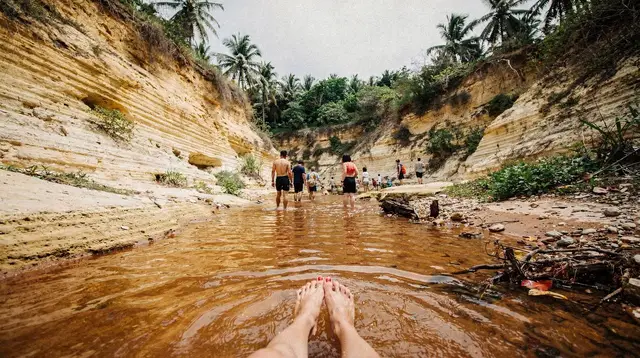
The dunes are usually paired with two other Mui Ne landmarks on the same outing. The Fairy Stream is a shallow, reddish waterway that cuts through sandstone formations a short distance away, walked barefoot rather than driven, and often folded into the same half-day as the red dunes given how close the two sit to one another; the dedicated walking guide to the Fairy Stream covers that route on its own. Mui Ne’s working fishing harbour, with its distinctive round basket boats, sits at the opposite end of town from the dunes and makes a natural early-morning stop for visitors already up for sunrise at the sand.
Combining the Dunes with the Rest of a Mui Ne Stay
Because neither dune field takes an entire day on its own, most visitors treat them as one piece of a broader Mui Ne stay rather than the whole reason for the trip. A common pattern pairs an early start at the dunes with the Fairy Stream, then a slower afternoon around Phan Thiet or along the resort strip, and an evening built around the town’s seafood scene. Travelers interested in that side of a Mui Ne stop can look at a guided evening out built around local food and culture.
a sunset food tour through Phan Thiet with a local guide, including a stop at the Cham towersVisitors extending further along the coast sometimes add a quieter, more upscale detour toward the Ke Ga lighthouse and Ta Cu, well south of the dune area, as a contrast to the desert scenery.
a more upscale day trip out to the Ke Ga lighthouse and Ta Cu, away from the dunesVisitors planning several days around Mui Ne rather than a single stop can see how the dunes fit into a longer coastal itinerary through the three-day Saigon–Mui Ne desert escape, and travelers comparing Mui Ne against other coastal stops from Ho Chi Minh City may find the Vung Tau versus Mui Ne comparison and the broader choosing a beach near Saigon guide useful before settling on which coastline suits the trip better.
For the transport side of getting out to Mui Ne in the first place, the long-distance transfer guide lays out the road options, and the wider things to do in Mui Ne hub and the sand dunes activities category round out the planning picture. General travel tips for the region cover the rest of what to pack and expect along the coast.
Frequently Asked Questions About the Mui Ne Sand Dunes
Are the red dunes and white dunes in Mui Ne the same place?
No. They are two separate, unconnected sand formations near Mui Ne. The red dunes sit close to town and are compact and steep, while the white dunes lie further away along the road toward Phan Thiet and cover a much larger, flatter area.
Which dunes are closer to central Mui Ne?
The red dunes are the closer of the two, sitting near the main stretch of Mui Ne, which is why they tend to be the more visited and more crowded site.
Can I visit both dune fields in one outing?
Yes, and most buggy, ATV, and jeep excursions are built around visiting both in sequence, since getting from one to the other means returning to the coastal road and continuing on rather than walking between them.
Do I need a vehicle to see the dunes, or can I walk?
Both sites can be explored on foot. Walking is easier at the compact red dunes, while the much larger white dunes are usually only partly walked, with visitors picking a direction and turning back rather than crossing the whole area.
Which dune field is better for photography?
The red dunes suit close, textured shots of ridges and sand patterns, while the white dunes suit wider, more minimalist compositions across their larger, paler expanse, especially near the lake at their edge.
Is there shade or shelter at either dune field?
No, both sites are fully exposed, which is part of why light, protective clothing, a hat, and something to cover the face against blown sand are recommended for either one.
Why do travel guides often describe the Mui Ne dunes as a single site?
Both dune fields are sandy, sit within the wider Mui Ne area, and are commonly sold together as one bundled excursion, which blurs the fact that they are two distinct, separately located landscapes rather than one place with two names.