What the Dry Season Actually Feels Like in the South
What is the dry season like in southern Vietnam?
It runs roughly from December to April, with almost no rain and a sky that stays clear for weeks at a stretch. It isn't cool at any point — the heat builds steadily and peaks in the final stretch, in March and April.
Six months without an umbrella
I didn’t understand the dry season here until I’d sat through a few of its months back to back. Coming from a place with four seasons, I kept expecting some kind of hinge point — a week where the air would cool, the light would change, something. It never came. What I got instead was six months, roughly December through April, where the sky over Ho Chi Minh City simply stayed open. Blue in the morning, blue at midday, blue again at sunset. I’d check the forecast out of habit for the first couple of weeks and then stop bothering.
That’s really the whole shape of it: an extended stretch with almost no rain, sitting between two wet seasons that bookend the calendar here. If you’ve already read how the wet season works, you know the south only really has two seasons, not four — I won’t repeat that case here, since it’s already made properly on that page. What I want to describe instead is what living inside the dry half of that pattern actually feels like, day to day, because it’s easy to picture it wrong.
The trap: thinking “dry” means “cool”
The confusion I ran into more than once, and that I still hear from other travelers, is picturing the dry season as some kind of gentle winter — an escape from the heat rather than a different flavor of it. It isn’t. There’s no cool snap anywhere in this stretch. The far south of Vietnam doesn’t get a real winter the way the north does, and importing that idea here just sets you up to pack the wrong clothes and misjudge your energy for the day.
What actually happens is closer to the opposite of cooling down. The dry season starts out relatively gentle around December, and then the heat builds, month by month, until it reaches its sharpest point right at the end of the run, in March and into April. So the “dry” months aren’t a rest from the tropical climate — they’re where the tropical climate shows its most intense side, just without the rain to go with it.
I remember being caught out by this on a trip that started in December and stretched into March: the early days felt easy, almost mild by local standards, and I assumed the rest of the trip would feel the same. It didn’t. By the time I was walking around District 1 in the early afternoon in late March, I was moving the way I used to move in July heat back home — slower, closer to the shade, drinking water on a schedule rather than when I felt like it.
What clear skies actually buy you
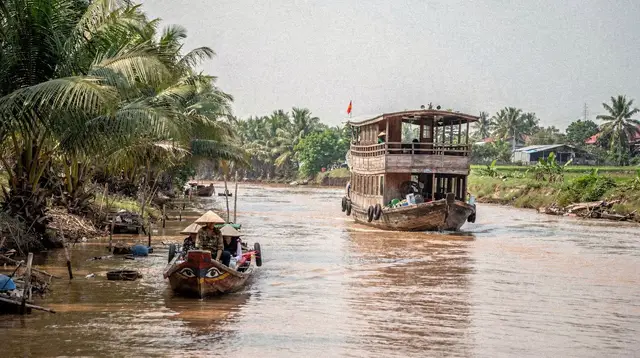
The upside of all that is real, and it’s the reason this stretch of the year gets built into so many itineraries. A sky that doesn’t threaten rain changes what a day actually looks like on the ground. Boat trips on the Saigon River run without anyone watching the horizon. A Mekong Delta day trip out toward the orchards and canals doesn’t come with a mental asterisk about getting rained out halfway through.
I’ve taken a small-group day into the delta during this stretch and the whole rhythm of it — the boat transfers, the walk through a fruit orchard, sitting down for lunch outdoors — depends on a sky that just stays out of the way. If you’d like the details of how a trip like that actually runs, a small-group day trip into the Mekong Delta covers the practical side of it.
The same logic applies further out. Out toward Mui Ne, the dunes and the coast are far more comfortable to walk when there’s no chance of a downpour turning sand into something closer to mud. And a half-day out to the Cu Chi tunnels, spent mostly outdoors moving between tunnel sections and shaded stops, is a much easier day under a settled sky than under one that could open up at any moment — something I can say from having done it both ways. A half-day tour out to the tunnels is the version I’d point a first-time visitor toward.
A stretch, not a single mood
One thing I keep coming back to is that the dry season isn’t one static condition — it’s a slope. December sits at one end of it, still relatively easy; April sits at the other, considerably harder. That’s part of why I’ve deliberately kept this page general rather than trying to describe every month here.
Each month in this run has its own character, and I’ve written those up separately: December, January, February, March and April each get their own page, because the difference between arriving in early December and arriving in mid-April is genuinely large, even though both fall inside “the dry season.”
If you’re trying to decide when in that window to go, the best time to visit overview and the site’s best-time tool do a better job of weighing that trade-off than I can in a single paragraph here. What I can say from experience is: don’t let the word “dry” do more work in your head than it should. It tells you about rain, not about temperature.
How I’d use this stretch
In practice, I treat the earlier months of the dry season — December into January and February — as the easiest window for anything that keeps me outdoors for long stretches: a river dinner cruise in the evening, a day trip out to Tay Ninh and the Black Virgin Mountain, a slow morning around Ben Thanh and District 1. As the season moves into March and April, I start shifting the outdoor time earlier in the day and building in more breaks, because the heat by then is doing most of the talking.
An evening on the water is one place where the dry season genuinely earns its reputation — no clouds to worry about, just the city lights along the river as the sun goes down. A buffet dinner cruise on the Saigon River is the kind of evening that depends entirely on that settled sky. If a full day into the delta appeals more than an evening cruise, a classic one-day Mekong Delta tour is worth a look too.
None of that changes the underlying fact I’d want anyone reading this to leave with: the dry season here is a season without rain, not a season without heat. Plan the days accordingly and it works in your favor almost every time.
Questions I get about the dry season
Is the dry season cold in Ho Chi Minh City?
No. There’s no cold season here at all — that’s a northern Vietnam idea. The dry season is simply dry, and the heat only builds as it goes on.
Does it ever rain during the dry season?
Rarely, and when it does it’s usually a short, isolated shower rather than a real system. Most days from December through April are simply clear from morning to evening.
Which part of the dry season is the hottest?
The tail end. As the months move from December into April, the heat climbs steadily, and the last weeks before the rains return are the most intense of the whole stretch.
Is the dry season the same everywhere I go from Ho Chi Minh City?
The pattern is consistent across the city, the Mekong Delta and the coast, since they share the same southern climate. Local guides for each destination are still worth checking for practical details.
Should I plan my trip entirely around the dry season?
It helps for anything outdoors, but it’s one factor among several — flights, holidays and Tet closures matter too. I go into that more in the month-by-month pages.
Is the dry season the busiest time to visit?
This page doesn’t cover crowd levels or pricing — for planning around demand and cost, the monthly guides and the best-time overview are the better source.
Seasonal Guide
Verified deep-linked GetYourGuide tours. Book through these links and we earn a small commission at no cost to you.
GetYourGuide does not provide a product photo for this activity — the image shows the meeting point, photographed by us.