Reunification Palace: The Fall of Saigon and Its Aftermath
What is the historical significance of the Reunification Palace?
The Reunification Palace was the seat of the South Vietnamese government in Saigon until a tank crashed through its gates on 30 April 1975, ending the Vietnam War. It was rebuilt in the mid-1960s after an earlier building on the site was bombed, and it now stands preserved largely as it was that morning.
A Palace Built Twice, and What It Replaced
Few buildings in Vietnam carry as much political weight per square metre as the block of modernist concrete standing behind wide lawns in District 1, Ho Chi Minh City’s central district. Most visitors know it today by its current name, the Reunification Palace, and many photograph its gates without realizing that the building they are looking at is not the one that stood on this site through most of the colonial and early independence periods, and that its story only really begins in earnest in the 1960s.
The site itself has been a seat of power since French colonial rule, when a governor’s residence known as Norodom Palace occupied the ground. When Vietnam split in 1954 into a communist-aligned north and an American-backed south, the building became the official residence and workplace of the president of the newly formed Republic of Vietnam, based in Saigon, and took the name Independence Palace. That original structure did not survive the decade. In February 1962, two pilots of the Republic of Vietnam Air Force, acting against the government they served, bombed the palace in an attempted assassination of the sitting president. He survived, but the building was damaged badly enough that it was ultimately demolished rather than repaired.
What replaced it is the building visitors see now: a long, low, strikingly modernist structure designed by the Vietnamese architect Ngo Viet Thu, completed in 1966 on the same footprint as its predecessor. It was built as a statement as much as a workplace, meant to project the confidence and modernity of a young republic even as the war around it intensified. For the better part of a decade, it functioned exactly as intended: the administrative and ceremonial heart of the South Vietnamese state, hosting cabinet meetings, military briefings and the day-to-day business of running a government at war.
The Government That Worked Inside It
Understanding why the palace matters means understanding what kind of government sat inside it. The Republic of Vietnam, commonly called South Vietnam, was one half of a country divided along the 17th parallel after 1954, with its capital in Saigon and its rival government, the Democratic Republic of Vietnam, based far to the north in Hanoi. Ho Chi Minh City is not that northern capital and never has been; the country’s actual capital remains Hanoi, roughly 1,100 kilometres away, a distance that underlines just how separate the two governments and the two cities were for the two decades the war lasted.
South Vietnam’s presidency changed hands more than once, sometimes through elections, sometimes through military coups, and the palace was the stage for several of those transitions. Cabinet reshuffles, coup announcements and the elaborate rituals of a government trying to project legitimacy to both its own population and its American backers all happened within these walls. The basement held a command and communications centre, wired for a government that expected, correctly, that it might one day need to run a war from underground. Upstairs, reception halls were built for the kind of formal diplomacy a government fighting for international recognition depended on.
None of this made the palace merely ceremonial. It was a working nerve centre for a state locked in a war that, by the early 1970s, was going visibly badly for Saigon, even as the palace’s halls continued to host receptions and briefings as though the outcome were still undecided.
The Morning of 30 April 1975
The palace’s most consequential day arrived on the morning of 30 April 1975. By that point North Vietnamese and allied forces had advanced to the edges of Saigon itself, and the South Vietnamese government had cycled through leadership in a matter of days as the situation collapsed. The man holding the presidency that morning had been in office for barely 48 hours, inheriting a government with almost nothing left to govern.
At around 10:45 in the morning, a tank belonging to the North Vietnamese Army crashed through the palace’s iron gates. Photographs and film of that moment, tank treads on the driveway and troops moving across the lawn, became some of the defining images of the war’s end, reproduced ever since in documentaries, textbooks and news retrospectives. Soldiers moved into the building, and within the hour a flag was raised over the palace marking the change of power.
Inside, the president formally announced the surrender of the South Vietnamese government to the officer who had led the assault, a brief and almost anticlimactic exchange given everything it closed out. That surrender is what is generally meant by the phrase “the fall of Saigon,” and by extension the end of the Vietnam War as a shooting conflict, even though the country’s formal reunification as a single socialist state took a little longer to complete administratively.
The renaming of the building followed naturally from what had just happened inside it. Independence Palace, a name tied to a government that no longer existed, became the Reunification Palace, a name tied to the union of north and south under a single government based in Hanoi. The building’s function changed just as completely as its name: it stopped being a seat of executive power and became, instead, a monument to the moment that power changed hands.
Preserved as a Snapshot, Not Modernized
What makes the Reunification Palace unusual among former seats of government is the decision, made after 1975, to preserve its interiors largely as they were on the day the war ended, rather than gut and repurpose them. Cabinet rooms retain their period furniture. The war room in the basement, wired with communications equipment and marked with maps that show the military situation as understood at the time, has not been redressed for a later narrative. The president’s private quarters, reception rooms and the sweeping formal staircases all read less like a museum built after the fact and more like a government office abandoned mid-shift.
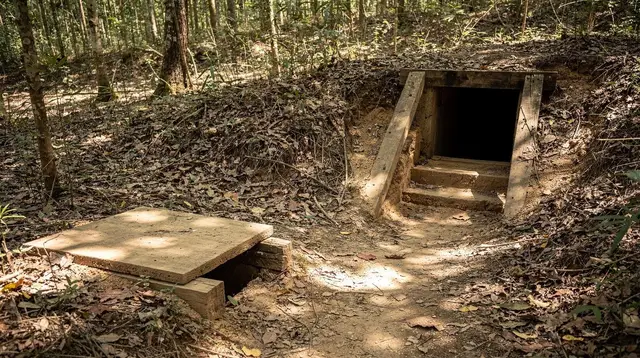
That preservation is part of why the building carries such weight for visitors interested in the war beyond its combat history. Sites like the Cu Chi Tunnels show the war from below ground and from the perspective of an insurgent force; the War Remnants Museum, a short distance away in District 3, documents the war’s human and material cost through photography and captured equipment. The palace offers something distinct from either: the seat of the government that lost, preserved at the exact moment it stopped functioning as one.
Two Palaces, Two Cities, Frequently Confused
One confusion comes up often enough to be worth addressing directly: the Reunification Palace in Ho Chi Minh City is not the same building as the Presidential Palace in Hanoi, and the two should not be treated as interchangeable or as somehow the same institution under different names. Hanoi’s Presidential Palace is a mustard-yellow French colonial building associated with the northern leadership, and famously the residence Ho Chi Minh chose not to live in, preferring a simpler stilt house nearby. It represents the northern, communist government that eventually prevailed; the Reunification Palace represents the southern government that did not.
The two buildings sit in two different cities separated by roughly 1,100 kilometres, served two rival governments through the length of the war, and tell opposite halves of the same story. Visitors piecing together the history of the Vietnam War across a trip that covers both the north and the south sometimes fold the two palaces into a single mental image; keeping them separate is the surest way to keep the politics of the divided country straight as well.
The Palace’s Place in Ho Chi Minh City Today
The Reunification Palace no longer functions as a working seat of government, that role having shifted definitively to Hanoi after 1975, but it has not been sidelined either. It stands at the centre of a cluster of sites that together form the backbone of any serious engagement with the war’s history in Ho Chi Minh City: the palace itself, the War Remnants Museum a short walk away, and further out, the Cu Chi Tunnels and the sites around Tay Ninh that tell the story of the war fought from the countryside rather than from a presidential office.
The building occasionally hosts official receptions and state functions, a modest continuity with its original purpose, but its primary role today is as a historic site, one of the clearest physical markers left of a government and a war that ended, quite literally, at its front gate. For visitors trying to understand not just what happened during the Vietnam War but how South Vietnam itself was governed while it lasted, the palace remains the single most direct point of entry.
Reunification Palace History: Frequently Asked Questions
Is the Reunification Palace the same building as Hanoi’s Presidential Palace?
No. They are two distinct buildings in two distinct cities. The Reunification Palace, in District 1 of Ho Chi Minh City, was the seat of the South Vietnamese government. The Presidential Palace in Hanoi is a French colonial building associated with the northern, communist leadership, including Ho Chi Minh, who famously chose not to live in it.
Why was it called the Independence Palace?
Independence Palace was the name given to the building when it served as the residence and workplace of the president of the Republic of Vietnam, the US-backed government based in Saigon. After the government fell in 1975, the building was renamed the Reunification Palace to mark the reunification of North and South Vietnam under a single state.
What happened at the palace on 30 April 1975?
A North Vietnamese Army tank broke through the main gates on the morning of 30 April 1975, and troops raised a flag on the building shortly afterward. The president of South Vietnam, who had held office for only two days, formally surrendered inside the palace that same morning, an event usually described as the fall of Saigon and the end of the Vietnam War.
Was the current building the original palace on this site?
No. An earlier building on the same site, built under French colonial rule, was badly damaged in a 1962 bombing attempt on the sitting president and was later demolished. The structure visitors see today was designed by a Vietnamese architect and completed in 1966, replacing the older building entirely.
Why does the palace still look like 1975 inside?
After 1975 the new government chose to preserve the palace’s interiors largely as they stood at the moment of the surrender, rather than repurpose or modernize the rooms. That decision is why the war room, the reception halls and the president’s private quarters still read as a snapshot of a government at the point it ceased to exist.
Is the Reunification Palace still used as a government building?
No longer as a seat of executive power. It is preserved as a historic site and occasionally hosts state functions and official receptions, but it does not house the day-to-day government of Vietnam, which is based in Hanoi.
Planning a Visit
Ticket prices, opening hours and how long to allow inside the palace are covered separately in the dedicated ticket and visiting guide, which is the better starting point for planning the practical side of a visit. This page focuses on why the building matters rather than how to plan around it.
For travelers weighing the palace against the rest of the war history circuit, the War Remnants Museum guide and the walking-focused Saigon war sites walking tour both pair naturally with a palace visit, and the Cu Chi Tunnels history guide extends the story out to the resistance fought from underground rather than from behind a desk. A guided option that combines the palace with the museum in a single outing is worth considering for visitors short on time.
a standalone entry ticket to the Reunification Palace covers the palace on its own, while a day tour pairing the palace with other city highlights is a common way to see it alongside the rest of central Ho Chi Minh City.
Travelers who want the war history sites grouped together with a guide can look at a private tour combining the palace with the War Remnants Museum, and those extending the theme underground can add a historical tour of the Cu Chi Tunnels on a separate day.
Beyond District 1, the war history trail continues north-west toward Cu Chi and the Cao Dai Holy See at Tay Ninh, both accessible on a single long day from the city, and covered in more depth in the Cu Chi Tunnels and Cao Dai Temple day trip guide.
Closer to the palace itself, the Notre-Dame Cathedral and Central Post Office sit a short walk away and belong to an earlier, French colonial layer of the same district’s history, useful context for anyone trying to understand how Saigon’s built environment layered French rule, an independent southern republic, and reunification on top of one another within a few blocks.
Anyone building a longer itinerary around this period of history can also look at the broader neighborhood guide to District 1 and the citywide Ho Chi Minh City classic city tour, both of which place the palace within the wider fabric of the city that grew up around it, both before and after the events of April 1975.
War History: Cu Chi Tunnels and the War Remnants Museum
Verified deep-linked GetYourGuide tours. Book through these links and we earn a small commission at no cost to you.
GetYourGuide does not provide a product photo for this activity — the image shows the meeting point, photographed by us.