The Rainy Season in Southern Vietnam, Explained
What is the rainy season like in Ho Chi Minh City and southern Vietnam?
It runs roughly from May to November, with clear or partly cloudy mornings followed by a short, intense downpour in the late afternoon, plus high humidity all day. It is not a continuous monsoon, and most days still have plenty of usable dry hours.
How the Rain Actually Works Here
The first time I spent a rainy-season week in Ho Chi Minh City, I kept waiting for a day of solid grey drizzle, the kind I associated with the word monsoon. It never came. What came instead was a pattern that repeated itself almost every day: I would wake up to a clear or lightly hazy sky, get through a full morning of walking around District 1 or riding out to a day trip, and then, somewhere between three and six in the afternoon, the sky would darken fast and the rain would arrive all at once.
Loud, heavy, sometimes with thunder rolling over the Saigon River, and then, within an hour or two, gone again. By evening the streets were often dry enough that a visitor who had spent the day indoors would have no idea it had rained at all.
That is the rainy season in the south of Vietnam, roughly from May through November. It is real, it is daily, and it is worth planning around, but it is not the all-day soaking that the word conjures for people coming from other rainy climates. Southern Vietnam does not run on the four-season calendar either — there is no autumn slide into a wet, grey stretch. There are two seasons, dry and wet, and the wet one is defined less by total rainfall and more by timing: clear mornings, a short violent burst later in the day, and humidity that never really lets up in between.
Where the Confusion Comes From
I think the mix-up happens because “rainy season” and “monsoon” get used interchangeably in a lot of general travel writing, and further north and elsewhere in Asia that word often does mean multi-day systems of continuous rain. Southern Vietnam’s rainy season is a different mechanism: warm, moisture-laden air builds up over the course of the morning and early afternoon, and by late afternoon it releases as a short, intense downpour rather than settling in as a steady drizzle. I have had days where the rain lasted twenty minutes and days where it lasted closer to two hours, but in both cases it was a discrete event with a beginning and an end, not a mood that settled over the whole day.
This matters for how I plan a day here. On a trip out to Cu Chi or a boat morning on the canals, I treat the hours before early afternoon as the reliable window and build the more exposed, outdoor parts of the day around them. If I know rain is likely later, I schedule anything under cover, like a market visit or a museum stop, for that stretch instead of leaving it for the morning when the weather is actually at its best.
What It Feels Like Day to Day
Humidity is the part that surprises people more than the rain itself. It sits at a high, sticky level through the entire rainy season, rain or no rain, so even a completely dry morning can feel heavy and close. I have found that dressing for humidity, not just for rain, makes a bigger difference to comfort than carrying an umbrella. Light, quick-drying clothes, a change of shirt if the day is long, and shoes that will not fall apart if they get wet once are more useful to me than a full rain suit.
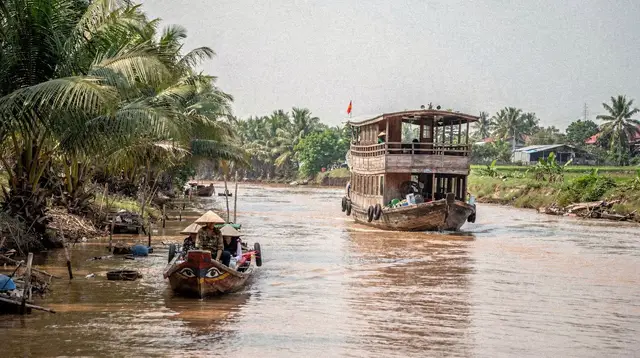
The upside of all that moisture is visible everywhere once you notice it. The canals running through neighborhoods like Binh Thanh run fuller, courtyard trees and rooftop plants look deep green rather than dusty, and out toward the delta the rice country takes on a color that the dry season simply does not produce. I have come to prefer photographing the city and the countryside in these months for exactly that reason, as long as I accept that I am shooting around a fixed afternoon interruption rather than ignoring it.
The Mekong Delta’s Own Rhythm
Out in the Mekong Delta, the rainy season adds a second, slower layer on top of the daily pattern: over these months the river system gradually rises as a normal part of its seasonal cycle, which locals and farmers plan their year around.
I am deliberately not giving a month-by-month breakdown of that rise here, because the detail that actually matters for trip planning — which months see the fullest water and what that means for a visit to somewhere like Can Tho or the Cai Rang floating market — belongs on the pages built around those specific months and that specific region, not on a general explainer like this one. What I will say from my own visits is that the delta’s daily weather still follows the same clear-morning, brief-afternoon-rain pattern as the city, so a floating market visit at dawn is not something the rainy season interferes with.
How I Plan Around It
My working rule for these months is simple: mornings are for anything outdoors or boat-based, afternoons are for anything I am happy to do under a roof or that I can cut short if the sky turns. A half-day at Cu Chi fits neatly into a morning slot, and I have paired it more than once with a covered stop afterward rather than pushing into open ground later in the day.
For the delta, I lean toward trips that start early, since that gets me on the water before the humidity and any afternoon system build up, and it matches how the small-group Mekong Delta day trip and the classic full-day Mekong Delta tour are both structured.
If I only have a morning free, the half-day Cu Chi Tunnels tour is the one I reach for, since it is built to wrap up before the afternoon rain tends to arrive. And on an evening when I would rather watch a downpour pass from somewhere dry and comfortable than sit it out on a street corner, a Saigon River dinner cruise has been a reliable way to turn the season’s own rhythm into part of the evening rather than an obstacle to it.
None of this has ever made me rule out visiting in these months. If anything, I now prefer them for how alive the city and the delta both look, as long as I keep the rain’s actual behavior in mind rather than the version of “rainy season” I had in my head before I first came here.
For the numbers on temperatures and how this compares to the December-to-April stretch, I keep the dry season explainer and the broader best-time-to-visit guide close at hand, along with the month pages for September, October and November when I am narrowing down actual travel dates.
For deciding whether the delta itself is worth building a whole day around in this weather, I still point people to this look at whether a Mekong Delta day trip is worth it, and if birdlife is part of the draw, the wetter months are actually when Mekong Delta bird watching gets more interesting, not less.
Rainy Season Questions I Get Asked Often
Does it rain all day during the rainy season in southern Vietnam?
No. The typical pattern is a clear or partly cloudy morning, then a heavy but short downpour in the late afternoon that usually clears within an hour or two, leaving the rest of the day dry.
Is the rainy season in Ho Chi Minh City the same as a monsoon further north or in other parts of Asia?
Not really. The rain here is concentrated into a short daily window rather than falling continuously for days, which is the pattern many visitors expect from the word monsoon.
Can I still do a full day of sightseeing during the rainy season?
Yes. I plan outdoor mornings and keep afternoons flexible, since the rain tends to arrive later in the day and passes quickly.
Does the rainy season affect the Mekong Delta more than the city?
The delta sees a general seasonal rise in water levels through these months, which is part of normal river life there, but the day-to-day rainfall pattern of clear mornings and brief afternoon downpours is the same as in the city.
How humid does it get in the rainy season?
Humidity stays high through the entire season, not just during the rain itself, so clothes and shoes can feel damp even between downpours.
Should I avoid visiting southern Vietnam in the rainy season?
I would not avoid it. Mornings are reliably usable, the city and delta are noticeably greener, and the short afternoon rain is easy to plan around once you know it is coming.
What should I pack for the rainy season around Ho Chi Minh City?
A light rain jacket or poncho, a dry bag for electronics, and shoes that can handle sudden puddles, since a downpour can start with little warning.
Seasonal Guide
Verified deep-linked GetYourGuide tours. Book through these links and we earn a small commission at no cost to you.
GetYourGuide does not provide a product photo for this activity — the image shows the meeting point, photographed by us.