A Region of Provinces, Not a Single Place
Say “the Mekong Delta” and most visitors picture one destination, reachable in a single outing from Ho Chi Minh City. In reality it is a whole region, fanned out across the many arms of the Mekong River as it nears the sea, and made up of separate provinces with their own capitals, markets and character.
My Tho, Ben Tre, Cai Be, Vinh Long, Sa Dec, Can Tho, Chau Doc and Ca Mau are not neighbourhoods of one delta town — they are distinct provincial centres, each a destination in its own right, linked by roads, bridges and countless smaller waterways rather than by any single circuit.
This page exists to make sense of that structure before you decide where to go. It will not hand you a schedule of prices, timetables or exact travel times, because those numbers age quickly and belong on the pages for each place, each tour and each itinerary. What it will do is explain how the delta is organised, how it connects to Ho Chi Minh City, and which mistakes to avoid when planning around it.
The River’s Many Arms
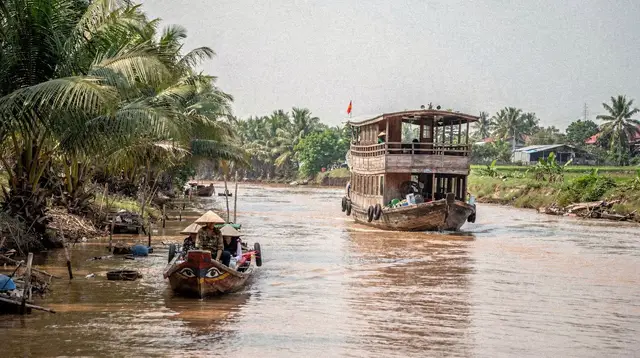
The Mekong reaches the South China Sea not as one channel but as several, splitting and rejoining as it crosses the flat, intensely cultivated land south-west of Saigon. This branching is the reason the region feels less like a single “delta” and more like a patchwork of provinces, each sitting on or near a different arm of the river, each with its own orchards, canals and market towns. Life here runs on the water: boats move rice, fruit and people along channels that often matter more than the roads running alongside them.
That geography explains why some towns feel close to each other while others, on paper not far apart, sit on opposite banks with a different rhythm entirely. It also explains why a single day trip can only ever show a slice of the region — usually the nearer provinces, close to the main routes out of the city — while the more distant ones reward a longer stay.
How the Delta Connects to Ho Chi Minh City
Every route into the delta from Ho Chi Minh City runs by road, in a coach, a shared “limousine” van or a private car, before switching to boats once you reach the river itself. The nearer provinces sit close enough to the city for a comfortable day out; the further ones, deeper into the delta or nearer the Cambodian border, are more naturally paired with an overnight stay. There is no shortcut by rail or air for any of this — road, then water, is simply how the delta is reached.
Because the provinces are spread out rather than clustered, “getting to the Mekong Delta” is really a question of choosing a departure point first. My Tho and Ben Tre sit closest to the city and are the classic choice for a first, shorter visit. Vinh Long and Cai Be lie a little further along, known for their orchards and river life. Can Tho, further again, is the delta’s largest city and the natural base for anyone spending more than a single day. Chau Doc, near the Cambodian border, and Ca Mau, at the southern tip of the country, are further still and suit travellers building a longer loop through the south rather than a quick side trip.
Choosing How Long to Stay
There is no single correct length of visit — it depends entirely on what you want from the region. A single day, focused on one or two of the nearer provinces, gives a real if brief impression of orchards, canals and a local market. Staying at least one night opens up the further provinces and lets you experience the river at its quietest, before the day’s boat traffic builds up, rather than seeing it only in the middle of the morning.
Travellers building a longer trip through southern Vietnam often treat the delta as a two- or three-day chapter: a night in or near Can Tho, perhaps a further night near Chau Doc, before returning to the city or continuing on to the coast. Others fold a shorter delta stop into a longer day that also covers the Cu Chi Tunnels, trading depth for breadth. Neither approach is wrong; they simply serve different kinds of trip, and it is worth deciding which one you want before booking anything.
For guidance on stitching the delta into a wider southern Vietnam trip, see the Mekong Delta day trip from Saigon guide, the comparison of a day trip against a two-day tour, and the broader question of how many days to spend in southern Vietnam as a whole.
The Rhythm of the Seasons
Southern Vietnam runs on two seasons rather than four, and the delta follows the same pattern as Ho Chi Minh City: a drier stretch through the winter months and a wetter one through the middle of the year. In the dry season, mornings on the water tend to be calm and predictable, which suits early starts toward a market or an orchard visit. In the wet season, rain in the delta behaves much as it does in the city — a short, heavy downpour most likely in the afternoon, rather than a day lost to steady rain — so a wet-season morning on the river is often unaffected.
Neither season should be treated as a reason to avoid the region. The dry months remove some of the uncertainty around timing a boat trip, while the wet months bring a deeper green to the orchards and canals. What matters more than the calendar is building some flexibility into a delta itinerary, since river life does not run to a fixed schedule.
Common Confusions Worth Clearing Up
Two mix-ups come up again and again when people plan a delta trip, and both are worth settling early.
The first is treating the delta’s towns as though they were suburbs or districts of Ho Chi Minh City. They are not. My Tho, Ben Tre, Vinh Long, Can Tho and Chau Doc are separate provincial centres with their own local administration, well outside the city’s boundaries. They feel close only because coach and van transfers run frequently and comfortably along good roads — proximity in travel time, not administrative closeness.
The second is the location of the Cai Rang floating market. It sits on the river at Can Tho, not at My Tho. Because My Tho is often the first delta name visitors hear, the market gets attached to it in conversation and in some casual write-ups, but the two are in different provinces entirely. If a floating market is the reason you are visiting the delta, Can Tho — not My Tho — is where you need to be. The comparison of My Tho against Can Tho as a base goes into this distinction in more depth.
Planning a Route Through the Delta
Rather than trying to see the whole delta at once, most successful trips pick a departure point and build outward from it. The guide to choosing a departure point walks through the trade-offs between the nearer towns and the more distant ones. From there, a shorter loop such as My Tho and Ben Tre together or Cai Be and Vinh Long together suits a single day, while a sunrise visit to Can Tho and Cai Rang rewards an overnight stay nearby.
For those who want to go further, an overnight or multi-night stay opens up options like a homestay experience among orchards and canals, or a multi-day cruise toward Chau Doc and the Cambodian border for travellers continuing their trip beyond Vietnam.
If you are still weighing whether the region is worth the detour from the city at all, the guide on whether a Mekong Delta day trip is worth it addresses that question directly, and the things to do in the Mekong Delta hub lists the range of boat trips, cycling routes and cooking experiences on offer across the different provinces.
Several organised tours cover the classic combination of orchards, canals and a local market, and differ mainly in how many days they take and how far into the delta they go. A shorter option such as the kayak, bike and cooking day among the delta’s canals suits a single-day visit near the city, while the two-day Mekong Delta tour extends the trip with an overnight stay closer to Can Tho.
Travellers who want a slower, more immersive stay can look at the two-day tour built around a local homestay deep in the delta, while those based in Can Tho itself might prefer the two-day cycling and cooking tour departing from Can Tho. For travellers who only have one day to spare and want to combine two very different sides of southern Vietnam, the combined Cu Chi Tunnels and Mekong Delta day trip pairs a wartime history site with a shorter taste of the river.
If a longer loop through southern Vietnam appeals more than a single delta stop, the three-day classic Saigon, Cu Chi and Mekong itinerary, the two-day Can Tho and Cai Rang itinerary, and the more ambitious four-day loop covering Can Tho and Chau Doc each build a structured route through several delta provinces rather than just one. All of them start from the same premise as this page: the Mekong Delta rewards travellers who treat it as a region to move through, not a single stop to tick off.
Frequently Asked Questions About the Mekong Delta
Is the Mekong Delta a single place I can visit in one stop?
No. It is a region made up of several distinct provinces spread across the river’s branches, each reached by its own road and each with its own towns. Deciding which province to visit matters more than deciding to visit “the delta” in general.
Are My Tho, Ben Tre and Can Tho districts of Ho Chi Minh City?
No. My Tho, Ben Tre, Vinh Long, Can Tho and Chau Doc are separate provincial towns and cities in their own right, well outside Ho Chi Minh City’s administrative boundaries. They only feel close because coach and van transfers from the city are frequent and comfortable.
Where is the Cai Rang floating market?
Cai Rang is on the river at Can Tho, not at My Tho. This is one of the most common mix-ups among first-time visitors, since My Tho is the delta town people hear about first, but the floating market itself belongs to Can Tho.
Should I visit the delta on a day trip or stay overnight?
A day trip from Ho Chi Minh City works well for a first taste of orchards, canals and a local market, usually focused on the nearer provinces. Staying at least one night lets you reach the further provinces at a gentler pace and see the river at dawn rather than mid-morning.
Does the rainy season ruin a delta visit?
Not usually. Wet-season rain in the south tends to arrive as a short, heavy downpour in the late afternoon rather than settling in for the whole day, so mornings on the water are often unaffected. The dry season simply removes that uncertainty.
Which delta province should a first-time visitor choose?
There is no single right answer: it depends on whether you want an easy half-day near the city, a market experience, or a slower multi-day loop further from Saigon. The choice of departure point shapes the whole trip more than any other decision.
Can I combine the Mekong Delta with other day trips from Saigon?
Yes, some itineraries pair a shorter delta visit with the Cu Chi Tunnels in a single long day, though this trades depth for coverage. A dedicated delta day or overnight trip usually gives a better sense of the region.
Do I need a guide to visit the Mekong Delta?
A guide or organised tour is not strictly required, but it does simplify the logistics of boats, transfers between towns and language, especially the further you go from Ho Chi Minh City. Independent travel is possible on the more visited routes near My Tho and Ben Tre.