A smaller floating market, and why that matters
Say “floating market” to most visitors planning a Mekong Delta trip and they picture one place: a dense knot of boats, each hanging a sample of what it’s selling from a tall pole, jostling for space on a wide brown river at first light. That image belongs to Cai Rang, near Can Tho, and it is by far the delta’s largest and most photographed market. Cai Be, in Tien Giang province, is a different place entirely — smaller, quieter, and easy to confuse with its more famous cousin because both names start the same way and both involve boats stacked with produce.
The mix-up is common enough that it’s worth stating plainly: the Cai Be floating market and the Cai Rang floating market are not the same market under two names, they are two separate markets in two separate provinces, roughly a couple of hours apart by road. If a tour itinerary, a blog post, or a driver mentions “the floating market” without naming which one, ask. The experience, the crowd, and the surrounding town are genuinely different.
Cai Be sits on a broad stretch of the Mekong where several channels meet, which historically made it a natural point for river traders to gather and exchange goods before continuing on to Ho Chi Minh City or further into the delta. That trading function still shapes the market today: it survives on wholesale movement of fruit, vegetables and household goods between boats, not on selling snacks and souvenirs to visitors, even though tour boats now share the water with the working traffic.
What the market actually looks like
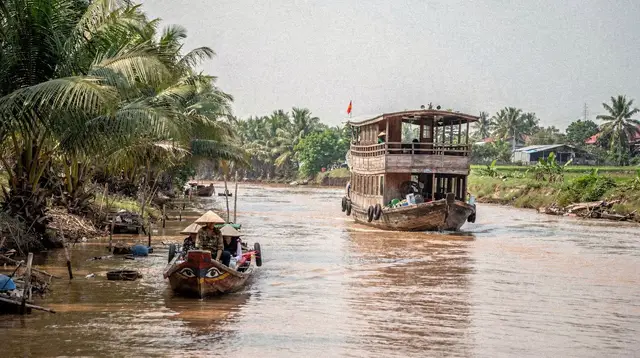
Because Cai Be functions as a wholesale exchange rather than a retail bazaar, the boats here tend to be larger cargo vessels rather than small sampans, and what changes hands is measured in sacks and crates rather than single bunches. Traders identify what they’re carrying using the same “hanging pole” system seen at Cai Rang and elsewhere in the delta — a bamboo pole lashed upright on the bow with a sample of the cargo (a pineapple, a bundle of greens, a coil of rope) tied near the top, so buyers gliding past in other boats can see the offer without shouting across the water.
Visitors reach the market by smaller boat, usually a covered wooden vessel that threads between the moored cargo boats rather than mooring among them. Expect real commerce rather than a show staged for cameras: some mornings are busier than others, some boats have already sold out and moved on, and there is no guarantee of the wall-to-wall boat traffic that photographs of Cai Rang tend to promise. That variability is part of what makes Cai Be worth visiting on its own terms rather than as a consolation prize — it shows the ordinary rhythm of river trade rather than a curated spectacle.
A landmark near the market is Cai Be’s large Catholic cathedral, its spire visible from the water, a reminder that this stretch of the delta has a substantial Catholic community going back to French-era missionary activity — a detail that surprises visitors expecting only pagodas and temples in southern Vietnam.
Cai Be versus Cai Rang, in practical terms
| Cai Be | Cai Rang | |
|---|---|---|
| Province | Tien Giang | Can Tho |
| --- | --- | --- |
| Scale | Smaller, wholesale-focused | The delta’s largest floating market |
| --- | --- | --- |
| Typical visitor experience | Quieter, fewer other tour boats | Busier, often visited at sunrise from Can Tho |
| --- | --- | --- |
| Usual approach | Half-day add-on from Ho Chi Minh City or Vinh Long | Often an overnight stay in Can Tho, or an early departure from My Tho |
| --- | --- | --- |
| Nearby land attractions | Orchards, brick kilns, coconut-candy workshops around Cai Be and Vinh Long | Can Tho city, Cai Rang itself, wider access to Chau Doc and the Cambodian border area |
Neither market is “better” in an absolute sense. Cai Rang rewards travellers who want the classic, widely shared image of the Mekong and don’t mind sharing the water with other tour boats. Cai Be rewards those who’d rather see a smaller, less curated slice of the same trade, usually as one stop in a longer day around Tien Giang and Vinh Long rather than the reason for the whole trip.
Getting to Cai Be
Cai Be lies on the Mekong’s northern arm, reached from Ho Chi Minh City by road through My Tho before turning toward the riverside town itself. Almost every visitor arrives as part of an organised route through the Mekong Delta rather than under their own steam, since the interesting part of the visit — the boat ride out to the market and on through the surrounding canals — depends on hiring a local boat, something arranged far more easily through a tour operator than negotiated independently at the dock.
Most itineraries treat Cai Be as a stop rather than a destination in itself, typically paired with a boat ride around nearby Tan Phong Island, a stop at an orchard or a workshop producing coconut candy or puffed rice, and sometimes a wider loop that continues to Vinh Long or on toward Sa Dec. That structure suits the market’s own character: because it’s a working wholesale market rather than a retail attraction built for visitors, an hour or so on the water is usually enough, with the surrounding countryside and canals filling the rest of the day.
a full-day route through Cai Be’s floating market and the orchards around Vinh Long covers this combination in a single, guided outing from Ho Chi Minh City, which removes the logistics of arranging a local boat independently.
Combining Cai Be with the rest of the delta
Because Cai Be sits close to the northern edge of the delta, it works naturally as a first stop for travellers heading further south and west — toward Sa Dec and its flower-growing villages, toward Chau Doc near the Cambodian border, or toward Can Tho and Cai Rang for travellers who want to compare the two floating markets directly in one trip. A multi-day route through several delta provinces is the more common way to see Cai Be properly rather than treating it as an isolated day trip, since the town itself has relatively little beyond the market and its immediate surroundings.
For travellers weighing up a single delta day trip against a longer route, the guide on choosing between a one-day and a multi-day Mekong itinerary lays out the trade-offs, and the piece comparing My Tho and Can Tho as departure points for the delta is useful background for deciding whether Cai Be fits better into a short outing or a longer loop.
Travellers who want to see several delta provinces without piecing the route together themselves should look at options built around a cacao farm and tasting visit further into Dong Thap province, which extends a Cai Be day into the delta’s less-visited agricultural side, or at the wider itineraries covered under multi-day Mekong cruises continuing toward Chau Doc and the Cambodian border for travellers with more time.
The general guide to choosing a departure point for the Mekong Delta also explains where Cai Be fits relative to My Tho, Ben Tre and Can Tho.
Tan Phong Island and the canals around Cai Be
Immediately opposite Cai Be town, Tan Phong Island sits low in the Mekong’s northern channel, covered in orchards reached by a network of narrow canals rather than roads. Boat trips from Cai Be typically continue here after the market, gliding under a canopy of fruit trees along waterways too narrow for anything but small boats, occasionally stopping at a household growing longan, mango or dragon fruit. This canal stretch is often the part of the day visitors remember most vividly, precisely because it has nothing to do with commerce and everything to do with the delta’s ordinary domestic landscape.
a small-group tour combining the Cai Be floating market with a paddle through the Tan Phong Island canals is built specifically around this pairing, and keeps the group size limited so the narrower canals don’t feel congested with other tour boats.
Village life beyond the market
Away from the water, Cai Be district is dotted with family workshops that have supplied the delta’s markets for generations — puffed rice, coconut candy, rice paper and traditional sweets made largely by hand, often in open-sided sheds where visitors can watch the process rather than simply buy the result. These stops complement the market well: where the floating market shows trade in motion, the village workshops show where a good part of that produce is headed next.
a village-focused day trip that pairs Cai Be with hands-on stops in the surrounding countryside leans into this side of the district, spending more time in workshops and homes than on the water itself, which suits travellers who found the market interesting but want to understand the wider community around it.
Cai Be’s floating market, questioned
Is the Cai Be floating market the same as Cai Rang?
No. They are two distinct floating markets in two different provinces of the Mekong Delta. Cai Be is in Tien Giang province, on the Mekong’s northern arm; Cai Rang trades near Can Tho, further south and considerably larger. Visitors sometimes assume a mention of “the floating market” refers to whichever one they’ve seen photographed online, which is almost always Cai Rang.
Which floating market should I visit, Cai Be or Cai Rang?
It depends on what you want from the visit. Cai Be suits travellers who prefer a quieter, less touristed market and who are already routing through Tien Giang or Vinh Long. Cai Rang suits those who want the delta’s largest floating market and don’t mind more company on the water, and it pairs naturally with a stay in Can Tho.
Can I combine Cai Be and Cai Rang in one trip?
Yes, on a longer route through the delta that travels from Tien Giang province toward Can Tho, visiting Cai Be earlier in the trip and Cai Rang closer to Can Tho. Trying to fit both into a single day from Ho Chi Minh City makes for a very full itinerary, so most travellers who want to see both build it into a multi-day Mekong route instead.
Is the Cai Be floating market touristy?
Less so than Cai Rang. Cai Be still functions primarily as a wholesale exchange point for cargo boats moving produce along the Mekong, and tour boats share the water with that working traffic rather than replacing it. Don’t expect a market built for visitors, with stalls and souvenirs; expect to watch genuine river commerce from a respectful distance.
What else is there to do around Cai Be besides the market?
The main draws beyond the market itself are the canals and orchards of nearby Tan Phong Island, reached by smaller boat, and the family workshops in Cai Be district producing coconut candy, puffed rice and other traditional foods. Most day trips combine two or three of these stops rather than visiting the market alone.
How do I get to Cai Be from Ho Chi Minh City?
Cai Be is reached by road through My Tho, continuing further along the Mekong’s northern arm, and almost all visitors arrange the trip through an organised tour rather than travelling independently, since the boat portion of the visit depends on hiring a local vessel that’s far easier to book in advance through an operator.
Does Cai Be have its own hotels, or is it a day-trip stop?
Cai Be is overwhelmingly visited as a day-trip stop rather than an overnight base. Travellers wanting to stay overnight in this part of the delta more commonly choose Vinh Long or continue toward Can Tho, using Cai Be as a stop along the way rather than a place to spend the night.
Is Cai Be part of the same province as Can Tho?
No. Cai Be sits in Tien Giang province, in the northern part of the Mekong Delta, while Can Tho — home to the Cai Rang floating market — is its own city further south. Vietnam’s July 2025 provincial merger changed some province boundaries and names across the country, but it did not rename either place, so Cai Be and Can Tho remain clearly separate points on any Mekong Delta map.