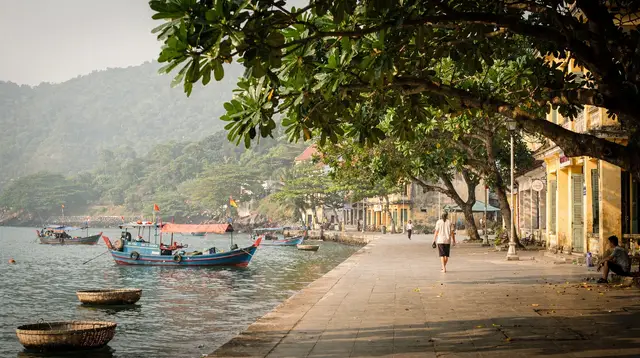
A different kind of beach coast
Ask about a beach near Ho Chi Minh City and most people say Vung Tau without a second thought. Ho Tram sits further along the same coast, and the two names get mentioned in the same breath so often that travellers arrive expecting a smaller, quieter version of the same place. It isn’t. Vung Tau is a working seaside city, dense and walkable, with a promenade, markets and a hillside statue watching over the bay.
Ho Tram is something else entirely: a long, low-density run of coast where a handful of large resort complexes face the sea, spaced apart by open ground, fishing hamlets and not much else. There is no strip to wander after dinner, no cluster of seafood stalls to graze through, no compact centre at all. What Ho Tram offers instead is space — a resort with its own pool, its own stretch of sand and its own rhythm, largely disconnected from whatever the resort next door is doing.
That difference matters more than the shared region on a map suggests. A trip built around Vung Tau is a trip built around a town: you walk, you eat where the crowd eats, you leave whenever you’ve had enough. A trip built around Ho Tram is a trip built around a resort: you settle in, you use the grounds you’ve paid for, and the wider coast stays mostly in the background.
Neither is better outright, but conflating them leads to disappointment in both directions — travellers who expect Ho Tram’s calm and get Vung Tau’s crowds, or travellers who expect Vung Tau’s buzz and find Ho Tram’s resorts quiet to the point of empty. For a broader look at how the whole southern coast breaks down, the comparison of beaches near Saigon is the better starting point than this page; what follows is Ho Tram on its own terms.
Where Ho Tram sits, and why it feels remote
Ho Tram lies on the coast east of Vung Tau, on the way toward Ho Chi Minh City’s wider south-eastern hinterland rather than tucked into a bay the way Vung Tau is. The road out from the city runs past Long Thanh and down toward the sea, and the last stretch into Ho Tram thins out noticeably: fewer roadside shops, more open land, longer gaps between settlements. That approach sets the tone. Arriving in Vung Tau, the traffic and the seafront hotels announce a city. Arriving in Ho Tram, the resort gates announce themselves one at a time, often with long fences and planted grounds between them, because each property was built on a scale that assumes guests won’t be leaving much.
This is also why Ho Tram rarely works as a bolt-on to a Vung Tau day trip in the way some itineraries suggest. The two aren’t neighbouring blocks of the same seafront; they’re a meaningful drive apart, and Ho Tram’s whole appeal — quiet, private, self-contained — evaporates if the plan is to rush in, see something, and rush back out. It rewards arriving with nowhere else to be that day, which is a different traveller than the one plotting a quick coastal escape from the city.
What the resorts actually offer
The resorts along Ho Tram were built with long stretches of beachfront and generous grounds, and that scale is the point. Expect large pool complexes, private or semi-private beach frontage, spa facilities, and enough on-site dining that guests can comfortably go a full stay without leaving the property. Some of the developments include golf courses inland from the beach, drawing a golfing crowd that treats the coast as a base rather than the main event. None of this comes with the kind of street life that makes an evening in Vung Tau or the food lanes of District 4 enjoyable to wander; Ho Tram’s evenings happen within the resort, by design.
For travellers who want a change of pace from a pool afternoon, the coast does have one dedicated attraction worth knowing about: a Polynesian-themed water park sits alongside the resort strip, aimed squarely at families and anyone wanting a livelier few hours than a sunbed offers.
a ticket to the Polynesian-themed water park on the Ho Tram coastBeyond the resorts and the water park, Ho Tram’s older identity as a fishing coast is still visible if you look for it — modest fishing hamlets sit between the developments, a reminder that this stretch of shoreline was quiet long before the resorts arrived and will likely stay quiet around them. It isn’t sightseeing territory, though, and treating it that way sets the wrong expectation; the appeal here is the absence of things to do, not a hidden list of them.
Ho Tram versus Vung Tau, side by side
| Ho Tram | Vung Tau | |
|---|---|---|
| Character | Isolated resort complexes | Compact, busy seaside city |
| --- | --- | --- |
| Layout | Spread out, car-dependent | Walkable centre and promenade |
| --- | --- | --- |
| Typical trip | Overnight or multi-night stay | Straightforward day trip from the city |
| --- | --- | --- |
| Evenings | Resort dining and facilities | Waterfront restaurants, street life |
| --- | --- | --- |
| Best suited to | Couples, golfers, resort-focused families | Day-trippers, groups wanting variety |
| --- | --- | --- |
| Signature sight | Resort beachfront, water park | Hilltop Christ statue, seafront promenade |
The table is a starting point, not the final word — for the fuller picture of how these two fit alongside Ho Chi Minh City’s other coastal options, including Long Hai and the deep-water port area near Phu My, the dedicated comparison of beaches near Saigon covers the full set.
Getting there and getting around
The route to Ho Tram runs by road out of Ho Chi Minh City, the same way nearly every coastal or delta trip from the city does — there’s no rail or ferry option here, unlike the flight-or-boat-only access to Con Dao further offshore. Most visitors arrive by private car, a booked transfer, or as part of a resort’s own shuttle service, since public transport options thin out considerably once the main highway ends and the coastal road begins. Once inside a resort, expect to rely on the property’s own shuttles or a car to reach anything outside the gates; walking between resorts is possible in principle but rarely practical given the distances and the lack of a continuous footpath or seafront promenade like Vung Tau’s.
Anyone weighing whether to base a trip near Cu Chi and the war-history sites inland, or to add a beach stretch to a longer south-east itinerary, should note that Ho Tram sits well apart from that circuit; combining the two into one day is not realistic, and treating them as separate legs of a trip works far better than trying to force them together.
a countryside and war-history excursion out of Vung Tau, for a change of pace from the resort coastWho Ho Tram suits, and who it doesn’t
Ho Tram is a strong fit for travellers who already know they want a resort stay and simply need a coastline to attach it to — couples on a slower leg of a longer Vietnam trip, golfers building a round or two into a beach break, and families who’d rather settle into one property’s pool and kids’ facilities than manage a day of sightseeing logistics. It is a poor fit for anyone hoping to combine a beach afternoon with a town to explore afterward, or for a traveller with only a single free day who wants to see as much of the coast as possible; that traveller is better served by Vung Tau, where the promenade, the markets and the hilltop statue are all within a short taxi ride of each other.
It’s also worth being honest about scale: Ho Tram’s resorts are built for guests who plan to stay put, and a visit that treats the area as a quick stop between other stops tends to feel oddly empty, because the coast was never designed around passing visitors in the first place.
a countryside farm-and-chocolate day out inland from the coastFor a Saigon-based traveller who wants to sample both, the honest approach is to plan them as two different trips rather than one combined itinerary: a day in Vung Tau for the city-and-seafront experience, and a separate overnight or multi-night stay in Ho Tram when the goal is genuinely to switch off. Trying to squeeze both into a single outing usually shortchanges whichever one comes second.
Pairing Ho Tram with the rest of a Saigon trip
Because Ho Tram doesn’t lend itself to a rushed visit, it tends to work best as a deliberate add-on to a longer stay in the region rather than a spontaneous side trip. Travellers spending several days around Ho Chi Minh City sometimes bookend their city time with a resort stretch on this coast, using it as a decompression stop before flying home rather than a stop along the way to somewhere else. Others fold it into a wider coastal loop that also touches Vung Tau and the quieter sands further along at Ho Tram itself and Long Hai, treating the whole stretch as one relaxed week rather than a single day’s errand.
Before spending a full day in the city itself, it’s worth pairing a coastal stay with some of the food and street-level experiences Ho Chi Minh City does best, since Ho Tram’s resorts don’t attempt to replicate that side of a Vietnam trip.
a private street-food walking tour back in the cityFrequently asked questions about Ho Tram beach
Is Ho Tram the same kind of trip as Vung Tau?
No. Vung Tau is a busy, walkable seaside city with a long promenade and a hilltop statue, easily done as a day trip. Ho Tram is a quieter stretch of coast further east, built around a handful of large resort complexes rather than a town centre, and it suits a slower overnight stay more than a rushed day out.
Why are Ho Tram and Vung Tau so often mentioned together?
They sit on the same general stretch of coast south-east of Ho Chi Minh City and are reached along the same road, so travel planning tools and quick itineraries lump them into one line. In practice they deliver very different holidays: one is urban and social, the other is isolated and resort-bound.
Can I visit Ho Tram as a day trip from Ho Chi Minh City?
It is possible, but Ho Tram is not built for it the way Vung Tau is. There is no real town centre to wander, and most of what the coast offers here — a resort pool, a private stretch of sand, a spa afternoon — rewards staying overnight rather than arriving and leaving the same day.
Is Ho Tram a walkable town like Vung Tau?
Not really. Vung Tau has a compact centre with a seafront promenade, markets and restaurants within walking distance of each other. Ho Tram’s resorts are spread along a longer, quieter road, each largely self-contained, so a car or a resort shuttle matters more here than a pair of walking shoes.
Does Ho Tram have anything besides resorts?
Yes, though it stays low-key by design. Ho Tram’s fishing-village roots are still visible away from the resort strip, and a themed water park sits alongside the beachfront hotels for a change of pace from the pool. It is a coast for winding down, not for sightseeing.
Is Ho Tram good for families?
It can be, particularly for families who want a self-contained base rather than a town to explore. Large resort grounds, calm resort beaches and a water park nearby suit younger children well; older kids and teenagers may find Vung Tau’s livelier waterfront a better match.
Should I choose Ho Tram or Vung Tau for a beach trip from Saigon?
It depends on the kind of coast you want. Vung Tau suits a shorter, sociable trip with a town to walk around; Ho Tram suits a slower, resort-based stay with fewer distractions. See the full comparison of the coast near Saigon for a side-by-side look.