Ho Chi Minh City vs Hanoi: Which One (or Both) Belongs in Your Trip
Is Ho Chi Minh City or Hanoi the capital of Vietnam?
Hanoi is the capital of Vietnam. Ho Chi Minh City, still widely called Saigon, is the country's largest city and economic centre, roughly 1,100 km to the south. They are two different cities in two different halves of the country, not two names for the same place.
The Question Behind the Question
Almost everyone who types “Ho Chi Minh City vs Hanoi” into a search bar is really asking one of two things: which city is Vietnam’s capital, or which city should get their limited time. This page is written from the south, by a site that covers only Ho Chi Minh City and the territory around it, so it will not pretend to be a Hanoi guide. What it can do is settle the confusion cleanly and help decide how to split — or not split — a trip between the two halves of the country.
Start with the fact that gets flattened in casual conversation: Hanoi is the capital of Vietnam. Ho Chi Minh City, still called Saigon by almost everyone who lives there and by most of the country besides, is Vietnam’s largest city and its economic engine, sitting on the Saigon River in the deep south. The two are not rival names for one city. They are two different cities, in two different regions, about 1,100 km apart, and each one anchors a different kind of Vietnam trip.
Capital vs Economic Capital: Why the Mix-Up Happens
The confusion is understandable. In a lot of countries the biggest city and the capital are the same place — London, Tokyo, Cairo. Vietnam split the two roles a long time ago, and the split has only become more visible since. Hanoi is the seat of government, the political capital, and the historic centre of the north, with a lineage that runs back roughly a thousand years. Ho Chi Minh City is the commercial capital: the biggest population, the densest concentration of business, manufacturing and finance, and the country’s busiest airport gateway alongside Hanoi’s.
Adding to the mix-up is the name itself. Before 1976 the southern city was called Saigon, and it is still called that constantly — on shopfronts, in conversation, in the name of the river that runs through District 1. “Ho Chi Minh City” is the official post-unification name, used in government documents, on flight boards and increasingly in daily use, but “Saigon” never went away. Neither name has ever referred to Hanoi, and travellers who arrive expecting the capital’s landmarks in Ho Chi Minh City are looking for the wrong city.
None of this is a matter of one city outranking the other. It is simply two different functions, held by two different cities, a very long way apart.
The Distance Is the Real Planning Fact
The number that matters more than any historical trivia is the distance: roughly 1,100 km separates Ho Chi Minh City from Hanoi, running the length of a country that is famously long and narrow. That is not a distance anyone covers as a side trip. It is the difference between “the south” and “the north” of Vietnam, and it explains why so many trip itineraries either commit to one region or build in a full multi-day chain — south, centre, north — rather than pretending the two cities are neighbours.
For anyone planning around Ho Chi Minh City, the practical takeaway is this: everything reachable in a day or two from the city sits to its own north-west, south-west, south-east or inland — the Mekong Delta, the Cu Chi Tunnels, the coast around Vung Tau and Mui Ne, and forest reserves like Cat Tien. Hanoi and everything around it — Ha Long Bay, Sapa, the old imperial capital of Hue further south along the coast — belongs to a separate leg of a longer trip, not a detour from the south.
What Each City Actually Offers a Traveller
Without turning into a Hanoi guide, it is worth being plain about what distinguishes the two experiences, because that is usually the real decision travellers are making.
Ho Chi Minh City is fast, dense with motorbikes, built around a colonial-era core in District 1 with landmarks like the Reunification Palace, the War Remnants Museum and the Notre-Dame Cathedral Basilica of Saigon, and it functions as the gateway to the Mekong Delta and the southern coast. It is a tropical city with two seasons rather than four, hot for essentially the entire year. A trip based here tends to combine city sightseeing with delta excursions, beach time and forest reserves, all reachable by road within a few hours.
Hanoi, by contrast, sits in a temperate-leaning north with an actual cool season, a much older urban core built around a series of lakes and a walled Old Quarter, and closer proximity to Ha Long Bay and the northern mountains. It is the natural base for a trip oriented around those northern landmarks. This site does not cover any of that in detail — no Hanoi neighbourhood breakdowns, no Old Quarter walking routes — because it exists specifically to cover the south well rather than the whole country thinly.
Splitting a Trip Between the Two
For travellers weighing a single trip that covers both cities, the honest framing is that it works better on a longer itinerary than a short one. A week is tight for one region done properly; splitting a week between Ho Chi Minh City and Hanoi usually means seeing both cities briefly and neither region in any depth, once transfer time and jet lag from the flight between them are accounted for. On a longer trip — commonly two weeks or more — a south-to-north or north-to-south route through the country, often with a stop in the centre around Hue and Hoi An, makes far more sense than treating the two big cities as a single weekend hop.
Where this site can help is entirely on the southern half of that route: how to sequence Ho Chi Minh City itself with the Mekong Delta, the coast, and the inland day trips, and how many days in southern Vietnam that combination realistically needs. Anyone building the northern half of a trip should look to a Hanoi-focused resource for the same level of detail this site gives the south.
A Quick Comparison
| Ho Chi Minh City (Saigon) | Hanoi | |
|---|---|---|
| Role | Largest city, economic centre | Capital city |
| --- | --- | --- |
| Region | South | North |
| --- | --- | --- |
| Approx. distance apart | ~1,100 km | ~1,100 km |
| --- | --- | --- |
| Climate pattern | Tropical, two seasons (dry/wet) | Four seasons, cool winter |
| --- | --- | --- |
| Gateway to | Mekong Delta, southern coast, southern highlands | Ha Long Bay, northern mountains |
| --- | --- | --- |
| Historic name | Saigon (pre-1976) | — |
| --- | --- | --- |
| Covered by this site | Yes, in full | No |
Use this table for orientation only — it is a starting point for deciding where to focus, not a ranking of one city over the other.
Building a Southern Itinerary Around Ho Chi Minh City
If the decision lands on the south, or on a south-first itinerary that leaves the north for another trip, the practical next step is sequencing. Most visitors base themselves in District 1 or nearby, spend a day or two on the city’s own sights — Ben Thanh Market, the war history sites, Cholon — and then branch out. The Cu Chi Tunnels sit north-west of the city and pair naturally with the Cao Dai Holy See in Tay Ninh.
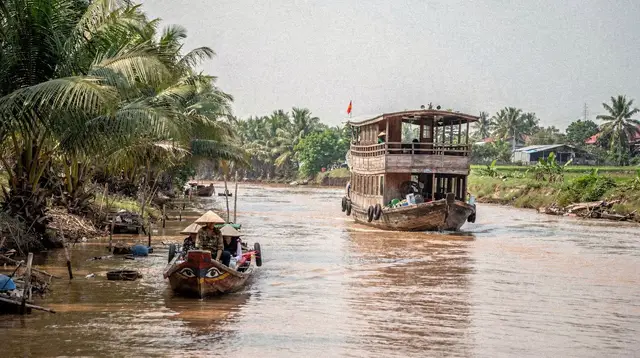
The Mekong Delta opens up to the south-west, with Can Tho and the Cai Rang floating market as the classic anchor. The coast and islands sit to the south-east around Vung Tau and Con Dao, and the dunes of Mui Ne lie along the coast to the north-east — a different direction from the delta, despite the two being regularly confused.
A guided city overview is a common way to get oriented on arrival: a half-day city tour covering the main District 1 landmarks works well on day one before branching into delta or coastal excursions. Travellers who prefer to move at their own pace across several sites in one day often look at a car and driver hired for the day rather than juggling separate bookings.
For the Mekong Delta specifically, the standard building blocks are a single intensive day or an overnight: a two-day private Mekong Delta tour covers more ground than a single day allows, while travellers combining the delta with the tunnels in one multi-day loop often choose a combined Cu Chi Tunnels and Mekong Delta multi-day tour.
None of this touches Hanoi, and it shouldn’t — see planning a trip across the city, the delta and the coast for the fuller version of a southern-only itinerary, or the Ho Chi Minh City itineraries hub for ready-made day-by-day plans of varying length.
Practical Notes for Whichever City You Land In
A few things are worth flagging regardless of which city ends up as base. Vietnam’s e-visa and visa-exemption rules depend on nationality and change over time, so check the visa guide or the official immigration portal rather than assuming a rule from a previous trip still holds.
Vietnam runs on a single time zone, UTC+7, with no daylight saving, so at least that part of planning is identical whichever city is the base. Tet, the lunar new year, falls on a different date each year between late January and mid-February and disrupts transport and business hours nationwide — in both cities, not just one — so checking the year’s exact dates before booking either leg of a trip is worth the five minutes it takes.
Where to stay, how to get around, and what neighbourhood suits a particular travel style are all questions this site answers only for the southern city; see where to stay in Saigon by neighborhood and getting around Saigon for that side of the planning.
Ho Chi Minh City vs Hanoi: Frequently Asked Questions About Choosing Between Them
Is Ho Chi Minh City or Hanoi the capital of Vietnam?
Hanoi is the capital. Ho Chi Minh City is the largest city and economic centre, about 1,100 km south of Hanoi. The mix-up is common because Ho Chi Minh City is bigger and more visible internationally, but administratively it is Hanoi that holds the capital function.
Is Saigon the same place as Ho Chi Minh City?
Yes. Saigon was the city’s name before 1976 and is still used constantly in everyday speech, especially for the central districts. Ho Chi Minh City is the official name. Neither name refers to Hanoi.
Can I visit both Ho Chi Minh City and Hanoi on the same short trip?
It is possible but the distance is real: roughly 1,100 km separates the two, far beyond a day trip, and each city opens onto a different region. A short trip is usually better spent going deep in one half of the country, north or south, rather than splitting a week between both.
Which city is better for first-time visitors to Vietnam?
Neither is objectively better; they answer different questions. Ho Chi Minh City suits a trip built around the Mekong Delta, the southern coast and a fast-paced, business-driven city. Hanoi suits a trip built around the north, Ha Long Bay and the old imperial and colonial core. The choice depends on what else is on the itinerary.
Does this site cover Hanoi and northern Vietnam?
No. This site covers Ho Chi Minh City and the south exclusively: the city itself, the Mekong Delta, the southern coast and islands, and the inland forests and highlands that sit within a day or two of the city. Hanoi and the north fall entirely outside its scope.
Is the weather different between Ho Chi Minh City and Hanoi?
Very different. Ho Chi Minh City has a tropical climate with two seasons, dry roughly from December to April and wet from May to November, and stays hot year-round. Hanoi has four seasons, including a genuinely cool, sometimes chilly winter, because it sits far to the north.
If I only have one week, should I pick the south or the north?
Pick one and go deep rather than spending the week in transit between the two. Southern Vietnam alone comfortably fills a week once the Mekong Delta, the coast and the city itself are included, and skipping the long transfer leaves more time on the ground.
Tour Comparisons
Verified deep-linked GetYourGuide tours. Book through these links and we earn a small commission at no cost to you.
GetYourGuide does not provide a product photo for this activity — the image shows the meeting point, photographed by us.