Wet Market Tasting Tour: Tropical Fruit and Street Snacks in Saigon
What is a wet market tasting tour in Ho Chi Minh City?
It is a guided walk through covered and neighborhood wet markets where fresh produce, tropical fruit and stall-cooked snacks are sampled on the spot, rather than eaten at a sit-down restaurant. It focuses on everyday local markets, not the souvenir stalls of Ben Thanh Market.
Tasting the Markets Locals Actually Shop At
Ho Chi Minh City has no shortage of food experiences built around sitting down at a restaurant table, but a wet market tasting tour is a different kind of morning. Instead of a menu, there is a covered hall or a stretch of neighborhood street lined with vendors selling what a household needs that day: leafy greens still wet from the wash, fish and shellfish laid out on ice, mountains of tropical fruit, and small stalls cooking snacks to order for anyone passing by. The point is not to buy souvenirs. It is to eat standing up, plate in hand, in the middle of a market that has nothing staged about it.
This is also where the confusion usually starts. Visitors hear “market” and think of Ben Thanh Market in the heart of District 1, with its landmark clock tower and rows of stalls selling clothing, lacquerware, coffee and gifts. Ben Thanh is worth a visit, but it has become primarily a market for visitors, and its food section is more food court than working kitchen.
A wet market tasting tour goes elsewhere: to the markets where the produce is fresher, the prices are set for neighbors rather than tourists, and nobody is trying to sell a magnet. If shopping for souvenirs is the goal, Ben Thanh is the right stop. If tasting real, everyday southern Vietnamese food in its natural setting is the goal, a wet market is the better answer.
What a Wet Market Actually Looks Like
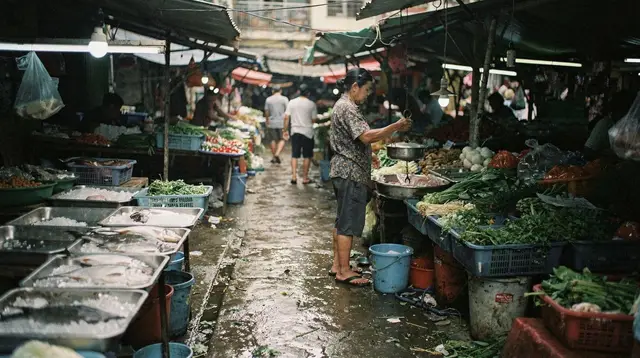
A wet market gets its name from the constant washing down of floors and stalls, needed because so much of what is sold is fresh: fish kept alive or on ice, produce sprayed to stay crisp, meat cut to order. Most wet markets in Ho Chi Minh City occupy a covered hall with narrow aisles, though plenty of trading also spills onto the surrounding streets, where cooked-food stalls tend to cluster. The atmosphere is loud, fast and unmistakably local — vendors calling out prices, motorbikes threading through the edges, and very little English spoken away from the main tourist districts.
For a first-time visitor, the layout can feel disorienting: produce here, meat and seafood there, a corridor of prepared snacks somewhere else, with no signage in English to guide the way. This is exactly where a guide earns their keep, steering toward stalls worth trying and explaining what is actually being cooked, since many market snacks have no direct equivalent outside Vietnam and are easy to walk past without recognizing.
Cholon: The Classic Ground for a Market Tasting Tour
Cholon, the historic Chinatown spread across District 5 and District 6, is where most wet market tasting tours spend their core time. It is one of the oldest and busiest commercial districts in the city, shaped by generations of Chinese-Vietnamese trade, and its markets reflect that layered food culture: southern Vietnamese staples sitting alongside Chinese-influenced snacks, herbal shops, and dried goods stalls that have operated for decades. Cholon’s covered markets and street stalls reward slow walking rather than a fixed itinerary, and a guide who knows the area can move between a produce hall, a noodle stall and a dessert vendor without doubling back.
Cholon also connects naturally to some of the district’s other landmarks, including Binh Tay Market and Thien Hau Temple, so a market tasting stop is often paired with a short walk past the area’s temples and older shopfronts. Anyone building a longer day around the neighborhood can pair this with a broader Cholon neighborhood guide for context on the district’s layout and history.
Beyond Cholon: Neighborhood Markets Worth Knowing
Cholon is not the only option. District 1 itself has working neighborhood markets away from its tourist core, serving residents of the surrounding streets rather than visitors, and these can be folded into a broader District 1 walking food tour that treats the market as one stop among several.
District 4, known citywide for its dense, after-dark street-food lanes, leans more toward cooked stalls than raw produce, which makes it a slightly different experience from a classic wet market but a natural complement to one. District 3, with its quieter villa streets and coffee shops, has smaller markets that see fewer visitors and can feel more relaxed for a first attempt at market food.
Choosing between these comes down to pace and appetite: Cholon rewards a longer, more immersive walk, while a District 1 or District 3 market suits someone who wants a shorter, more contained introduction before moving on to other sightseeing that day.
What Gets Tasted
The exact stalls a guide chooses will vary with the season and with what looks freshest that morning, but a few categories come up again and again on a market tasting route.
Tropical fruit is a centerpiece almost everywhere: fruit is often cut and served on the spot, letting a first-time visitor try several varieties without committing to a whole piece. Southern Vietnam’s warm, humid climate keeps a wide range of fruit in near-constant supply, and a guide can usually point out what is in season versus what has been shipped in.
Rice-based snacks are another staple of market stalls: sticky rice dishes, rice-flour cakes, and small savory bites wrapped in leaves, most of them designed to be eaten quickly while standing. Grilled and steamed items cooked over small charcoal or gas burners right at the stall are common too, and watching them prepared is often as much a part of the experience as eating them.
Herbs and greens used throughout southern Vietnamese cooking are worth a slow look even for visitors who are not buying anything — the sheer variety on display says a lot about how central fresh herbs are to the region’s food, in a way a restaurant plate alone does not always convey. And sweet drinks and desserts sold by the glass, broadly grouped under the name che, are typically available from at least one stall in any market and make a natural way to end a tasting route.
A market tasting tour intentionally avoids the sit-down restaurant format used by more conventional food tours. If a linked-together, multi-stop evening built around cooked stalls and sit-down bites is more appealing, a broader street food tour of the district covers that ground, and travelers avoiding meat can look at a dedicated vegetarian street food tour built around plant-based stalls specifically.
Guided Versus Independent
Wet markets are open to the public and free to walk through, so nothing stops an independent visitor from wandering in unguided. The trade-off is language and confidence: vendors in neighborhood markets speak far less English than staff in central tourist restaurants, dishes are rarely labeled, and it is easy to miss the stalls actually worth trying while feeling uncertain about hygiene standards elsewhere. A guide solves all three problems at once — translating, recommending, and steering toward stalls with visibly high turnover, which is one of the more reliable signals of freshness in a market setting.
| Approach | Best for | Trade-off |
|---|---|---|
| Guided market tasting tour | First-time visitors, language help, food recommendations | Less flexible timing, group or shared pace |
| --- | --- | --- |
| Independent market walk | Confident travelers, flexible schedule | No translation, easy to miss the best stalls |
| --- | --- | --- |
| Combined with a broader food tour | Visitors who also want cooked, sit-down stops | Longer overall time commitment |
Binh Tay Market: Cholon’s Wholesale Heart
Within Cholon, one market comes up more than any other when people talk about wet market tasting: Binh Tay Market. It functions as much as a wholesale hub for the surrounding region as a retail market for local shoppers, with traders moving produce, dried goods and household staples in bulk alongside the everyday fruit and vegetable stalls that a visitor actually tastes from. That dual identity — part neighborhood market, part regional wholesale point — is part of what makes it feel busier and more layered than a smaller District 1 or District 3 market.
For travelers who want to go a step further than tasting and actually learn to cook with what the market sells, a combined outing that pairs the market with a hands-on kitchen session is worth considering: a visit to Binh Tay’s wholesale fruit market followed by a cozy cooking class turns the ingredients seen on the tables into a finished dish rather than just a snack eaten standing up. Anyone who enjoys that format can also look at a dedicated Vietnamese cooking class in Saigon that goes deeper into technique beyond a single market stop.
More Guided Options for Market and Street Food Tasting
Because “market tasting” and “street food tour” overlap so much in practice, several tours marketed as street food experiences spend real time in or around wet markets even though the market itself is not the headline. A local street food and sightseeing tour by motorbike is one option that blends market stops with a broader look at the city, while a street food discovery tour built as a local culinary journey leans further into the tasting side of the experience.
Travelers who prefer a smaller, more personal group can also consider a hidden-alleys street food tour led by local students, which tends to reach quieter corners that larger group tours skip. Anyone weighing these against a two-wheeled itinerary can also read up on a general motorbike food crawl tour format before choosing a specific operator.
Timing a Market Visit: Time of Day and Time of Year
Time of day matters as much as which market is chosen. Most of the produce, fish and prepared snacks described above move fastest in the morning, when stock is freshest and stalls are at their busiest, and a market visit built around breakfast or an early lunch tends to see the widest range of what is on offer. By late afternoon, some stalls have sold out or packed up, and the atmosphere shifts toward the cooked-food side of the market rather than the raw produce.
Time of year plays a smaller but real role too. Southern Vietnam’s dry season tends to mean easier walking between market sections and less risk of a sudden downpour turning aisles slick, while the rainy season can bring short, heavy showers that make covered market halls a natural place to wait things out. Neither season rules out a market visit, but travelers planning the rest of their Ho Chi Minh City trip around the weather can factor a market morning in either way, since most of the experience happens under cover.
Booking a Related Market or Food Experience
Several bookable tours touch on markets and tasting in different parts of southern Vietnam, and it helps to know how they differ before choosing one. For a Saigon-based market and food outing, a scooter-based floating market and food tasting tour around Ho Chi Minh City pairs market food with a different mode of getting around the city. Travelers who want a foodie-focused market walk closer to the city center can look at a Saigon foodie market tour that also includes a free eSIM, a practical bonus for anyone who has not yet sorted out mobile data.
It is worth being clear that “floating market” tours are a separate category from the wet market tasting experience described on this page: floating markets trade from boats on the water, mostly in the Mekong Delta, not from stalls in a city market hall. For travelers extending their trip toward Can Tho or Cai Rang, a half-day outing to the Cai Rang floating market or a floating market and nature reserve tour around Can Tho covers that different but related experience.
Near Cai Be and Vinh Long, a tour combining the Tan Phong floating market with a visit to Vinh Trang Pagoda works well as part of a longer Mekong Delta day.
Practical Notes for a Market Visit
A few habits make a market tasting outing smoother regardless of which neighborhood is chosen. Cash is essential — small stalls in wet markets do not take cards, and having smaller denominations on hand avoids awkward change for low-cost snacks. Comfortable, closed shoes are worth wearing, since market floors are frequently wet and can be uneven. Mornings tend to bring the freshest produce and the liveliest atmosphere, since much of what is sold is meant to move quickly before the day’s heat sets in.
On food safety, the same general rule that applies across street food in Ho Chi Minh City applies inside a market: favor stalls with visible turnover and food cooked fresh in front of you, avoid anything that has clearly been sitting out, and stick to bottled or filtered water rather than tap water. Anyone with dietary restrictions should mention them to a guide early, since market snacks are not labeled and ingredients are not always obvious from appearance alone.
For a wider view of what to try across the region, an overview of iconic southern Vietnamese dishes is a useful companion, and travelers keeping half an eye on bags and phones in a crowded market should keep the general advice on common scams and petty theft in the city in mind, since crowded market aisles are exactly the kind of setting where a bag left unzipped becomes a problem.
Where This Fits in a Broader Saigon Food Itinerary
A wet market tasting stop works well as a self-contained morning activity, but it also slots naturally into a longer day built around food. Pairing it with a walk through Cholon’s pagodas, a stop for banh mi, or a coffee break exploring the city’s Vietnamese coffee culture turns a single market visit into a fuller picture of how the city eats. Travelers who prefer their food exploration on two wheels can also fold a market stop into an evening Vespa tour that covers cooked stalls after dark, once the wet markets themselves have closed for the day.
Whichever combination fits the day, the core distinction is worth remembering: Ben Thanh Market is where to go for gifts and souvenirs, and a neighborhood wet market — most reliably in Cholon — is where to go to taste Ho Chi Minh City the way its own residents do.
Street Food Tours and Vietnamese Cuisine Tastings
Verified deep-linked GetYourGuide tours. Book through these links and we earn a small commission at no cost to you.
GetYourGuide does not provide a product photo for this activity — the image shows the meeting point, photographed by us.