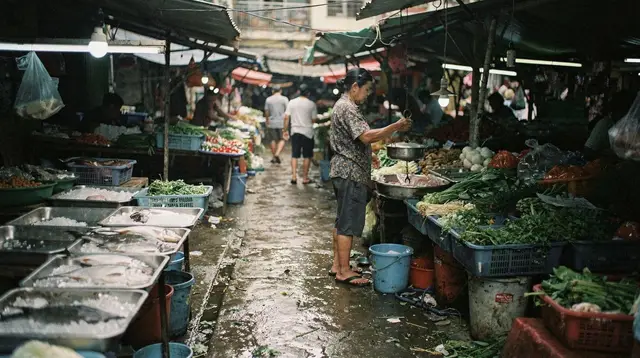
The Motorbike Food Crawl: Riding the Route Between Saigon's Kitchens
What is a motorbike food crawl in Ho Chi Minh City, and how is it different from a street food tour?
It is a guided ride that links several eating stops across different districts, with the riding itself as much a part of the experience as the food. A street food tour on foot or with short hops focuses on tasting; a motorbike crawl focuses on covering ground, reading traffic and moving between neighborhoods that would otherwise be too far apart to link on the same outing.
Why the Ride Is the Point, Not Just the Transport
A lot of visitors hear “motorbike food tour” and picture a string of dishes with a bike thrown in to get between them. That is not quite what a motorbike food crawl is. On this kind of outing, the riding is not a gap between stops — it is the experience. The pace of the ride, the choice of roads, the way a rider threads through a junction or slows for a lane of parked scooters: all of that is as much a part of the evening as what ends up on the plate.
This page is about that side of it — the route, the neighborhoods it strings together, and how a rider or guide actually gets a small group across Ho Chi Minh City after dark. For a page that goes deep on the dishes themselves, the motorbike street food tour in the evening covers that ground; here the focus stays on movement, not menus.
It is worth being direct about the distinction because the two get mixed up constantly. A walking or short-hop street food tour treats the food as the itinerary and the movement between stops as incidental. A motorbike food crawl flips that: the ride connects neighborhoods that would be inconvenient or slow to link any other way, and the food stops mark the rhythm of the ride rather than the other way around. If reading about ingredients and regional dishes is the goal, this is the wrong page. If the appeal is riding pillion through Saigon after dark, watching the city change character street by street, this is the one.
Reading the City From the Back of a Bike
Ho Chi Minh City is still commonly called Saigon, especially in reference to its central districts, and a motorbike crawl is one of the more direct ways to feel why the city earns that density of nicknames. Riding through it is not like riding through most other cities: the traffic does not stop and start in discrete bursts, it flows, and a rider who has spent years on these streets reads that flow the way a sailor reads current. Passengers notice this almost immediately — the bike rarely comes to a full stop at a junction with no signal; it simply merges into whatever is already moving.
That reading of traffic is the actual skill being demonstrated on a crawl like this. A guide or driver is choosing, moment to moment, between a wider road with more space but faster cross-traffic, and a narrower lane with tighter turns but a steadier pace. Over the course of an evening, a route generally favors the narrower, steadier option more often than not, because a food crawl is not trying to cover distance quickly — it is trying to move a small convoy of bikes safely and comfortably between a handful of eating points without breaking the rhythm each time.
District 1: Where Most Routes Begin
Most motorbike food crawls start somewhere in or near District 1, simply because that is where most visitors are staying and where evening energy is highest. Riding out of the center after dark has its own character — the Nguyen Hue walking street and the area around Ben Thanh Market are busy with pedestrians as well as vehicles, so early legs of a route tend to move at a careful, almost deliberate pace, weaving around foot traffic before the roads open up.
From there, routes typically fan outward rather than staying inside the center. Riding away from District 1 usually means picking up one of the roads that run parallel to the river or cutting through to Vo Van Kiet or similar corridors that carry heavier traffic but offer wider lanes — useful for covering ground quickly between the first and second stops of an evening, before the route tightens up again as it approaches denser residential lanes.
Crossing Into District 3 and District 4
A route that includes District 3 usually feels like a change of pace almost immediately. The wide, tree-lined streets and old villa architecture make for slower, more relaxed riding than the center, and it is a common choice for a route to slot in a quieter leg here between two busier stretches elsewhere. Traffic thins out compared to District 1, and a rider can hold a steadier line rather than constantly adjusting for cross-traffic.
District 4 is a different proposition. It sits just across a narrow channel from District 1 but feels like an entirely separate world once inside it — a warren of narrow lanes, low buildings and dense evening activity. Riding here means slowing right down; the alleys are not built for speed, and a guide navigating them is relying on familiarity rather than any signage. This is often the leg of a route where passengers feel most clearly that they are being taken somewhere they would never find or navigate alone, which is a large part of the appeal of doing this by motorbike with a local rider rather than on foot with a map.
Crossing the River: Binh Thanh and Thao Dien
Routes that extend across the Saigon River into Binh Thanh or on toward Thao Dien in Thu Duc City involve a genuinely different kind of riding. Crossing one of the bridges over the Saigon River means a stretch of faster, more open road, often the fastest sustained riding of the whole evening, before the route slows again once it reaches the smaller streets on the far side.
This side of the river has a noticeably different feel from the center — newer buildings, quieter side streets, and less of the shoulder-to-shoulder motorbike density that defines District 1. A guide leading a crawl out this way is usually doing so deliberately, to give a route contrast: a loud, dense first half in the old center, followed by a calmer, more spread-out second half across the river. Not every route makes this crossing, since it adds a meaningful stretch of riding time, but when it does, it tends to be one of the more memorable legs simply because of how different the riding feels.
Cholon: A Route Through a Different Rhythm
Some crawls route through or near Cholon, the historic Chinese quarter spread across District 5 and District 6. Riding here has its own texture again — older shopfronts, narrower colonial-era streets, and a different density of foot and vehicle traffic than either the center or the areas across the river. A route that includes Cholon is usually built around it as a distinct chapter of the evening rather than a quick pass-through, since the neighborhood rewards a slower pace and a rider willing to take smaller lanes rather than the main roads that skirt its edges.
How a Guide Sequences the Ride
The logic behind sequencing a route is rarely about geographic efficiency alone. A good guide is thinking about traffic density at different points in the evening, about giving a group a mix of fast and slow legs so the ride does not feel monotonous, and about arriving at each stop at a point in the night when that particular street or lane has its own character. Riding style shifts constantly through an evening like this: assertive and close in the densest parts of the center, unhurried and observant in a quiet residential lane, briefly fast and open on a river crossing.
Group size affects this too. A convoy of several bikes riding together has to move differently than a single rider — sticking closer together through junctions, regrouping at set points, and generally favoring roads wide enough to keep the group from getting split up by a light or a gap in traffic. This is one of the quieter reasons a guided crawl works better than trying to replicate the same evening independently: a guide is managing the group’s movement through the city, not just picking destinations.
What This Page Deliberately Leaves Out
This page does not cover how many stops a given route includes, how long a crawl runs, or what it costs — those details vary by operator and by night, and are better confirmed directly when booking rather than fixed here. It is also not a guide to the food itself; that ground belongs to the evening street food tour pages, which go into the dishes, the ingredients and what to expect on the plate rather than on the road. If the plan is to understand how a route through the city actually moves — the roads chosen, the neighborhoods linked, the way riding style shifts from one district to the next — that is what this page has focused on.
Choosing Between a Motorbike Crawl and Other Ways to Ride
Saigon offers several distinct ways to see the city from two wheels, and a food-focused crawl is only one of them. A full-day motorbike tour with a driver covers far more ground during daylight and is built around sightseeing rather than eating stops. An evening vespa tour shares the after-dark timing and the passenger-seat experience but is often styled around atmosphere and photo stops rather than a sequence of food.
A hidden Saigon motorbike tour tends to prioritize back streets and lesser-known corners over any particular theme. For those weighing whether to ride pillion or handle a bike independently, the comparison of self-drive versus chauffeured motorbike riding lays out the tradeoffs plainly, and travelers curious about an older-style option can look at sidecar tours around Saigon, which move at a different pace again.
One practical route option worth booking directly:
a guided city motorbike ride through Saigon’s neighborhoods after darkcovers much of the ground described above, with a local rider handling navigation through the center, across the river and into the quieter side streets.
For a route that leans further into the back lanes and less-visited pockets of the city rather than the postcard center, a motorbike route through Ho Chi Minh City’s working-class neighborhoods takes a similar riding style into different territory.
Riders who want the food itself front and center, rather than the road, are better served by an evening street food outing paired with live acoustic music, which shifts the balance back toward tasting.
Taking the Same Approach Beyond the City
The same idea — using a vehicle’s route as the backbone of an eating itinerary — extends beyond Ho Chi Minh City itself. Day trips into the Mekong Delta apply a comparable logic on water and by road: the boat or van route through orchards, canals and market towns shapes what gets tasted along the way just as a motorbike route shapes a Saigon crawl. Travelers drawn to that structure might look at a guided route through the Mekong Delta’s waterways and orchard towns or, for a slower single-destination version, a full day tour through Ben Tre’s coconut country.
Planning Around a Motorbike Food Crawl
Because this kind of outing runs in the evening and depends on group riding, it tends to sit well alongside a walking food tour done earlier in a trip, giving a visitor two very different ways to experience the city’s food scene — one on foot and slow, one on two wheels and fast. It also pairs naturally with a stay in or near District 1, simply because most operators start and end routes close to the center for convenience.
Anyone planning where to stay with an evening like this in mind can check the broader neighborhood guide to choosing a base in Saigon, and those building out a fuller schedule around a short stay might look at the one-day Ho Chi Minh City highlights itinerary for how a crawl like this can slot into an evening after a day of sightseeing.
Riding as a passenger through Saigon at night, watching a guide read the traffic and choose a lane a beat before anyone else on the road would, is a different way of understanding the city than seeing it from a car or on foot. The food stops give the ride a rhythm and a reason to keep moving, but for anyone drawn to this kind of tour, it is worth going in expecting the ride itself to be the memory that lasts.
Street Food Tours and Vietnamese Cuisine Tastings
Verified deep-linked GetYourGuide tours. Book through these links and we earn a small commission at no cost to you.
GetYourGuide does not provide a product photo for this activity — the image shows the meeting point, photographed by us.