Cholon's Pagodas: A Guide to Saigon's Chinatown Temples
What are the main pagodas to visit in Cholon, Saigon's Chinatown?
Cholon, the historic Chinese quarter spread across District 5 and District 6, holds some of Ho Chi Minh City's oldest and most active places of worship, including Thien Hau Temple, Quan Am Pagoda and several clan and community halls built by Cholon's Chinese congregations over generations. These remain working temples of daily worship and community life, not museum pieces, and reward a slow, unhurried visit rather than a quick photo stop between market stalls.
Beyond the Market: Cholon as a City of Temples
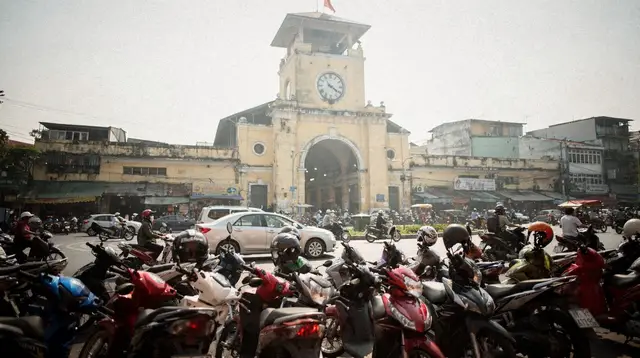
Most visitors arrive in Cholon with a single landmark in mind: the covered halls of Binh Tay Market, a few photographs of its clock tower, then back to District 1. That leaves out most of what makes Cholon one of the most historically layered districts anywhere in Ho Chi Minh City.
Cholon — spread across District 5 and District 6 — grew as a distinct Chinese trading city alongside Saigon, and the congregations who built it left behind a dense concentration of pagodas, clan halls and community temples that still function today. This page is a guide to those pagodas specifically. For the neighborhood as a whole, its streets, its market economy and where it sits relative to the rest of the city, see the dedicated Cholon neighborhood guide rather than this one.
The pagodas of Cholon are not relics kept for visitors. They are working religious buildings, tended daily, where incense coils hang from the ceiling in long spirals and worshippers arrive throughout the day to make offerings. Treating Cholon as “the market district” misses the point of what its founding communities actually built there: a network of sacred spaces that anchored Chinese-Vietnamese life in the south for well over a century.
The Chinese Congregations Behind the Pagodas
Cholon’s Chinese population did not arrive as one undifferentiated group. Families came from different regions of southern China, speaking different dialects, and organized themselves into separate congregations — often called bang — each of which typically built and maintained its own temple or assembly hall. This is part of why Cholon has so many pagodas within a compact area rather than one grand central temple: each congregation wanted its own space, dedicated to its own patron deities, serving its own community of worshippers, traders and mutual-aid members.
That structure is worth understanding before stepping into any single building, because it explains why the pagodas differ so much from one another in dedication, style and atmosphere despite standing within easy walking distance of each other. A walking tour built around District 1 covers colonial landmarks in sequence; a Cholon pagoda visit works differently, moving between separate, self-contained communities of worship rather than one continuous historical narrative.
Thien Hau Temple: Worship of the Sea Goddess
Thien Hau Temple is the pagoda most visitors encounter first, and it remains one of the most active temples in the district. It is dedicated to Thien Hau, a sea goddess widely venerated across southern Chinese coastal communities as a protector of sailors, fishermen and traders — a fitting focus of devotion for a community whose founders arrived in southern Vietnam by sea. Inside, the air is thick with incense smoke rising from enormous spiral coils suspended from the roof beams, each one typically sponsored by a family or a business as an ongoing offering.
The roofline and courtyard carry elaborate ceramic figurines depicting scenes from Chinese folklore and opera, a decorative tradition distinct from the Buddhist and Taoist iconography found in temples elsewhere in the city, such as the Jade Emperor Pagoda closer to District 1. Worshippers move through the courtyard and inner halls with a practiced, unhurried rhythm — lighting incense, placing offerings, murmuring prayers — and visitors are welcome to observe quietly from the edges without becoming part of the ceremony themselves.
Quan Am Pagoda and the Other Halls of Cholon
Quan Am Pagoda, dedicated to the bodhisattva of compassion venerated across both Vietnamese and Chinese Buddhist practice, sits a short walk from Thien Hau and offers a noticeably different atmosphere. Its layered courtyards and heavily ornamented roofline draw fewer visitors than Thien Hau, which makes it a better stop for anyone who wants to watch daily temple life unfold without a crowd of cameras nearby.
Beyond these two well-known pagodas, Cholon holds a wider scatter of clan halls and community temples, each tied to a specific congregation and often less visited by outsiders altogether. Exploring several of them in sequence gives a much richer sense of Cholon’s religious landscape than visiting a single flagship temple, since each hall reflects the particular history, dialect group and patron deities of the community that built it. Because these buildings are spread across Cholon’s grid rather than clustered on one street, a guided route — on foot or by cyclo, as covered in the Saigon cyclo tour guide — helps visitors move between them without missing the smaller, less obvious halls tucked behind shopfronts.
For travelers who want the historical framing filled in as they go rather than piecing it together afterward, a half-day guided route through the district’s temples and heritage sites removes much of the guesswork. The half-day Chinatown heritage tour moves between several of Cholon’s pagodas and historic buildings with a guide who can explain which congregation built which hall and why.
What Cholon’s Pagodas Reveal About Its History
Read together, Cholon’s pagodas tell a story that the market alone does not: a trading city built by successive waves of Chinese migration, organized around congregation, dialect and patron deity, and sustained by religious institutions that also functioned as mutual-aid networks for new arrivals. That layered history sits alongside, rather than beneath, the district’s commercial identity — Cholon was and remains a major trading hub, but its temples show that trade was never the whole story.
This pattern of sacred architecture tied to community organization has parallels elsewhere in the region. Travelers who go on to visit the Khmer pagodas of the Mekong Delta will notice a similar dynamic: temples built and maintained by a specific ethnic or linguistic community, serving as much a social function as a religious one. Cholon’s pagodas are best understood in that light — as institutions built by and for specific communities, still doing that work today, rather than as static heritage sites preserved for outside visitors.
Some of Cholon’s history is more unsettling than picturesque, and travelers curious about the district’s stranger corners — old buildings with reputations attached, funeral traditions, and local ghost stories tied to specific sites — can go further with the evening tour covering haunted buildings and a funeral pagoda, which threads a different narrative through some of the same streets after dark.
Visiting Etiquette and What to Expect Inside
Because these are active places of worship rather than converted museums, the same etiquette that applies at any Vietnamese temple applies here, arguably more strictly given how frequently local worshippers are present. Shoulders and knees should be covered. Movement inside the halls should stay quiet and unhurried, and visitors should keep a respectful distance from anyone actively praying or making an offering rather than stepping around them for a photograph. Photographing individual worshippers without asking first is generally considered intrusive, even where photographing the building itself is not an issue.
Incense smoke inside the halls can be dense, particularly near the coiled offerings suspended overhead, which is worth knowing for anyone sensitive to smoke. The temples are working buildings with caretakers present, and offerings — incense, fruit, sometimes paper items burned for ancestors — are an ordinary part of what visitors will see happening around them rather than a special ceremony staged for tourists.
Visitors who want the historical and religious context translated as they walk, rather than guessing at the significance of a carving or a shrine, tend to get more out of a guided visit. The private museums and heritage sites tour can be adapted to prioritize Cholon’s temples alongside the city’s major museums, which suits travelers who want the district folded into a broader half-day of Ho Chi Minh City’s historical landmarks.
Where the Pagodas Fit Into a Cholon Visit
Cholon rewards a visit that treats the pagodas as one layer among several rather than an isolated checklist. The district’s food scene, covered separately in the Cholon street food guide, sits within the same blocks as several of the temples, so a single outing can move naturally between a pagoda courtyard and a nearby stall without much backtracking.
Travelers building a wider itinerary around colonial-era landmarks may also want to compare Cholon’s temple architecture with the very different heritage on display around the Notre-Dame Cathedral and Central Post Office and the broader colonial architecture of Saigon, both firmly within District 1 rather than Cholon.
For a first visit to the city that includes Cholon as one stop among several, the one-day Ho Chi Minh City highlights itinerary shows how a temple visit here can sit alongside District 1’s landmarks without overloading a single day. Cholon’s own category page for temples and heritage sites and its dedicated things-to-do listing for the district are useful starting points for building out a longer visit once the pagodas above have set the historical frame.
Travelers who want to slow the pace down after a morning of temple visits often gravitate toward Cholon’s older cafés and coffee culture, a contrast covered from a different angle by the relaxed café tour, which pairs well as a lower-key follow-up to a morning spent moving between incense-filled courtyards.
Frequently Asked Questions About Cholon’s Pagodas
Is Cholon just a market, or is there more to see?
Cholon is far more than a market. It is Saigon’s historic Chinatown, a district shaped by generations of Chinese congregations who built pagodas, clan halls and community associations alongside their shops and trading houses. Binh Tay Market is one landmark among many; the pagodas are where Cholon’s older, quieter identity is most visible.
What is Thien Hau Temple dedicated to?
Thien Hau Temple is dedicated to Thien Hau, a sea goddess venerated across southern Chinese coastal communities as a protector of sailors, traders and travelers. Cholon’s congregations, many descended from families who arrived by sea, built the temple as both a place of worship and a community anchor.
What is Quan Am Pagoda known for?
Quan Am Pagoda is dedicated to Quan Am, the bodhisattva of compassion widely venerated in Vietnamese and Chinese Buddhist practice. It is known for its layered courtyards, elaborate roof ornamentation and the steady presence of worshippers rather than tour groups, which gives it a different rhythm from Cholon’s better-known stops.
Are Cholon’s pagodas still active places of worship?
Yes. Every pagoda described on this page is an active place of worship, tended by resident caretakers and visited daily by local worshippers who come to burn incense, make offerings and pray. Visitors are welcome, but the buildings function first as community temples, not tourist attractions.
What should visitors wear or do inside a Cholon pagoda?
Modest clothing that covers the shoulders and knees is appropriate, as in any active place of worship in Vietnam. Move quietly, keep a respectful distance from people who are praying or making offerings, and ask before photographing anyone inside rather than assuming it is fine.
Are the pagodas connected to a specific ethnic community?
Most of Cholon’s pagodas and halls were founded by specific Chinese congregations, often grouped by ancestral region or dialect, who used the temple as both a religious site and a mutual-aid association for newly arrived families. That layered history of distinct congregations is part of what makes Cholon different from a single generic Chinatown.
Is a guide necessary to understand what’s inside?
A guide is not strictly necessary, since the temples are open to respectful visitors, but the carvings, deities and congregation histories are not signposted in much detail on site. A local guide or a well-prepared self-guided route adds a great deal to what would otherwise be a visually striking but historically opaque stop.
How does a pagoda visit fit with the rest of a Cholon walk?
The pagodas work best as anchors on a wider Cholon walk that also takes in the market streets, herbal medicine shops and street food stalls; this page focuses on the temples themselves, while the neighborhood’s full layout and food scene are covered separately.
Temples and Heritage in Ho Chi Minh City
Verified deep-linked GetYourGuide tours. Book through these links and we earn a small commission at no cost to you.
GetYourGuide does not provide a product photo for this activity — the image shows the meeting point, photographed by us.