Vietnamese Coffee Culture Tour in Ho Chi Minh City
What does a Vietnamese coffee culture tour in Ho Chi Minh City actually cover?
It is built around the drink itself, not a meal: a guided walk or workshop through traditional drip-filter cafes, the multi-storey apartment buildings that hide dozens of hanging cafes behind ordinary front doors, and the everyday ritual of ca phe sua da, iced coffee with condensed milk. Egg coffee, when it appears, is explained as a Hanoi specialty that has migrated south rather than a native Saigon drink.
A tour built around one drink, not one meal
Ho Chi Minh City runs on coffee in a way that is easy to underestimate from the outside. Roadside stools fill with commuters before eight in the morning, apartment stairwells hide entire vertical neighbourhoods of cafes, and the sweet, syrupy stillness of a glass of iced coffee is as much a part of the city’s rhythm as its traffic.
A coffee culture tour here is deliberately narrow in scope: it leaves the full food crawls, the motorbike street food tour and the banh mi sandwich tour to their own pages, and stays with the cup itself — how it is brewed, where it is drunk, and what the ritual around it means in a city that is still commonly called Saigon in everyday speech, even though that name officially ended in 1976.
This guide covers what a dedicated coffee tour in Ho Chi Minh City actually shows: the traditional drip-filter method, the phenomenon of cafes suspended inside old apartment blocks, the ritual of ca phe sua da, and the recurring confusion around egg coffee, which visitors often assume is a Saigon creation when it is, in fact, a Hanoi specialty that has simply spread south over the past decade.
The traditional method: the phin filter
Vietnamese coffee is built around a small individual metal filter called a phin, set directly on top of the glass or cup. Ground coffee sits inside the filter, hot water is poured over it, and the coffee drips through slowly, sometimes over ten minutes, straight onto a layer of sweetened condensed milk waiting at the bottom. Nothing about the process is rushed, and that slowness is part of the point: the phin turns a drink into a small pause in the day rather than something grabbed on the move.
A dedicated coffee tour usually opens with this method, either watched at a traditional cafe in District 1 or tried hands-on in a short workshop format, before moving on to the buildings and neighbourhoods where the culture actually lives.
Cafes suspended in old apartment buildings
The single most distinctive feature of Saigon’s coffee scene is the vertical cafe: independent coffee shops built inside the stairwells, landings and old balconies of ageing residential apartment blocks in the centre, most famously around Nguyen Hue walking street and Dong Khoi. These buildings were originally built as ordinary housing decades ago; over time, floor by floor, residents and small operators converted balconies and landings into cafes, each with its own décor, its own regulars, and often its own view down onto the street below.
Visiting one properly means climbing several flights of narrow stairs, often past laundry lines and mailboxes, before arriving at a room that might be minimalist and modern one floor and covered in vintage motorbike parts the next. A guided walk saves the guesswork of which door leads where, and adds context on how this format developed — a case of adaptive reuse that has become one of the city’s most photographed pieces of everyday architecture, entirely separate from any planned tourist attraction.
These buildings sit close to other central landmarks worth combining into the same outing, including Ben Thanh Market and the Bitexco Financial Tower, though a coffee-focused visit is best kept unhurried rather than squeezed between other sights.
Ca phe sua da: the everyday ritual
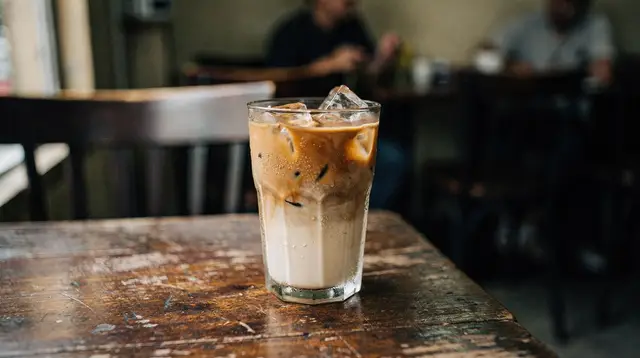
If the apartment cafes are the visual signature of the scene, ca phe sua da is its daily ritual. The name translates loosely as “milk coffee ice,” and it is exactly that: strong drip coffee poured over a layer of sweetened condensed milk and stirred through a full glass of ice. It is drunk everywhere, from folding plastic stools on the pavement to air-conditioned cafes with padded chairs, and it is rarely rushed. Locals will often let a glass sit for twenty minutes, topping it up with more ice as it melts, treating it as a reason to sit rather than a quick fix of caffeine.
A black, unsweetened version without milk, ca phe den, exists for those who prefer it, and a version topped with coconut cream, ca phe cot dua, has become popular in recent years as a heavier, dessert-like variant. All three share the same base method and the same unhurried social use: coffee here is something to sit with, at a stool, a stairwell cafe, or a bench by the Saigon River, rather than something carried out the door.
Egg coffee: a Hanoi specialty, not a Saigon one
One correction is worth making clearly, because it is one of the most common mix-ups among first-time visitors: egg coffee, ca phe trung, is not a Ho Chi Minh City invention. It was created in Hanoi, where whipped egg yolk, sugar and condensed milk are beaten into a thick, custard-like foam and spooned over hot black coffee. It belongs to the north’s coffee tradition, and it developed there for practical reasons tied to a period of milk shortages decades ago.
Egg coffee has since travelled south, and it is not hard to find on menus in Ho Chi Minh City, including in some of the apartment-building cafes described above. But treating it as a native Saigon drink misrepresents both cities’ coffee cultures: the south’s own signature is the iced, condensed-milk style described above, not the whipped-egg version. A well-run coffee tour in this city will serve or mention egg coffee as an option while being explicit that its roots lie roughly 1,100 km north, in Hanoi.
Comparing the coffee styles you’ll encounter
| Style | What it is | Where it belongs |
|---|---|---|
| Ca phe den | Black drip coffee, no milk, often over ice | Southern staple, found everywhere |
| --- | --- | --- |
| Ca phe sua da | Drip coffee with condensed milk, over ice | The defining Saigon-style everyday drink |
| --- | --- | --- |
| Ca phe cot dua | Drip coffee blended with coconut cream, often as a thicker iced drink | Popular modern southern variant |
| --- | --- | --- |
| Ca phe trung (egg coffee) | Whipped egg yolk, sugar and condensed milk over hot black coffee | Hanoi in origin, now sold in the south too |
Where a coffee-focused tour typically goes
Most guided coffee experiences in the city stay concentrated in the central districts, where the density of cafes per block is highest and the apartment-building format is most developed. A typical route moves on foot between a handful of stops: a traditional street-level cafe to see the phin filter used properly, one or two floors inside a converted apartment building, and a stop dedicated to tasting ca phe sua da itself, sometimes alongside a short explanation of how the beans are roasted and where southern Vietnam’s coffee-growing regions, mostly further north in the central highlands, fit into the national picture.
Some formats extend into a light hands-on workshop, where visitors brew their own phin coffee under guidance rather than only watching or tasting. This suits people who want to recreate the ritual once they are home, since the phin filter itself is inexpensive and widely sold as a souvenir.
a hands-on coffee workshop that walks through brewing, tasting and the culture behind each style covers this format directly, pairing the phin method with a guided look at where the ritual plays out across the city. A closely related option, a coffee culture tour paired with a short brewing workshop, adds more time inside the apartment-building cafes for those who want the architectural side of the scene alongside the tasting.
Choosing a neighbourhood for a self-guided coffee walk
Travellers who prefer to explore independently rather than book a guided format can still follow the same logic. District 1 around Dong Khoi and Nguyen Hue holds the highest concentration of both traditional cafes and converted apartment-building cafes, and it is easy to cover on foot in a loose afternoon loop without any fixed schedule. District 3, just beyond the centre, has a quieter, more residential version of the same scene, with cafes set in colonial-era villas rather than stairwells.
Cholon, the historic Chinatown spanning Districts 5 and 6, adds a different flavour again: coffee stalls here often sit alongside herbal tea vendors and older Chinese-style tea houses, giving a useful contrast to the more design-led cafes of the centre. A Cholon neighbourhood guide is worth reading before heading over, since the layout around Binh Tay Market is denser and less signposted for visitors than District 1.
Across the river, Thao Dien in Thu Duc City has developed its own newer wave of specialty cafes aimed at a younger, design-conscious crowd, a useful stop if the goal is to see how the coffee scene is evolving rather than only its traditional forms.
Fitting a coffee tour around the rest of a Saigon itinerary
Because this experience is intentionally short and focused, it fits comfortably alongside almost any other activity on a first day or a slower afternoon in the city. It pairs naturally with a walk through the war history sites of the centre, described in the War Remnants Museum guide, or with an evening spent on Saigon’s rooftop bars once the heat of the day has eased. Visitors staying near the centre can check where to stay in Saigon by neighbourhood to judge how close their hotel sits to the main apartment-cafe cluster.
For travellers building a longer loop through the south, the same coffee culture extends, in a rougher form, into the delta towns. Can Tho and its market streets have their own version of the roadside coffee-stool culture, explored in a foodie walking tour through Can Tho’s market streets, which sits alongside food stops rather than being coffee-exclusive. Those combining a Mekong Delta side trip with the city can also look at a Mekong Delta tour covering the river towns and canals for a broader sense of how daily life, including its coffee stalls, plays out beyond Ho Chi Minh City itself.
What this tour deliberately leaves out
Because the angle here is the drink and its settings rather than a full culinary crawl, a coffee-focused tour does not attempt to double as a meal. Travellers looking for a broader tasting experience across dishes, rather than drinks, are better served by the district 1 walking food tour, the Cholon street food tour or the evening-focused motorbike street food tour, each of which treats coffee as one stop among many savoury ones rather than the entire subject.
It also does not go into pricing, fixed schedules or exact durations, since cafe visits of this kind are inherently flexible: a stairwell cafe with a good view invites a longer stay, while a quick tasting stop does not. What stays constant, regardless of format or pace, is the sequence at the centre of the experience — the phin filter, the vertical apartment cafes unique to this city, and a glass of ca phe sua da that is meant to be drunk slowly, not on the move.
Frequently asked questions about Saigon’s coffee culture
Is Vietnamese coffee culture the same in Saigon as in Hanoi?
No. The drink and the drip-filter method are shared nationwide, but the social ritual differs. Ho Chi Minh City leans toward iced coffee, quick roadside stools, and vertical apartment-building cafes; Hanoi’s scene is older-fashioned and includes egg coffee, which did not originate in the south.
What exactly is ca phe sua da?
It is Vietnamese drip coffee, brewed slowly through a small metal phin filter directly over a layer of sweetened condensed milk, then stirred and poured over ice. It is strong, sweet, and normally drunk slowly rather than on the move.
Is egg coffee available in Ho Chi Minh City, and is it a local specialty?
It is available in a number of cafes across the city, but it is not a Saigon invention. Egg coffee was created in Hanoi and belongs to that city’s coffee tradition; in Ho Chi Minh City it is usually served as an import from the north rather than as part of the southern repertoire.
What is a “cafe chung cu”, or apartment building cafe?
It refers to independent cafes tucked inside the stairwells and old balconies of ageing residential apartment blocks in central districts, reached by narrow stairs rather than a street-level entrance. Each floor tends to hold a different cafe, often with its own design and its own regulars.
Do I need to book a guided coffee tour, or can I explore on my own?
Central cafes and the best-known apartment buildings can be visited independently, since most sit within walking distance of Dong Khoi and Nguyen Hue. A guided coffee tour mainly saves time finding the less obvious floors and adds context on brewing methods and the culture around each stop.
Is this tour suitable for people who don’t drink much coffee?
Yes, most guided formats include a lighter iced tea or fruit-based option alongside coffee tastings, and the interest for many visitors is the buildings and street life as much as the drink itself.
What should I wear or bring for a coffee-focused walk in the city?
Light, breathable clothing and comfortable shoes are enough, since the walk covers narrow staircases and uneven pavement rather than long distances. A phone or camera is useful, since many of the apartment cafes have distinctive views over the street.
Street Food Tours and Vietnamese Cuisine Tastings
Verified deep-linked GetYourGuide tours. Book through these links and we earn a small commission at no cost to you.
GetYourGuide does not provide a product photo for this activity — the image shows the meeting point, photographed by us.