A Chinatown with its own history, not a District 1 extension
It is easy to look at a map of Ho Chi Minh City and assume Cholon is simply where the centre trails off into more streets. It is not. Cholon — the name means roughly “big market” in Vietnamese — grew as its own river-port settlement, founded by Chinese immigrants who arrived over the eighteenth and nineteenth centuries and built a trading town along the canals south-west of the older Vietnamese and later French quarters.
For a long stretch of its history Cholon was administratively separate from Saigon, its own municipality with its own docks, guild halls and temples, and it only merged into the wider metropolis over the twentieth century. Today the name Cholon describes an area spread mainly across Cholon itself as a district identity, spilling over the modern administrative lines of District 5 and District 6.
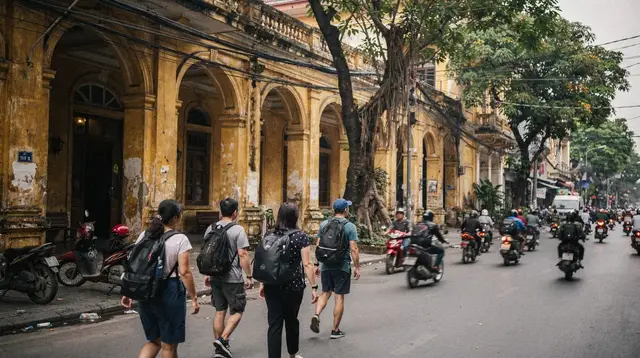
That history matters for how the area feels on the ground. Where District 1 is organised around a French colonial grid, wide boulevards and the commercial towers that followed independence, Cholon keeps a denser, older street pattern shaped by Chinese-style shophouses, narrow lanes and clan or “congregation” halls built by immigrants from different regions of southern China — Cantonese, Fujianese, Hainanese, Chaozhou and Hakka communities each built their own meeting halls and temples, several of which still stand. Walking from one to the centre is walking between two different urban logics, not between a downtown and its suburb.
Why the “just an extension of downtown” idea persists
The confusion is understandable. Cholon sits close enough to central Ho Chi Minh City that a single taxi or ride-hailing trip covers the distance, there is no river or obvious physical barrier marking the boundary the way the Saigon River separates the centre from Thao Dien, and modern street numbering runs continuously across both areas. Many visitors also arrive at Cholon on the same day as a walk through District 1, folding the two into one blurred impression of “downtown.”
But treat Cholon as a separate cultural destination rather than a neighbourhood tacked onto the city centre. Its temples were built by specific immigrant congregations for specific communities, its market grew out of Chinese merchant trade rather than colonial planning, and its traditional pharmacies reflect a medical tradition — Chinese herbal medicine — that has no equivalent shopfront presence in District 1. Local residents still refer to going “to Cholon” as a trip with its own identity, the way one might say “going to Chinatown” in another city, rather than simply naming a street within downtown.
The temples that anchor the district
Cholon’s religious architecture is its most distinctive layer, and it rewards slow walking rather than a single stop. The Jade Emperor Pagoda lies closer to District 1 and District 3 and is often visited on its own, but Cholon itself holds a denser cluster of temples built directly by the congregation halls of different Chinese communities.
Thien Hau Temple, dedicated to a sea goddess venerated by sailors and merchants, is the best known, its roof ridges crowded with ceramic figures and its interior thick with the smoke of large spiral incense coils that visitors and worshippers hang from the ceiling. Nearby halls serve other purposes: ancestor veneration, ongoing worship tied to specific clan names, and community gathering space that still functions as such rather than existing purely as a heritage display.
What sets these apart from religious sites elsewhere in the city is their working nature. They remain active places of worship for the descendants of the communities that built them, not stops preserved for visitors. That distinction is worth carrying into a visit: quiet observation, modest dress and unobtrusive photography go further here than in a purely secular tourist attraction.
Binh Tay Market and the trading identity of Cholon
If the temples represent Cholon’s spiritual life, Binh Tay Market represents its commercial one. Built under French administration but financed and shaped by the local Chinese merchant community, it remains a wholesale and retail hub where goods move in bulk — dried foods, fabrics, household items, spices — rather than existing primarily as a souvenir stop the way parts of Ben Thanh Market in District 1 have become. The building itself, with its distinctive tower and covered courtyard, signals the scale of trade that has passed through Cholon for generations, and the surrounding lanes extend the market outward into specialised streets, each historically associated with a particular trade.
This is also where Cholon’s role as a supply point for the wider south becomes visible. Goods bought and sorted here have long moved onward toward the Mekong Delta and other trading routes, a reminder that Cholon’s importance to Ho Chi Minh City’s economic history runs deeper than its present-day appeal to visitors.
Traditional pharmacies and a living medical tradition
Threaded among the market lanes and temple streets are shopfronts selling traditional Chinese medicine: dried herbs, roots, preserved animal products and prepared remedies arranged in glass jars and wooden drawers, often within pharmacies that have operated under the same family name for multiple generations. These businesses are not curated for visitors; they serve a local clientele that still consults traditional practitioners alongside, or instead of, Western medicine. Browsing them offers a different kind of insight into Cholon than the temples or the market — a sense of a knowledge system, brought from southern China, that has continued in daily use in this one part of the city for well over a century.
How Cholon connects to the rest of the city
Cholon does not exist in isolation from the rest of Ho Chi Minh City, and understanding it well means placing it correctly on the wider map. It sits south-west of District 1 and west of District 4, on the same side of the Saigon River as the historic centre but at a clear physical remove from it.
It is not on the route out toward Cu Chi or Tay Ninh to the north-west, and it is not a stop on the way to the Mekong Delta proper, though its market has historically traded with delta towns such as My Tho and Can Tho. Visitors sometimes try to fold a Cholon walk into a Mekong day trip; the two are better treated as separate outings, since Cholon rewards unhurried walking rather than a stop en route to somewhere else.
For orientation on how Cholon fits into the wider city, and for the general context on Ho Chi Minh City’s districts and layout, the Ho Chi Minh City overview page is the place to start before narrowing in on this one neighbourhood.
What travellers come to Cholon for
| Interest | What Cholon offers |
|---|---|
| Religious architecture | Congregation-hall temples built by distinct Chinese communities, still active |
| --- | --- |
| Market culture | Binh Tay Market and the trading lanes that surround it |
| --- | --- |
| Traditional medicine | Long-established herbal pharmacies still serving local families |
| --- | --- |
| Street food | Cantonese- and Chaozhou-influenced dishes alongside southern Vietnamese staples |
| --- | --- |
| Photography | Shophouse facades, incense-filled temple interiors, working market scenes |
| --- | --- |
| Quiet contrast | A slower, denser counterpoint to the towers and boulevards of District 1 |
Food shaped by two culinary traditions
Cholon’s food scene reflects its dual heritage: Cantonese and Chaozhou dishes sit alongside southern Vietnamese staples, sometimes on the same street or even served by the same family-run kitchens. Rice noodle soups with a Chinese-influenced broth, roast meats hung in shop windows, and dim-sum-style snacks appear here in ways they generally do not elsewhere in the city, while the com tam and banh mi familiar from central Ho Chi Minh City remain easy to find as well. This overlap is one of the clearest everyday signs that Cholon developed as a distinct community rather than a copy of the city centre with a different name.
Craft, shopping and hands-on ways to spend time here
Beyond temples and the market, Cholon’s trading streets have long supported small workshops and craft production tied to its merchant history, from textile and household-goods trade to specialised food production.
Travellers who want a more hands-on way to explore this side of the district, rather than a straightforward walk between landmarks, are better served by a dedicated overview of workshop-style activities across the city than by trying to line up individual stops themselves; the Craft Workshops category page for Ho Chi Minh City brings these options together in one place, alongside general shopping in the Ben Thanh Saigon markets style covered elsewhere on this site.
Combining Cholon with a wider Ho Chi Minh City visit
Because Cholon sits apart from the central sights, most visitors treat it as a dedicated outing rather than folding it into a walk through District 1 or District 3. It pairs naturally with a broader look at how the city’s neighbourhoods differ from one another, and with the kind of street-level food exploration that Cholon’s mixed culinary heritage rewards. Those planning where to base themselves for a stay that includes both the centre and Cholon may also find it useful to read a general comparison of the city’s neighbourhoods before booking accommodation.
Travellers building out day trips from the city, whether toward the tunnels north-west of town or onward toward the delta and the coast, can look at organised options such as a half-day tour out to the Cu Chi tunnel network or a day tour into the Mekong Delta to round out a longer stay, though neither of these overlaps directly with a Cholon itinerary itself.
For an evening back in the city, a Saigon River dinner cruise with a buffet or a river dinner cruise offers a contrasting, modern view of the city after a day spent among Cholon’s older streets.
Cholon, Ho Chi Minh City’s Chinatown: frequently asked questions
Is Cholon part of District 1?
No. Cholon lies south-west of District 1 and is spread mainly across District 5 and District 6. It grew as its own settlement, founded by Chinese immigrants, and was historically a separate town from the older Vietnamese and French-era core that is now District 1.
Is Cholon just a bigger version of Ben Thanh Market?
No. Ben Thanh Market sits in District 1 and has become heavily oriented toward visitors, while Binh Tay Market in Cholon developed as a wholesale trading hub for the Chinese merchant community and continues to serve that role today, alongside retail stalls in the surrounding streets.
What makes Cholon’s temples different from other pagodas in the city?
Cholon’s temples were mostly built by specific Chinese congregation groups — Cantonese, Fujianese, Hainanese, Chaozhou and Hakka communities among them — as combined places of worship and community gathering. Many remain active today, still used by the descendants of the families who built them.
Can I combine Cholon with a Mekong Delta day trip?
They are best treated separately. Cholon is a city neighbourhood suited to unhurried walking, while Mekong Delta day trips head out of the city toward towns such as My Tho or Can Tho. Trying to combine both in one outing tends to shortchange whichever comes second.
Is Cholon’s food different from what I would eat in District 1?
Cholon’s food scene blends Cantonese- and Chaozhou-influenced dishes with southern Vietnamese staples, a mix that is less pronounced elsewhere in the city. Roast meats, Chinese-style noodle soups and dim-sum-style snacks are easier to find here than in the central districts.
Do the traditional pharmacies in Cholon sell to visitors?
They are working pharmacies serving local families rather than shops set up for tourists, though browsing the shopfronts and their displays of dried herbs and traditional remedies is generally welcome. Treat them as a glimpse of an everyday medical tradition rather than a shopping stop.
Why do people confuse Cholon with an extension of downtown Ho Chi Minh City?
Cholon is close enough to central Ho Chi Minh City to reach easily by taxi or ride-hailing, there is no river or major barrier marking a clear boundary, and street numbering runs continuously across both areas. That physical closeness masks a cultural and historical distinction that goes back to Cholon’s founding as a separate Chinese-immigrant trading town.
Is Cholon connected to any UNESCO-listed site?
No. Cholon has no UNESCO World Heritage or Biosphere Reserve designation; its significance is cultural and historical rather than being tied to an international heritage listing.