Seven-Day South Vietnam Grand Loop: Saigon to Mui Ne
What does a seven-day grand loop of southern Vietnam actually cover?
It links Ho Chi Minh City, the Cu Chi Tunnels, the Mekong Delta down to Can Tho and Chau Doc, and the Mui Ne coast, entirely overland by private car or van with a driver. It leaves out Con Dao, which requires a flight, and treats Ca Mau as a separate, more specialised delta trip.
How the Seven Days Fit Together
This is the longest overland option this site covers for southern Vietnam: a full week that starts and effectively ends in Ho Chi Minh City, and threads through the Cu Chi Tunnels, the length of the Mekong Delta down to the Cambodian border at Chau Doc, and the dune coast at Mui Ne, all in a car or van with a driver rather than switching between buses, boats and flights.
The shape of the route matters more than the day count. Cu Chi sits north-west of the city, the delta stretches south-west, and Mui Ne lies north-east along the coast — three directions, not one. A car covering all three in a week has to come back through the same road corridor near Ho Chi Minh City more than once rather than tracing a straight line on the map. Travellers who picture this loop as a tidy circle are usually surprised by how much backtracking is built in, and that backtracking is normal, not a sign of a badly planned trip.
Two destinations that come up constantly in the wider region are deliberately left out. Con Dao sits roughly 230 km offshore and is reached only by air or fast ferry, which breaks the entirely-by-road logic this itinerary is built on — it gets its own separate island itinerary instead. Ca Mau, the southernmost point of the delta, is left to itineraries that specialise in the deep delta rather than added to a week that also has to reach the coast north-east of the city.
Because the week combines a private guide-led day near the city, a multi-day delta swing, and an independent coastal stretch, most travellers book the Cu Chi day and the Mekong Delta leg as tours with a driver and guide, then arrange their own car transfer up to Mui Ne, or fold everything into one continuous chauffeured booking. Either approach works; what matters is confirming the whole week with one operator or a small number of connected bookings rather than assembling it stop by stop as you go.
Day 1: Settling Into Ho Chi Minh City
The first day stays entirely in the city and works as both an introduction and a buffer for jet lag. Most itineraries anchor it around District 1: Ben Thanh Market and its clock tower, the Reunification Palace, Notre-Dame Cathedral Basilica of Saigon — currently under a long-running restoration, so do not expect an unobstructed facade — and the Central Post Office nearby. The War Remnants Museum is worth a slower, separate block of time rather than a rushed add-on.
In the evening, Dong Khoi and the Nguyen Hue walking street give an easy first look at how the city moves after dark, and a rooftop bar overlooking the Bitexco Financial Tower or Landmark 81 is a common way to end the day. This is also the day to settle logistics for the week ahead — confirming pickup points for the Cu Chi day and the start of the Mekong Delta leg — since both usually begin early the next morning or the morning after.
Day 2: The Cu Chi Tunnels
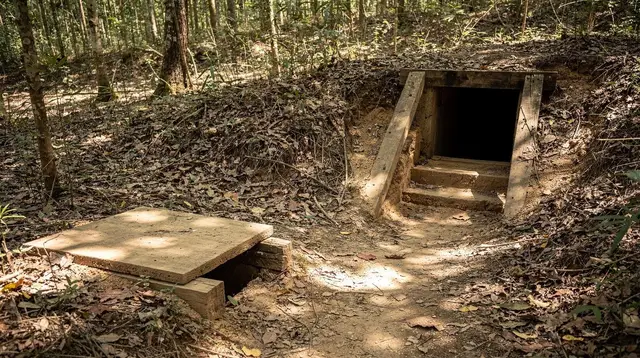
Day two is a dedicated trip to the Cu Chi Tunnels, one of the two sites most people build this entire week around. The tunnels are open at two separate locations — Ben Dinh, closer to the city and considerably busier, and Ben Duoc, further out and quieter — and choosing between them shapes how the whole day feels; the comparison is covered in detail in a dedicated guide to Ben Duoc versus Ben Dinh.
a guided day trip out to the Cu Chi Tunnels with an English-speaking guide is the most common way to handle this leg, since it removes the need to arrange a driver for a single out-and-back day.
Some versions of this loop extend the day toward Tay Ninh to see the Cao Dai Holy See, roughly 100 km from the city — Cu Chi is a district of Ho Chi Minh City itself, while Tay Ninh is a separate province further out, which is why the two are usually combined rather than treated as neighbours. Folding both into one day makes for a long day; travellers who prefer a lighter pace can read the half-day versus full-day comparison before deciding. The night is spent back in Ho Chi Minh City.
Day 3: Into the Mekong Delta
Day three turns south-west, away from the city and toward the Mekong Delta. Most itineraries in this loop use a multi-day Mekong booking rather than a single day trip, since the distance and the number of worthwhile stops make a slower pace more rewarding. My Tho and Ben Tre are typically the first proper delta stops on the way out, with orchard visits and boat rides on the smaller canals giving a first sense of how different the pace of life is here compared with the city.
a two-day Mekong Delta tour that overnights in the delta itself is the standard way to cover this stretch without rushing it, and it sets up the next two days of the loop naturally, since it continues on toward Can Tho rather than doubling back to the city overnight.
Day 4: Can Tho and Cai Rang
The fourth day centers on Can Tho, the delta’s main city, and the early-morning Cai Rang floating market, which trades at dawn and is genuinely at Can Tho rather than at My Tho, a mix-up worth avoiding when reading about this stop elsewhere. A sunrise boat ride through the market is the reason most people build a full extra day around Can Tho rather than treating it as a quick stop on the way past.
a countryside cycling route around Can Tho is a common way to fill the rest of the day at a slower pace once the market visit is done, taking in orchards and smaller canals away from the main road. Coverage of the sunrise visit itself sits in the Cai Rang floating market guide.
Day 5: Chau Doc Near the Cambodian Border
Day five continues further into the delta to Chau Doc, near the Cambodian border, with Sam Mountain and the Tra Su cajuput forest as the two draws in the area. This is the furthest point south-west that the loop reaches, and it is also the stop most often trimmed by travellers who decide midway through the week that six days suits them better than seven.
a combined Can Tho and Chau Doc delta tour is how most operators package days four and five together, since the two towns sit along the same stretch of the delta. Travellers weighing whether to go this deep into the delta at all, rather than stopping at Can Tho, can compare the options in the guide to choosing a Mekong Delta departure point.
Day 6: Back Toward Saigon and On to Mui Ne
Day six is the hinge of the whole week and the clearest example of why this loop is not a straight line. The delta leg ends by returning toward Ho Chi Minh City along the same road corridor used on the way out, before the route turns again, this time north-east along the coast toward Mui Ne. Depending on how the week is booked, some travellers pass back through the city itself for a change of vehicle, while others arrange a direct continuation from the delta toward the coast — either way, this day involves more time on the road than any other in the loop, and it is deliberately treated as a transition day rather than a sightseeing one.
Travellers assembling this week themselves, rather than booking it as one continuous package, often find it easier to treat the return from the delta and the onward leg to Mui Ne as two separate bookings with the same or a coordinated operator. The guide to getting between the delta and the coast lays out how that handoff typically works.
Day 7: Mui Ne’s Dunes and the Fairy Stream
The final day is spent around Mui Ne and neighbouring Phan Thiet, on the south-central coast — Binh Thuan province, not the Mekong Delta, despite how often the two get confused in casual trip write-ups. The white and red sand dunes and the shallow, walkable Fairy Stream are the two anchors of the day, alongside the working fishing harbour that gives the town a very different rhythm from either Saigon or the delta.
The guide to the red and white sand dunes and the guide to walking the Fairy Stream both cover the practical side of this last stop in more detail than fits here. From Mui Ne, most travellers either fly out via Ho Chi Minh City or arrange a final transfer back to the airport, closing out the loop.
Planning Notes for This Loop
A week is enough to cover this route without constant rushing, but it is a demanding week rather than an easy one — long stretches in a car, an early rise for the floating market, and a full day of tunnels and temples.
Travellers who want the same territory at a gentler pace, or who are unsure whether seven days suits them, may prefer to start with the guide to how many days southern Vietnam actually needs or compare this loop against the shorter three-day Saigon–Cu Chi–Mekong classic and the four-day comfort itinerary with a private car, both of which cover parts of the same ground in less time.
Booking a single driver for the whole week, rather than switching providers at every stage, is the detail that most affects how the week actually feels — it removes the daily task of finding onward transport and lets the days build on each other. The guide comparing group and private tours in the south is worth reading before choosing how to book the delta and Mui Ne legs. Travellers who finish this loop and still have days to spare sometimes extend it toward Con Dao by air, or push further with the ten-day ultimate south Vietnam itinerary, which folds a version of this same loop into a longer trip.
FAQ About the Seven-Day South Vietnam Grand Loop
Does this loop include Con Dao or Ca Mau?
No. Con Dao sits offshore and is reached only by air or fast ferry, which breaks the overland logic of this route, so it belongs to its own itinerary. Ca Mau, at the very southern tip of the delta, is left to more specialised, delta-focused trips rather than folded into a week that also needs to reach Mui Ne.
Is this route a straight line from Saigon to Mui Ne?
No, and this is the most common misunderstanding of the loop. The delta legs run south-west from Saigon while Mui Ne sits north-east along the coast, so the route doubles back through a shared road corridor near Ho Chi Minh City rather than tracing a single line across the map.
Do we need a different vehicle for each leg?
No. The point of booking a car or van with a driver for the whole week is that one vehicle and one driver carry you through every leg, including the detour to Tay Ninh and the return from the delta, without changing transport providers between stops.
Could this loop be done by public bus instead of a private car?
It could, but the connections between the delta towns and back up to Mui Ne are not designed around a single loop, so a self-arranged bus version means more transfers and more waiting than a chauffeured car or van, which is why this itinerary assumes a car.
Which single day could be skipped if we only have six days?
The Chau Doc leg is the one most travellers trim first, since it sits furthest from the main loop near the Cambodian border, while Cu Chi, Can Tho and Mui Ne are the pillars that most reviewers treat as non-negotiable.
Should Cu Chi be visited on the way out or on a separate day?
Most versions of this loop treat Cu Chi as a dedicated day trip out of Saigon before heading toward the delta, rather than as a stop directly en route, because the tunnels sit north-west of the city while the delta lies to the south-west.
Is the Mekong Delta portion of this loop the same as a standalone Mekong tour?
The stops overlap with a standalone Mekong Delta tour, but here they are sequenced as one stage of a longer week rather than a self-contained trip, so travellers wanting only the delta are better served by a dedicated two-day Mekong itinerary.
tours.7 days
Verified deep-linked GetYourGuide tours. Book through these links and we earn a small commission at no cost to you.
GetYourGuide does not provide a product photo for this activity — the image shows the meeting point, photographed by us.