Mekong Delta Day Trip or Two-Day Tour: How to Choose
Should I do a Mekong Delta day trip or a two-day tour from Ho Chi Minh City?
A day trip covers one province close to the city and gives a real but narrow taste of the delta, while a two-day tour reaches further, adds an overnight stay and usually includes the Cai Rang floating market at the hour it actually trades. Neither format shows the whole delta, which spans several provinces far larger than a single outing.
What Each Format Actually Covers
The Mekong Delta is not a single place. It is a fan of provinces spreading south-west from Ho Chi Minh City toward the coast and the Cambodian border, laced together by branches of the Mekong River and thousands of smaller canals. Choosing between a day trip and a two-day tour is really a choice about how much of that fan a visit can reach, and what kind of experience fits inside the time available.
Both formats share the same basic building blocks: a road transfer out of the city, boat time on the river or its canals, a stop at an orchard or workshop, and usually a market. What differs is the geography they can reach, the pace of the day, and whether the itinerary includes an overnight stay. Neither format is a shortcut to seeing “the delta” as a whole, since even a generous multi-day itinerary only strings together a handful of its many provinces.
This guide compares the two formats on those terms — what each one realistically allows a traveler to experience — rather than laying out a fixed hour-by-hour route. Specific itineraries, whether by day or by river cruise, are covered in the destination and itinerary guides linked throughout.
The One-Day Format
A day trip out of Ho Chi Minh City works on a tight geographic logic: it can only reach places close enough to the city that a return trip fits into daylight hours, alongside meaningful time at the destination itself. That generally limits a day trip to the delta’s closer provinces — the ones nearest the edge of the city — rather than the towns and markets further south-west.
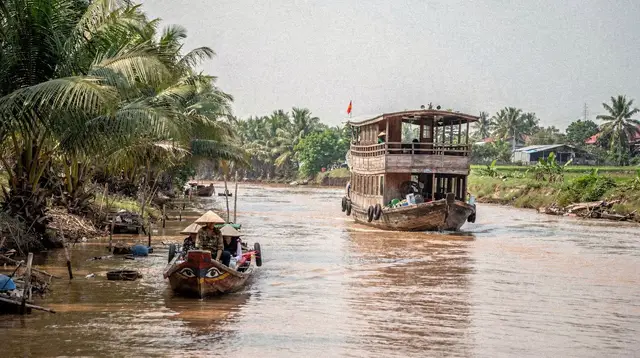
Within that radius, a typical day trip still delivers a genuine slice of delta life: a boat ride along a canal lined with fruit orchards, a stop where local sweets, coconut candy or rice paper are made by hand, and a walk or cycle through a village. Many day trips are paired with another destination altogether, most often the Cu Chi Tunnels, turning the day into a single loop that samples two very different sides of southern Vietnam rather than devoting the full day to the delta alone. That pairing is popular precisely because the delta’s closest reaches and Cu Chi sit in roughly the same direction from the city, though on opposite sides of it.
The trade-off is straightforward: a day trip cannot reach the delta’s more distant, and often more atmospheric, corners. The provinces that sit further from Ho Chi Minh City, with their bigger rivers and more elaborate floating markets, are simply too far for a single round trip that still leaves time to actually stop, walk and eat. A day trip answers the question “can I see something of the Mekong Delta on a short visit to Saigon” — it does not answer “can I see the delta’s floating markets and its furthest provinces.”
a combined day trip pairing the Cu Chi Tunnels with a closer stretch of the deltaThe Two-Day Format
Adding a second day changes the geography available, not just the pace. With an overnight stay built in, an itinerary can push further south-west than any day trip could reasonably manage, because the return leg to Ho Chi Minh City no longer has to happen on the same afternoon. That extra reach is the main reason travelers choose a two-day tour over a day trip: it opens up provinces and stops that a single day simply cannot include.
The overnight itself takes one of two forms. Some two-day tours end the first day at a hotel in a delta town, offering a comfortable base with air conditioning and a proper night’s sleep before continuing the next morning. Others build the night around a homestay — a stay with a local family, often on stilts above a canal, that trades some comfort for a much closer look at how households along the delta actually live, eat and work.
Either version allows the next morning to begin very early, which matters for one specific reason: it is usually the only way a two-day tour reaches the Cai Rang floating market while it is genuinely active, since the market trades at dawn and is well south-west of the city, far outside day-trip range.
Beyond the floating market, the extra day typically adds one or two further stops that a day trip has no room for: a second orchard region, a longer stretch of canal by boat, a fruit or flower village, or simply more unhurried time in a single place rather than a schedule built around getting back to the city by evening. The net effect is less a “longer version of the day trip” than a different shape of visit — one overnight, two distinct days, and a route that can legitimately claim to have reached further into the delta.
a standard two-day tour with an overnight stop in the delta or, for a closer look at daily life along the canals, a two-day itinerary built around a homestay night with a local family
Comparing the Two Formats
| Day Trip | Two-Day Tour | |
|---|---|---|
| Overnight stay | None — returns to Ho Chi Minh City same day | One night, hotel or homestay |
| --- | --- | --- |
| Geographic reach | Closer delta provinces only | Extends further south-west |
| --- | --- | --- |
| Cai Rang floating market | Rarely included, too far for the timing | Common, reached at dawn on day two |
| --- | --- | --- |
| Pace | One packed day, built around the round trip | Spread across two days, generally less rushed |
| --- | --- | --- |
| Often paired with | Cu Chi Tunnels, as a single combined day | Delta destinations only |
| --- | --- | --- |
| Best suited to | A short stay in the city | A stay with a spare night to give |
The table simplifies a genuinely varied market — individual operators mix and match these elements — but the underlying pattern holds across most itineraries sold from Ho Chi Minh City.
What Neither Format Delivers
It is worth being direct about a common misconception: neither a day trip nor a standard two-day tour comes close to covering the Mekong Delta as a whole. The delta is a region of several distinct provinces, each with its own towns, markets, rivers and rhythms, and a two-day visit still only strings together a small handful of stops within that much larger area.
Deeper coverage — reaching further provinces near the Cambodian border, or spending several days moving through the delta rather than looping out and back — belongs to longer, multi-day itineraries, including river cruises that spend multiple nights aboard rather than in a single overnight stop. Anyone hoping to genuinely explore the delta, rather than sample it, should treat both the day trip and the two-day tour as a first look, not a complete circuit.
This also means the choice between the two formats is less about which one “sees the delta” and which one does not, and more about which slice of it fits a given trip. A day trip is not a compressed, lesser version of the two-day tour so much as a different kind of outing altogether, aimed at the closer provinces and often bundled with another destination for a single memorable day. The two-day tour, in turn, is not automatically “the complete Mekong Delta experience” — it is simply a wider slice, reaching a bit further and adding a night’s stay, still within a fraction of the region as a whole.
Activities That Favor Multi-Day Itineraries
Certain experiences are effectively exclusive to the two-day format because they need either the extra travel time, an early second-day start, or a full evening and morning in one place. A cooking class that runs into the evening, a slower cycle through back lanes away from the main canal routes, or a kayak paddle scheduled for cooler morning hours all fit far more comfortably into an itinerary with a night already built in.
a two-day itinerary combining kayaking, cycling and a cooking class or an overnight tour centered on a floating village and a hands-on cooking session
Day trips can and do include lighter versions of these activities — a short bike ride between an orchard and a boat dock, a quick tasting rather than a full cooking class — but the fuller, slower versions generally belong to the itineraries that have a second day to spend.
Choosing Based on Time in Ho Chi Minh City
The most practical filter is simply how many days are available. A traveler with two or three days in the city, and other plans already competing for time, is usually better served by a day trip: it delivers a real taste of the delta without requiring a night away from the hotel, and pairs naturally with a stop at Cu Chi on the way. A traveler with four or more days, or one deliberately building a slower trip around the south of the country, gains more from setting aside a night for the two-day version, particularly if seeing the floating market at its liveliest hour matters.
A useful middle step, for anyone still undecided, is reading how the delta’s two main gateway towns compare: see My Tho versus Can Tho for the Mekong Delta for how those specific starting points shape a day trip differently from a longer route through Can Tho itself. That comparison sits alongside this one rather than repeating it: this guide is about the day-trip-versus-multi-day decision, that one is about which delta town a given itinerary is actually built around.
Practical Notes That Apply to Both Formats
A few things hold regardless of which format is chosen. Both types of tour depend on road transfers by coach, minibus or private car to reach the delta from Ho Chi Minh City, followed by boat transport once the itinerary reaches the water — there is no rail option and no meaningful shortcut around the road leg. Both also run through a landscape shaped by two seasons rather than four: a dry season roughly from December to April and a wet season roughly from May to November, whose rain typically falls as a short, heavy downpour late in the day rather than as steady all-day rain. Neither the wet nor the dry season rules out either format, though a day trip leaves less flexibility to simply wait out an afternoon shower than a two-day tour does.
Anyone weighing whether a day trip is worth the effort at all, independent of the two-day comparison, will find that question addressed directly in is a Mekong Delta day trip worth it. For a sense of how a multi-day version can extend even further, toward the Cambodian border, see the multi-day Mekong cruise to Chau Doc and onward to Cambodia — a step beyond the standard two-day tour, for anyone whose available time reaches that far.
FAQ: Choosing Between a Mekong Delta Day Trip and a Two-Day Tour
Can I see the whole Mekong Delta in one day?
No. The delta is a network of provinces stretching from the edge of Ho Chi Minh City to the Cambodian border and the coast, and a single day only reaches the closest part of it. A day trip is a sample of one corner, not a survey of the region.
Is the Cai Rang floating market included on a day trip?
Only on day trips built around Can Tho, which start very early to reach the market during its active trading hours. Day trips to the closer provinces skip it entirely, since Cai Rang sits further from the city than those destinations.
What does a two-day tour add that a day trip cannot?
An overnight stay, whether in a hotel or a homestay, which opens up an early departure the next morning, a slower evening in a delta town, and time for activities that a single day cannot fit around the drive there and back.
Are two-day tours much more tiring than a day trip?
They involve more time on the road overall, but the pace within each day is usually gentler, since the itinerary is not squeezed into a single round trip from the city. Many travelers find the two-day version less rushed, not more.
Do both formats include boat rides on the delta’s canals?
Boat time is central to almost every Mekong Delta itinerary, whether a day trip or a multi-day tour, because the canals are how the delta’s markets, orchards and villages are reached. The amount and setting of that boat time varies by tour.
Is a homestay only available on multi-day tours?
Yes, by definition a homestay night requires staying overnight in the delta, so it only appears on two-day and longer itineraries. A day trip returns to Ho Chi Minh City the same evening.
Which format suits a short stay in Ho Chi Minh City?
A day trip fits more easily into a short stay, since it uses a single day and returns travelers to the city the same night for onward plans. A two-day tour needs an extra night set aside in the schedule.
Does a two-day tour go deeper into the delta than a day trip?
Generally yes, because the extra day allows the itinerary to reach provinces that are too far for a single round trip from Ho Chi Minh City, and to add a leg the next morning that a day trip has no time for.
More on planning a delta visit: choosing a Mekong Delta departure point, Cai Be and Vinh Long’s orchards and canals, Chau Doc near the Cambodian border, the two-day Mekong Delta itinerary through Can Tho and Cai Rang, and the three-day classic combining Saigon, Cu Chi and the Mekong Delta.
Tour Comparisons
Verified deep-linked GetYourGuide tours. Book through these links and we earn a small commission at no cost to you.
GetYourGuide does not provide a product photo for this activity — the image shows the meeting point, photographed by us.