Where to Stay in Saigon: A Neighborhood Guide
Which neighborhood should I choose for accommodation in Ho Chi Minh City?
District 1 is the default choice for first-time visitors, with the highest concentration of sights, restaurants, and nightlife. Cholon suits travelers who want a distinct historic atmosphere away from the tourist core, while Thao Dien and the Binh Thanh riverside suit those who prefer quiet streets and easy access to cafes over proximity to landmarks.
Understanding the Layout Before You Book
Ho Chi Minh City is large, and its districts differ from each other more than first-time visitors expect. Picking a neighborhood is really picking a rhythm: how far you’ll walk each day, how much traffic noise reaches your window, and whether the sights you came to see are a five-minute stroll or a twenty-minute ride away. This guide sets aside the day trips into the Mekong Delta and the coast — those are covered elsewhere — and focuses purely on the city itself: District 1 at the center, Cholon with its own historic identity, and the calmer stretches along the Saigon River.
The confusion that trips people up most often is treating District 1 and Cholon as interchangeable, or assuming Cholon is just “the older part of District 1.” It isn’t. Cholon is a separate historic district complex, and understanding that distinction early saves a lot of frustration when comparing listings.
District 1: The Default Choice for First-Timers
District 1 is the beating heart of Ho Chi Minh City, and for most visitors it remains the obvious base. This is where Ben Thanh Market and its landmark clock tower sit, where the Reunification Palace and the War Remnants Museum draw steady streams of visitors, and where Notre-Dame Cathedral Basilica of Saigon and the Central Post Office anchor the colonial-era streetscape (the cathedral’s exterior has been under long-running restoration, so don’t expect an unobstructed view of the facade).
Within District 1, the character shifts block by block. Dong Khoi street and the area around it carry an upscale, polished feel, lined with international hotel brands and boutiques. The Nguyen Hue walking street is pedestrian-friendly in the evenings and puts you close to the Bitexco Financial Tower. A few streets over, Bui Vien is a different world entirely: a dense strip of bars, cheap eats, and late-night noise aimed squarely at backpackers. Our Bui Vien nightlife guide covers what to expect there in more detail.
The practical case for District 1 is simple: it minimizes travel time. Most restaurants, rooftop bars, and attractions aimed at visitors sit within it, and most organized tours — whether heading to Cu Chi, the Mekong Delta, or the coast — use District 1 hotels as their default pickup point. If your schedule is tight and you want to spend your time seeing things rather than getting to them, this is where that logic points.
The tradeoff is equally simple: District 1 is the busiest, loudest, and most visibly touristic part of the city. Traffic is constant, motorbikes dominate every street, and areas around Ben Thanh Market see a fair amount of overcharging aimed at visitors. None of this is dangerous — violent crime is rare here — but it does mean District 1 rewards travelers who don’t mind noise and a steady hum of activity outside their window.
District 1 in Short
| What you get | What you trade |
|---|---|
| Walking distance to major sights | Traffic noise, especially near main roads |
| --- | --- |
| Widest choice of restaurants and bars | Higher visibility to touch-and-go scams near markets |
| --- | --- |
| Easiest pickup point for day tours | A very “touristic” atmosphere on the busiest streets |
| --- | --- |
| English widely spoken in hotels and agencies | Crowds around Ben Thanh Market and Bui Vien |
For a first orientation to how District 1 fits together on foot, an orientation walk with a local guide covers the layout faster than wandering alone with a map.
District 3: A Quieter Neighbor
Immediately next to District 1, District 3 offers something genuinely different without sacrificing much convenience. Read about it in the District 3 neighborhood guide: tree-lined streets, French-era villas repurposed as independent coffee shops, and a noticeably more residential pace. It’s an appealing middle ground for travelers who want to be close enough to walk into District 1 for an evening but prefer to sleep somewhere quieter.
The caveat is that District 3’s charm is scattered rather than concentrated — there’s no single strip of hotels or restaurants that defines it the way Dong Khoi or Bui Vien define parts of District 1. Staying here works best if you’re comfortable using ride-hailing apps for evenings out rather than expecting everything within a two-minute walk.
District 4: Local, Dense, and Food-Focused
Across a narrow channel from District 1 sits District 4, a compact, densely packed area best known for its street-food lanes — the subject of our District 4 street food guide. It’s less geared toward visitor accommodation than District 1 or Thao Dien, and infrastructure aimed at foreign travelers is thinner here. Some travelers choose it specifically for that reason: it feels more like an ordinary residential slice of the city, with prices to match, and it’s still only a short ride from District 1’s sights.
Cholon: A Separate Historic Identity, Not “Old District 1”
This is the distinction worth getting right before you book anything. Cholon is the historic Chinatown of Ho Chi Minh City, spread across District 5 and District 6, and it has its own layered history as a merchant quarter that predates the city’s modern center. It is home to Binh Tay Market, a working wholesale market rather than a polished tourist attraction, and to Thien Hau Temple, one of the city’s most atmospheric religious sites. The Cholon neighborhood guide goes deeper into its streets and temples.
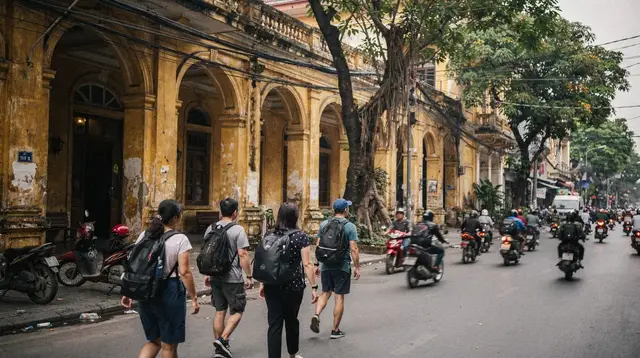
Cholon is not a quieter corner of District 1 — it is a genuinely different district, several kilometers from the center, with a different visual character: narrower streets, denser shophouses, and signage in both Vietnamese and Chinese. Staying here suits travelers who have already spent time in District 1 on a previous trip, or who specifically want to base themselves somewhere with a distinct identity rather than the more generalized international feel of the center.
The tradeoff is connectivity. Reaching District 1’s main sights from Cholon means a taxi, a ride-hailing trip, or a bus ride rather than a walk. Evening options within Cholon itself are also more limited and more locally oriented — fewer rooftop bars, more neighborhood eateries. A Cholon pagodas tour is a good way to see the area’s temples in a single organized outing if you’re staying elsewhere and only visiting for a day.
District 1 vs. Cholon at a Glance
| District 1 | Cholon | |
|---|---|---|
| Character | Modern city center, international feel | Historic Chinese-Vietnamese quarter |
| --- | --- | --- |
| Main draws | Ben Thanh Market, museums, cathedral | Binh Tay Market, Thien Hau Temple |
| --- | --- | --- |
| Distance from major sights | Central, mostly walkable | Several kilometers from District 1 |
| --- | --- | --- |
| Evening options | Extensive: bars, rooftops, walking street | More local, fewer visitor-oriented venues |
| --- | --- | --- |
| Best for | First visits, tight schedules | Repeat visitors, distinct atmosphere |
The Riverside Pockets: Thao Dien and Binh Thanh
Across the Saigon River from the center, Thao Dien sits within Thu Duc City — the merged administrative area that absorbed the former Districts 2 and 9 in 2021. The Thao Dien guide describes a leafy, low-rise area popular with long-term expatriate residents, known for its cafes, brunch spots, and a noticeably calmer street environment than District 1. It isn’t close to the main historic sights, but for travelers prioritizing a relaxed base with good food over proximity to landmarks, it’s a reasonable option, particularly for longer stays.
Back on the District 1 side of the river, Binh Thanh is home to Landmark 81, the country’s tallest tower, and to canal-adjacent streets covered in the Binh Thanh canal guide. It sits between the busy center and the quieter riverside areas, offering a partial version of both: some proximity to District 1, some distance from its noisiest streets.
An easy way to experience the river itself, regardless of which bank you sleep on, is a dinner cruise along the Saigon River in the evening, which gives a different perspective on the skyline than any hotel window will.
Matching a Neighborhood to Your Trip Length
For a short stay of one or two nights, District 1 is almost always the pragmatic choice — it removes travel time from an already tight schedule. Our guide on how many days to spend in southern Vietnam and the broader planning guide for the city, delta, and coast both assume a District 1 base for the city portion of a trip, since most itineraries link the center to day trips departing early in the morning.
For longer stays of four nights or more, splitting time between District 1 and either Cholon or the riverside pockets starts to make sense: a few nights central to cover the main sights and organize day trips, followed by a quieter stretch elsewhere once the essentials are checked off. This also suits travelers who want to try the city’s food scene more slowly — an evening street-food tour by motorbike covers ground across several neighborhoods in one outing, which can help decide where you’d actually like to spend more time.
Getting Between Neighborhoods
Whichever base you choose, getting around the city itself is straightforward but requires some orientation. Our guide to getting around Saigon and the companion piece on Grab and taxis in Ho Chi Minh City cover the practical options: ride-hailing apps, metered taxis, the new metro line running from the center out past Thu Duc, and the ever-present motorbike traffic. If you’re not used to a city where motorbikes dominate every street, our guide to crossing the street and reading traffic in Saigon is worth reading before your first night out, regardless of which neighborhood you end up in.
Traffic density is itself a factor in choosing where to stay: the busier the streets around your accommodation, the more that steady flow of motorbikes becomes part of the background of your stay, for better or worse depending on your tolerance for it.
Frequently Asked Questions About Choosing a Neighborhood in Saigon
Is District 1 the same thing as Cholon?
No. District 1 is the modern city center, home to Ben Thanh Market and most hotels aimed at visitors. Cholon is a separate historic area spread across District 5 and District 6, several kilometers away, with its own Chinese-Vietnamese heritage and identity.
Is Saigon the same city as Ho Chi Minh City?
Yes. Saigon was the city’s name before 1976 and is still used constantly in everyday speech, especially for the central districts. Both names refer to the same place, and travelers will hear both used interchangeably by locals and businesses.
Should I stay near Bui Vien if I don’t want a party atmosphere?
Probably not right on the street itself. Bui Vien is a compact backpacker strip inside District 1 known for late-night bars and street activity; staying a few blocks away, still within District 1, keeps the same central location with far less noise.
Is Cholon convenient for reaching District 1 sights?
Cholon is workable but requires a short taxi, ride-hailing, or bus trip to central District 1, since the two areas are not within comfortable walking distance of each other.
What is Thao Dien and is it central?
Thao Dien is a leafy riverside pocket in Thu Duc City, across the Saigon River from District 1. It is not central in the geographic sense, but it is well connected by road and popular for its cafes, restaurants, and calmer residential streets.
Is District 3 a good alternative to District 1?
District 3 sits right next to District 1 and offers a quieter, more residential feel with villas and independent coffee shops, while still being an easy walk or short ride from the central sights.
Does neighborhood choice affect access to day trips outside the city?
Most tours and coaches for destinations like the Mekong Delta or Cu Chi Tunnels pick up from central District 1 hotels first, so a District 1 base generally simplifies early-morning departures compared with outlying neighborhoods.
Trip Planning
Verified deep-linked GetYourGuide tours. Book through these links and we earn a small commission at no cost to you.
GetYourGuide does not provide a product photo for this activity — the image shows the meeting point, photographed by us.