Mui Ne's Red and White Sand Dunes: What Makes Them Different
Are the red dunes and the white dunes in Mui Ne the same place?
No. The Red Sand Dunes sit right at the edge of Mui Ne village, small and compact. The White Sand Dunes lie further away, on the road toward Phan Thiet, and cover a much larger, more desert-like area. They are two distinct sites with different scale and character.
Two dune fields, not one
Mui Ne’s reputation as a desert-like corner of the Vietnamese coast rests almost entirely on sand, but the sand comes in two separate places that are often confused, sometimes even by tour operators who blur them into a single stop. The Red Sand Dunes and the White Sand Dunes are not two names for the same hill. They are two different landscapes, a short but real distance apart, each with its own colour, scale, and feel underfoot. Anyone planning a visit to the sand dunes around Mui Ne benefits from understanding what separates them before choosing where to spend the light of the day.
This page focuses on the dunes themselves — what they look like, how they differ, and what each is good for as a landscape. It does not cover how to get out to Mui Ne from Ho Chi Minh City or how many days to allocate to the trip; that planning question belongs on the day trips section and on the dedicated three-day Mui Ne desert escape itinerary. It also does not re-describe quad biking or buggy riding, which have their own detailed page on quad and buggy rentals at the dunes.
The Red Sand Dunes: close, compact, and easy to reach on foot
The Red Sand Dunes, known locally as Doi Cat Do, sit right at the edge of Mui Ne village itself, close enough that many visitors staying along the coastal strip can walk to them or reach them with only a short ride. This proximity is their defining feature. Where the White Sand Dunes require a proper excursion, the Red Sand Dunes are almost an extension of the town, tucked behind the last row of resorts and fishing-village houses.
The colour is the other defining trait. The sand here carries a distinct rust-red to burnt-orange tone, a result of the mineral content of the soil rather than any dye or treatment. Under low, angled light the colour intensifies, shifting toward deep amber and copper. The dunes themselves are modest in height and area compared with their white counterpart — a series of undulating slopes rather than a sprawling desert. Because the site is compact, a visit tends to be brief: enough time to walk the ridgeline, take in the colour contrast against the sky and the nearby vegetation, and watch local children sledding down the slopes on rented plastic sleds, a small, low-key activity that has become part of the site’s character.
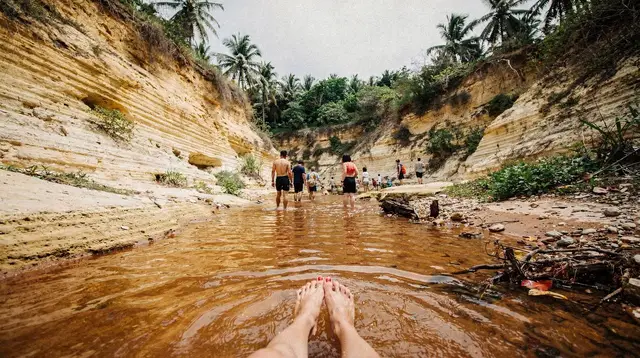
The Red Sand Dunes are also notable for how quickly they can be folded into a wider loop of the area, since their location near the village puts them close to other stops such as the Fairy Stream, the small red-hued stream that cuts through sandstone formations a short distance away and is often visited in the same outing given how close it sits to this dune field.
The White Sand Dunes: larger, farther out, and more desert-like
The White Sand Dunes, or Doi Cat Trang, are a different proposition altogether. They lie well outside Mui Ne village, on the road that runs toward Phan Thiet and beyond, and reaching them means a proper drive rather than a stroll. Once there, the scale is the first thing that registers: a wide, open expanse of pale, almost bone-white sand that rolls out in long ridges and shallow basins, with far less vegetation breaking up the view than at the red dunes. It is this openness — sand meeting sky with little else in the frame — that gives the site its desert-like reputation and makes it the more photogenic of the two for wide, minimalist shots.
The white sand itself behaves differently underfoot and visually from the red variety. It is finer and paler, closer to the colour of dry salt flats than to a beach, and it holds shape well enough that wind carves visible ripple patterns across its surface, patterns that shift from day to day. Because the dunes cover so much more ground, visitors typically spend meaningfully longer here than at the compact red site, whether walking the ridges, watching the light change, or taking one of the vehicle-based rides that operate across the sand — again, a topic covered separately on the quad and buggy guide rather than repeated here.
Photographers in particular tend to favour the White Sand Dunes for the way the light rakes across the open terrain near the start and end of the day, a pattern covered in more detail on the page about visiting the dunes at sunrise, which looks at how the low-angle light transforms the ridgelines and shadow lines across this larger site.
Side by side: how the two dune fields compare
| Red Sand Dunes (Doi Cat Do) | White Sand Dunes (Doi Cat Trang) | |
|---|---|---|
| Location relative to Mui Ne village | At the edge of the village, close in | Further out, toward Phan Thiet |
| --- | --- | --- |
| Sand colour | Rust-red to burnt orange | Pale, almost white |
| --- | --- | --- |
| Scale | Compact, a series of modest slopes | Large, sprawling, open expanse |
| --- | --- | --- |
| Typical feel | Quick, easy stop | A more immersive, desert-like landscape |
| --- | --- | --- |
| Vegetation nearby | Some, closer to the village fringe | Minimal, more open sky and sand |
| --- | --- | --- |
| Common activities on site | Short walks, sand sledding | Longer walks, vehicle-based rides across the dunes |
The single most useful fact to hold onto is the one travellers most often get wrong: these are not variations of the same hill seen at different times of day. They are separate sites with separate access points, and confusing them leads to disappointment — arriving at the small red slopes expecting the vast white expanse seen in photographs, or vice versa.
Colour, light, and how each site photographs
The contrast between the two dune fields is as much about colour theory as geography. The Red Sand Dunes work best when the goal is a shot with strong colour contrast — the warm red-orange sand against a blue sky, or against the darker green fringe of vegetation that borders the site. Because the area is smaller, compositions here tend to be tighter, focused on texture and colour rather than sweeping scale.
The White Sand Dunes invert that logic. Their appeal lies in emptiness and scale: long horizon lines, minimal colour variation, and the graphic quality of wind-carved ripples across pale sand. This is the site that produces the images most people associate with “the Sahara of Vietnam,” a comparison that circulates widely and that the openness of the White Sand Dunes genuinely earns, even though the area is a fraction of the size of an actual desert.
Both sites reward visiting outside the harshest midday hours, when the sun sits directly overhead and flattens the texture that makes the dunes visually interesting in the first place — though exact timing and sunrise logistics belong to the dedicated sunrise guide rather than this page.
Terrain and how it feels to walk
Underfoot, the two dune fields diverge as much as they do visually. The Red Sand Dunes have a firmer, coarser texture in places, with slopes short enough that climbing to a ridge and back is a matter of minutes rather than a sustained walk. Because the site is compact, most of it can be explored on a single, unhurried loop.
The White Sand Dunes demand more from a walker. The sand is finer and looser, which makes climbing the steeper faces noticeably more tiring than the firmer ground elsewhere in the area, and the sheer size of the site means a meaningful walk covers only a portion of what is there. This is part of why vehicle-based options across the White Sand Dunes are so popular — not as a substitute for walking, but as a way to cover ground that would otherwise take a long time on foot. Again, those rides are detailed on their own page rather than here, but it is worth knowing, purely as a matter of terrain, why they exist at this particular site and are less of a feature at the smaller red dunes.
Which one to prioritise if time is short
Travellers piecing together a southern Vietnam itinerary around a stop in Mui Ne sometimes have to choose rather than see both. As a matter of landscape alone, the two sites answer different questions. The Red Sand Dunes suit a traveller who wants a quick, easy, colourful stop with minimal time investment, ideal for slotting into a morning or afternoon that already includes other nearby sights such as the Fairy Stream. The White Sand Dunes suit a traveller who wants the fuller, more dramatic desert impression that Mui Ne is known for, and who is willing to give the site more time given both the distance to reach it and its larger scale once there.
Many visitors do end up seeing both, precisely because they are different enough that one does not substitute for the other. A combined look at the wider area, including how the dunes fit alongside the Mekong Delta and coastal route that some travellers build their trip around, can help frame how much time each site is worth relative to everything else nearby.
For travellers who want a structured way to see the White Sand Dunes without arranging transport themselves, a guided option covers the round trip and the time on the sand:
a day trip from Ho Chi Minh City out to the White Sand DunesFor those who want the dunes at their most photogenic, with the light still low and the sand largely undisturbed:
a sunrise jeep ride out to the White Sand DunesA wider loop that takes in both the dunes and other nearby coastal stops in one outing is covered by:
a jeep tour combining the sand dunes, the coast, and a hidden pagoda stopThose who prefer to explore the White Sand Dunes at their own pace, rather than as part of a guided loop, can arrange their own vehicle on site through:
renting a quad bike or ATV directly at the White Sand DunesPractical orientation, not logistics
It bears repeating that this page deliberately steers clear of prices, opening hours, sand temperature, or how busy either site gets at a given time — those figures shift too often to state reliably here and belong to pages built specifically to track them, including the ATV and buggy guide for vehicle-based details and the sunrise-timing guide for light and timing. What is stable, and what this page focuses on, is the geography: two dune fields, different colours, different scales, different distances from the village, and different reasons to visit each one.
Anyone building a broader picture of the Mui Ne and Phan Thiet coast should treat the dunes as two separate entries on the list, not one. That single distinction resolves most of the confusion that arises when comparing notes, photographs, or trip reports from other travellers, since a photo of the Red Sand Dunes and a photo of the White Sand Dunes can look like they belong to entirely different countries, let alone different corners of the same coastline.
Seasonal light also affects how each site presents itself, a subject covered more broadly for the region on the best time to visit Ho Chi Minh City and the south page, and travellers heading out to spend time on open sand in the middle of the day may want to check the general packing advice on what to pack for Ho Chi Minh City, since sun and wind exposure differ meaningfully between a short stop at the red dunes and a longer session out on the white ones.
Those exploring the wider category of dune-based activities beyond these two specific sites can browse the full sand dunes and ATV category, while a broader view of everything on offer around this stretch of coast sits under things to do in Mui Ne and the dedicated things to do at the sand dunes page.
FAQ: the Mui Ne dunes, red and white
Are the red dunes and the white dunes in Mui Ne the same place?
No. The Red Sand Dunes sit right at the edge of Mui Ne village, small and compact. The White Sand Dunes lie further away, on the road toward Phan Thiet, and cover a much larger, more desert-like area. They are two distinct sites with different scale and character.
Which dunes are bigger, red or white?
The White Sand Dunes are considerably larger and more open, with rolling ridges that stretch further than the eye can easily follow. The Red Sand Dunes are more modest in scale, closer in feel to a large sloping hillside than to a desert.
Why are the Red Sand Dunes red?
The colour comes from the natural mineral content of the sand and soil in that specific spot near the village, not from any added dye or treatment. The tone intensifies visually under low, angled light.
Can I walk to the Red Sand Dunes from Mui Ne village?
Yes, their defining feature is proximity: they sit right at the edge of the village, close enough for many visitors staying nearby to reach them on foot or with only a very short ride.
Do I need a vehicle to see the White Sand Dunes properly?
The site is large enough that covering meaningful ground on foot takes real time and effort, which is why vehicle-based rides across the sand are popular there; the mechanics of those rides are covered on the separate ATV and buggy guide rather than here.
Which dune field is better for photography?
They suit different kinds of images. The Red Sand Dunes favour tighter shots with strong colour contrast between the warm sand and surrounding greenery. The White Sand Dunes favour wide, minimalist compositions built around scale and emptiness.
Is the Fairy Stream part of either dune field?
No, but it sits close to the Red Sand Dunes and is commonly visited in the same outing given the short distance between the two.
Should I visit both dune fields or just one?
If time allows, many travellers visit both precisely because they are different enough that one does not substitute for the other — a quick, colourful stop at the red dunes and a longer, more immersive visit to the larger white dunes.
Mui Ne Sand Dunes and Jeep Tours
Verified deep-linked GetYourGuide tours. Book through these links and we earn a small commission at no cost to you.
GetYourGuide does not provide a product photo for this activity — the image shows the meeting point, photographed by us.