Choosing Your Mekong Delta Departure Point from Saigon
Is there one departure point for the Mekong Delta from Saigon?
No. The Mekong Delta spans several provinces, and each one is reached by its own road out of Saigon. My Tho and Ben Tre sit on the closest corridor, Cai Be and Vinh Long a little further along the same route, and Can Tho and Chau Doc lie deeper into the delta on separate roads. Picking a departure point means picking a province and a mood, not a single fixed gate.
There Is No Single Gate to the Delta
Ask a handful of visitors how they got to the Mekong Delta from Saigon and the answers will not agree, and none of them will be wrong. The delta is not one destination with one road in — it is a fan of provinces spreading south-west from the city, each with its own highway, its own river branch, and its own character. My Tho sits on the corridor closest to the city.
Can Tho lies much further in, on a different route entirely. Chau Doc, near the Cambodian border, is further again. Treating any one of them as “the” departure point for the delta is the most common mix-up travelers make when planning from Saigon, and it is worth untangling before booking anything.
This page is not a rewrite of the individual town guides — My Tho and Ben Tre, Cai Be and Vinh Long and Can Tho and the Cai Rang floating market each have their own detailed write-up. What follows is a way to decide which of those doors to walk through, based on the kind of delta experience being looked for, not on chasing the shortest possible drive.
The My Tho and Ben Tre Corridor: The Classic First Look
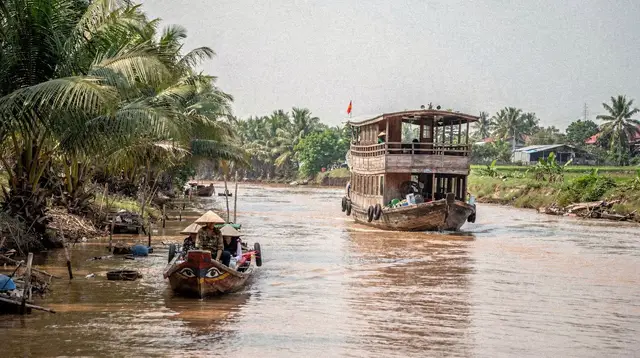
My Tho is the delta town most Saigon day trips are built around, and Ben Tre sits just across the water from it, sharing the same coconut-palm landscape. Together they form the corridor most people picture when they imagine “a Mekong Delta day trip”: a short boat ride out to island orchards, a stop at a small workshop turning coconut into candy, a paddle down a narrow canal in a sampan rowed by hand.
This is the busiest of the delta gateways, which cuts both ways. It is well organized, easy to combine with other stops, and forgiving of a late start from the city. It is also the corridor where a visitor is least likely to feel they have the river to themselves. Anyone who has already pictured wide brown water, drooping mangroves and market boats piled with pineapples from a documentary should know that the My Tho side delivers the postcard version efficiently, but it is a version many other visitors are seeing on the same morning.
Cai Be and Vinh Long: A Step Further, A Notch Quieter
Continue past My Tho along the delta’s main channel and the character shifts. Cai Be and Vinh Long sit further from Saigon on the same general route, deeper into orchard country, where brick kilns and rice-paper workshops sit alongside the fruit gardens. The floating trade here is smaller and more local than the organized market boats near My Tho, and the canals tend to feel less rehearsed for visitors.
This corridor rewards travelers who have already done a first delta day trip, or who simply want less company on the water. It is not a wilder or more remote destination in absolute terms — it is still within a comfortable road distance of the city — but it sits one step further from the standard My Tho circuit, and that step tends to thin the crowds noticeably.
Can Tho: The Delta’s Own City, and the Floating Market
Can Tho is a different proposition altogether. It is not a stop along the way to somewhere else; it is the delta’s largest city, with its own waterfront, its own restaurant scene, and its own rhythm distinct from Saigon’s. It is also the only reliable way to see the Cai Rang floating market, which trades on the water at dawn — a frequent point of confusion, since some visitors assume any delta boat trip includes a floating market, when in fact Cai Rang is specifically a Can Tho experience, not a My Tho one.
Choosing Can Tho as a departure point means choosing a genuine river city over an orchard day out. It suits travelers who want to feel the delta as a place people live and trade in, not only a rural backdrop, and who are willing to go further from Saigon to get that. Because Can Tho sits deeper into the delta than My Tho or Vinh Long, many visitors extend the visit into an overnight rather than treating it as a single long day, which also makes an early market start far more comfortable — see the overnight and multi-day options for how that typically works.
Sa Dec and Chau Doc: Further Provinces, A Different Angle
Two more provinces sit beyond the main Can Tho route and are worth naming, even though they suit a smaller number of trips. Sa Dec is known for its flower-growing village and a quieter, more residential feel than the tourist-oriented stretches nearer My Tho. Chau Doc, close to the Cambodian border, adds a different layer again: Sam Mountain, the Tra Su cajuput forest, and a visible mix of ethnic communities along the border region.
Neither of these is a natural single-day departure point from Saigon in the way My Tho is — the distance and the depth of what they offer both push toward a longer, multi-day Mekong itinerary rather than a there-and-back day. They are worth choosing specifically when the goal is to go further into the delta than the standard corridors reach, not as a default first stop.
Matching the Departure Point to the Trip, Not the Other Way Around
The most useful way to decide is to start from what kind of day is wanted, then work backward to the province that delivers it, rather than picking a road first and hoping it fits.
| Looking for… | Better-suited departure area |
|---|---|
| An easy first taste of delta life, orchards and canals | My Tho and Ben Tre |
| --- | --- |
| The same style of day trip with fewer other visitors | Cai Be and Vinh Long |
| --- | --- |
| A genuine river city and the floating market | Can Tho |
| --- | --- |
| A quieter, more residential detour | Sa Dec |
| --- | --- |
| Ethnic-community sites and the border region | Chau Doc |
| --- | --- |
| Combining Cu Chi’s tunnels with a taste of the delta in one day | Cu Chi and the delta together |
This table deliberately leaves out travel times and prices, because those move often and depend on the operator, the vehicle, and the season — what does not move is the geography: each of these is a distinct province with its own road out of the city, and none of them is a stand-in for the others.
For travelers still weighing whether to commit a full day to the delta at all, this comparison of the day-trip decision is a useful companion piece, and the direct My Tho versus Can Tho comparison goes further into the two most commonly confused options.
Combining Corridors on a Longer Trip
None of the above needs to be an exclusive choice. A two-day structure can open on the My Tho or Ben Tre side, closer to Saigon, and close deeper in around Can Tho, letting a single trip cover both the classic orchard-and-canal introduction and the floating-market morning without rushing either one. A guided two-day Mekong Delta tour is built around exactly this kind of route, moving from the closer provinces into Can Tho territory over two days rather than trying to compress everything into one.
Travelers who want to go further than a standard itinerary, staying with a family rather than passing through, tend to prefer a homestay-based structure such as the HCMC 2 Day Mekong Delta Deep Local Homestay, which spends the overnight inside delta life rather than in a hotel back in Saigon.
Active and Craft-Focused Ways Into the Delta
Departure point aside, how a visitor moves through the delta also shapes the experience. A more active route, mixing paddling and cycling with a hands-on cooking session, is offered through the Mekong Delta Kayak Bike Cooking Experience, which suits travelers who would rather move under their own effort than sit in a boat for most of the day.
For those departing via the Can Tho side specifically, a craft-based stop is available through the Can Tho Italian Charm Bracelet Workshop in Mekong Delta, a small addition that works well alongside a floating-market morning. Closer to the My Tho and Ben Tre side, a hands-on artisan visit is built into the Mekong Delta Day Trip with Hat Making Artisan, pairing the usual orchard stops with a traditional conical-hat workshop.
A Practical Way to Decide
If none of the above resolves the choice, a simple filter helps: pick the province, not the road. Decide first whether the trip is meant to be an easy, well-organized introduction (My Tho, Ben Tre), a quieter version of the same idea (Cai Be, Vinh Long), a full river-city day built around the floating market (Can Tho), or a deeper detour toward the border (Sa Dec, Chau Doc). Once that choice is made, the road out of Saigon follows automatically — each province already has its own route, and no amount of planning changes which one leads where.
Anyone still undecided between a single day and something longer should also weigh the delta against other regions reachable from the city on a similar timeframe, covered in the broader day-trip and short-itinerary planning guide, before settling on a departure point.
FAQ: Choosing a Mekong Delta Departure Point
Is there a single departure point for the Mekong Delta?
No single point. The delta is a group of provinces, and My Tho, Ben Tre, Cai Be, Vinh Long, Can Tho and Chau Doc are each reached by a different road leaving Saigon in a different direction, so the choice is really about which province and which atmosphere suits the trip.
What is the difference between the My Tho and Can Tho approaches?
My Tho sits on the corridor closest to Saigon and is the most visited entry point, with island orchards and coconut-candy workshops reached by short boat rides. Can Tho lies deeper in the delta, feels more like a working river city, and is the usual base for the Cai Rang floating market.
Where is the Cai Rang floating market, and can it be reached from My Tho?
Cai Rang trades on the river at Can Tho, not at My Tho. Some itineraries combine both provinces over two days, but a single day out of My Tho does not reach the floating market.
Are Ben Tre and Cai Be different from My Tho, or the same trip?
Ben Tre sits just across the river from My Tho and shares its coconut-growing landscape, while Cai Be lies further along the delta’s main channel toward Vinh Long. All three can anchor a similar boats-and-orchards day, but each departs on a slightly different route and reaches different canals.
Which departure point suits a quieter, less crowded visit?
Vinh Long and Cai Be generally feel calmer than the My Tho corridor, which carries the heaviest day-trip traffic out of Saigon. Chau Doc, further still toward the Cambodian border, is the quietest of all but is usually paired with an overnight rather than a single day.
Does the departure point decide whether a trip is a day trip or overnight?
It strongly influences it. My Tho, Ben Tre, Cai Be and Vinh Long are commonly done as day trips from Saigon. Can Tho and Chau Doc lie deep enough into the delta that an overnight is the more comfortable way to include the floating market or the border region without rushing back the same day.
Should the choice be based on what is available near Saigon on the day?
It is better to choose based on what a province actually offers than on convenience alone. My Tho and Ben Tre suit a first, easy look at delta life; Can Tho suits travelers who want the floating market and a river city; Chau Doc suits those adding an ethnic-community or border angle to the trip.
Mekong Delta Cruises and Floating Markets
Verified deep-linked GetYourGuide tours. Book through these links and we earn a small commission at no cost to you.
GetYourGuide does not provide a product photo for this activity — the image shows the meeting point, photographed by us.