Fairy Stream, Mui Ne: A Walk You Do on Foot, No Dunes Required
Is the Fairy Stream the same place as the Mui Ne sand dunes?
No. The Fairy Stream is a separate site inside Mui Ne itself, a shallow sand-and-water gully walked on foot and barefoot. The red and white dunes are a different location outside town usually visited by jeep or quad, and have their own guide.
A different kind of Mui Ne morning: walking, not riding
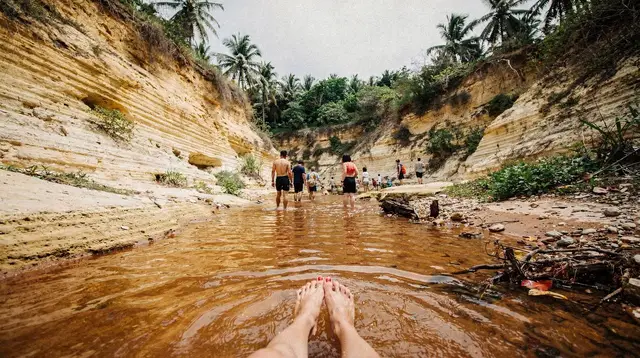
Most people arrive in Mui Ne with the red and white sand dunes already in mind, pictured with a jeep, a quad or a rented buggy churning across open sand. The Fairy Stream is a different experience entirely, and it sits apart from both dune fields. It is a shallow channel of water and sand running through a narrow gully lined with eroded red, orange and white walls, inside Mui Ne itself rather than out at the dunes. There is no vehicle involved in the walk. Shoes come off at the start, and the whole outing happens on foot and mostly barefoot, wading upstream through ankle-to-knee-deep water over a soft, shifting bed of sand.
That difference matters more than it might sound. Travelers who arrive expecting another dune outing sometimes leave disappointed, because the Fairy Stream was never meant to be that. It rewards a slower, quieter pace: watching the water carve patterns through soft sand, noticing how the canyon walls change colour as the light shifts, and simply walking rather than being driven across a landscape. If the dunes are about scale and momentum, the Fairy Stream is about texture and stillness.
This guide covers what the walk itself involves and how to do it well. For how to physically get to Phan Thiet and Mui Ne from Ho Chi Minh City, and for how to structure a full day or multi-day stay once you are there, the logistics live on the day-trip and itinerary pages linked throughout this guide rather than being repeated here.
Where the Fairy Stream sits relative to the rest of Mui Ne
Mui Ne is a long, thin fishing town strung along the coast, and its attractions are spread out rather than clustered. The Fairy Stream entrance sits along the main road through town, closer to the built-up part of Mui Ne than the dune fields are. The white sand dunes and the smaller red dunes lie further out, in open country reached by road, and that separation is exactly why the two are so often confused when people plan a single day around “the dunes.” They are not the same excursion, they are not reached the same way, and they do not look alike once you are standing in either one.
Because the stream sits inside town, a number of hotels along the Mui Ne strip are within a reasonable walk of the entrance, while the dunes generally call for a jeep, a rented motorbike, or an organised tour to reach comfortably. If you are trying to work out which stops fit into which part of a Mui Ne day, or how to sequence the stream against the dunes and the fishing harbour, the day-trip and things to do in Mui Ne pages break that down properly. This page stays with the walk itself.
What the walk actually involves
The path into the Fairy Stream follows the water rather than a paved trail. At the entrance, most visitors remove their footwear and either carry it or leave it with someone minding shoes nearby, because the streambed alternates between firm sand, soft silt that gives underfoot, and patches of shallow flowing water. Walking barefoot is the normal way to do this, and trying to keep shoes on tends to be more trouble than it is worth.
From there, the walk proceeds upstream, following the gully as it narrows and the walls on either side rise. Those walls are the main visual reason people come: layered sand in shades of red, orange, cream and white, exposed and shaped by the water cutting through it. In places the stream is only a few steps wide, and the canyon walls close in enough to block the wider view of town, which is part of what makes it feel separate from the rest of Mui Ne despite being so close to it.
The walk is flat in the sense that there is no climbing involved, but the footing is uneven and it changes constantly. A slow, steady pace with your eyes on where you are stepping works far better than trying to move quickly, especially where the sand is soft enough to sink into or where the current picks up slightly. Most visitors turn around after a comfortable amount of walking and follow the same route back downstream to the entrance; the stream does continue further for those who want to go deeper, but there is no obligation to go any particular distance, and turning back whenever you are ready is entirely normal.
Because you are wading through water for most of the walk, expect your lower legs and feet to be wet throughout, and expect the fine red and white sand to cling to skin and clothing. Bring something you do not mind getting wet and sandy, and plan for a change of clothes and footwear afterward. A dry bag, a sealed plastic bag or a waterproof phone pouch is worth carrying, since both hands are often needed for balance on the uneven bed and it is easy to end up handling a phone or camera with wet or sandy fingers otherwise.
Who this suits, and who might prefer the dunes instead
The Fairy Stream works well for travelers who want something gentler than the dunes: a short, flat, barefoot walk rather than an open expanse of hot sand crossed by vehicle. Families with children who enjoy wading and playing in shallow water often find it more engaging than the dunes, since there is water to touch, sand to squeeze between toes, and narrow canyon walls that feel like an adventure at a manageable scale. Older travelers or anyone uneasy on a jeep or a quad may also prefer it for the same reason: it asks for balance and a steady pace, not speed.
Travelers chasing the classic postcard image of rolling dune ridges, or wanting the thrill of an ATV or buggy crossing open sand, should look at the dune guide and the separate ATV and buggy guide instead, since neither of those experiences happens at the Fairy Stream. The two outings are complementary rather than substitutes for each other, and many visitors do both during the same stay in Mui Ne, on different mornings or as part of the same longer day.
| Aspect | Fairy Stream | Red and white dunes |
|---|---|---|
| Location | Inside Mui Ne town | Outside town, separate site |
| --- | --- | --- |
| Movement | On foot, barefoot, wading | Jeep, quad or buggy typically used |
| --- | --- | --- |
| Terrain | Shallow water and sand gully | Open dune ridges |
| --- | --- | --- |
| Pace | Slow, walking | Faster, vehicle-driven |
| --- | --- | --- |
| Best paired with | A relaxed in-town morning | Sunrise or sunset dune visit |
Sunrise, midday or evening: timing without the specifics
This guide does not give fixed opening times, prices or water conditions, since those details change and are better checked locally or through whichever operator arranges your visit. What can be said more generally is that light changes the character of the canyon walls considerably. Early and late light tends to bring out the reds and oranges in the sand more strongly, similar to the effect seen at the dunes at sunrise, while the middle of the day gives flatter, harsher light. If photography of the canyon colours matters to you, plan around softer light rather than midday.
Because the Fairy Stream sits inside town, it does not require the same early departure that a sunrise dune visit does. That makes it a natural fit for a slower morning, or as a stop worked into a day that also includes the harbour, the town itself, or a combined excursion further out.
Combining the stream with a wider Mui Ne day
Because the Fairy Stream and the dunes are physically separate, several tours package them together with transport included, which removes the need to work out logistics between the two yourself. A jeep excursion that visits the dunes and stops at the stream on the same run is a common way to see both without arranging separate transport.
a jeep run that covers the sunset dunes and the Fairy Stream on the same outing is built around exactly that pairing, letting you do the walk at the stream and still reach the dunes for the softer late-day light.
For travelers who want the stream folded into a broader look at the area’s other sights, a tour taking in the Cham towers alongside the Fairy Stream and the dunes adds cultural stops to the same general route, useful if a single dune-and-stream outing feels too narrow for the time you have.
If you would rather move at your own pace with a private driver, a private sunset tour covering the sand dunes and Fairy Stream gives more flexibility on timing than a scheduled group departure, which suits anyone wanting extra time wading the stream without holding up a group.
Food is a separate but easy add-on to the same evening: a jeep-based local food tour run in the same area can be paired with a stream visit earlier in the day for a fuller Mui Ne itinerary without adding a second transport arrangement.
Small practicalities that make the walk easier
A few habits make the difference between an easy stream walk and an uncomfortable one. Loose, quick-drying clothing beats anything heavy or restrictive, since it will be wet from the knees down for most of the outing and needs to dry out afterward. Sandals or flip-flops carried in a bag are more useful than sneakers, which are awkward to carry and slow to dry if they end up wet by accident. Keep valuables to a minimum: a phone in a sealed bag, a little cash, and not much else, since there is nowhere dry to set things down along most of the route and both hands are often needed for balance on the softer stretches of sand.
Local minders at the entrance sometimes offer to watch shoes or guide visitors upstream for a small tip; this is optional rather than required, and travelers who prefer to manage their own belongings and pace are free to do so. Because the walk is short and contained within a narrow gully, it is difficult to get lost, and the only real decision along the way is how far upstream to go before turning back.
Why the confusion with the dunes keeps happening
Part of the reason travelers mix up the Fairy Stream with the dunes is that both are marketed together so often, bundled into the same half-day or sunset excursions out of Mui Ne. That bundling makes sense logistically, since a jeep can stop at the stream on the way to or from the dune fields without much detour, but it also means the two names get used almost interchangeably in casual trip planning. Seeing “Mui Ne sand dunes and Fairy Stream” in a single tour listing is normal; treating them as the same physical place is the mistake. One is a walk through water and sand at ground level, boxed in by narrow canyon walls; the other is an open, wind-shaped landscape you cross by vehicle. Knowing that distinction before booking anything makes it much easier to read a tour description accurately and to know what a given morning or evening will actually involve.
For travelers weighing whether to book a jeep excursion at all versus renting a quad or buggy independently for the dune portion of a Mui Ne visit, quad bike and ATV rental at the white sand dunes is the option worth comparing against a guided jeep tour, though it applies to the dunes rather than to the stream itself, which has no vehicle component at all. Travelers coming out from Ho Chi Minh City for the day rather than staying overnight in Mui Ne can also look at a day trip from Ho Chi Minh City that includes the Fairy Stream and the sand dunes, which builds the round-trip transport into a single booking rather than requiring a separate overnight stay in Mui Ne.
Fitting the Fairy Stream into a longer trip
Mui Ne rarely stands alone on an itinerary out of Ho Chi Minh City; it is usually one stop within a longer coastal or desert-focused stretch. The three-day Saigon to Mui Ne desert escape itinerary sets out a compact version of that trip, and the stream fits naturally into an in-town morning within it. Travelers who prefer their own car and a more comfortable pace can look at the four-day private-car itinerary from Saigon along the coast to Mui Ne, which allows more room to treat the stream, the dunes and the harbour as separate, unhurried outings rather than one rushed morning.
Getting to Mui Ne from Ho Chi Minh City at all is its own logistical question, covered properly on the long-distance transfer guide, which lays out the road options rather than repeating them here. Once in the area, some travelers extend outward toward the Mekong Delta as part of a wider loop through southern Vietnam, treating Mui Ne as a coastal stop between the city and the delta rather than an isolated beach break.
If beach time matters more than desert scenery on a particular trip, it is worth comparing Mui Ne against the closer options south-east of the city; the guide to choosing a beach near Saigon lays out how Mui Ne stacks up against Vung Tau and the quieter stretches nearer the city for travelers deciding where to spend limited beach time.
For a wider sense of what else sits in and around Mui Ne beyond the stream and the dunes, from the fishing harbour to nearby activity operators, the things to do in Mui Ne hub and the sand dunes and ATV category both group the relevant pages together in one place.
The one thing worth remembering
The Fairy Stream is not a smaller or quieter version of the dunes; it is a different kind of place entirely, defined by walking barefoot through water and sand rather than riding across open dune ridges. Treat it as its own short, easy outing rather than expecting dune scenery, and it tends to be one of the more relaxed stops in a Mui Ne visit. For everything involving vehicles, dune ridges and the wider excursions out of town, the dedicated dune and transfer guides linked above are the right place to keep reading.
Mui Ne Sand Dunes and Jeep Tours
Verified deep-linked GetYourGuide tours. Book through these links and we earn a small commission at no cost to you.
GetYourGuide does not provide a product photo for this activity — the image shows the meeting point, photographed by us.