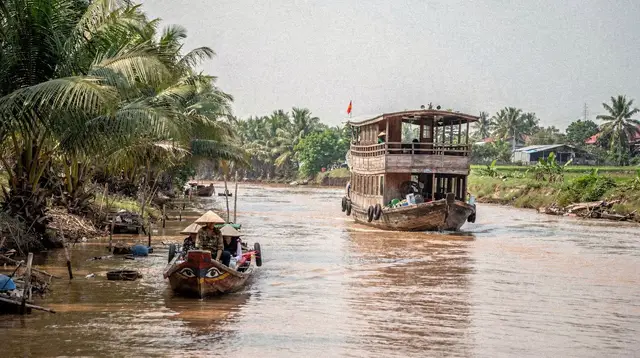
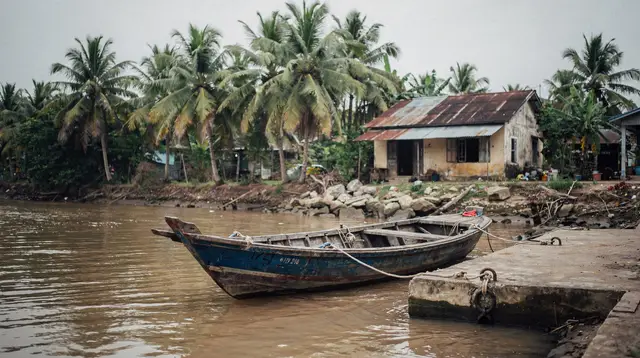
Vietnam’s Land Runs Out Here
Every other stop in the Mekong Delta still feels connected to the rest of the country — orchards, brick kilns, floating markets, all within reach of a return trip to Saigon. Ca Mau is different. It sits at the very southern tip of Vietnam, past Can Tho, past Soc Trang and Rach Gia, at the point where the delta’s rivers finally give way to the sea.
This is where the S-shaped map of Vietnam physically ends, and it is also where the landscape changes character entirely: instead of orchards and rice paddies, the province is dominated by a genuine mangrove and cajuput forest, the U Minh Ha, that has none of the manicured, garden-like feel of the delta closer to the city.
Because of the distance, Ca Mau sees far fewer foreign visitors than My Tho, Ben Tre or even Can Tho. It rewards travellers who have already done the classic delta circuit and want to go further, or who are specifically drawn to wetlands, birdlife and a slower, wilder edge of southern Vietnam rather than another floating market or fruit orchard.
Not Can Gio: Two Different Mangroves, Two Different Places
One confusion comes up constantly, and it is worth clearing up before anything else. Can Gio, the mangrove biosphere reserve visited on an easy day trip from Ho Chi Minh City, is not the same place as the mangrove forest at Ca Mau, and the two should never be treated as interchangeable.
Can Gio sits just outside the city itself, on the edge of the urban sprawl, and its forest is a replanted one — mangrove that was destroyed during the war and has since been regrown as a managed biosphere reserve. It is compact, accessible, and designed for a short excursion: a boat ride, a walk on raised boardwalks, perhaps a stop to see the resident monkeys. It works precisely because it is close and quick.
Ca Mau’s mangrove and cajuput forest is a different order of place. It lies at the southern edge of the entire country, well beyond the reach of a day trip from Saigon, and it forms part of a much larger, more continuous wetland system rather than a single ring-fenced reserve. The forest here reads as genuinely wild rather than restored-and-managed, with waterways that thread for long stretches between stands of mangrove and melaleuca (cajuput) trees, home to a far wider range of birdlife than the smaller, closer reserve.
Travellers who arrive expecting a bigger version of Can Gio are usually surprised at how different the two experiences are — Ca Mau demands more effort to reach, but delivers a much deeper sense of wilderness in return. For a fuller comparison of what each mangrove ecosystem actually offers and how they differ ecologically, the dedicated guide on mangrove and nature experiences lays out the distinctions site-wide, and the Can Gio mangrove biosphere reserve guide covers that closer option in detail.
The Southernmost Point of Vietnam
Part of what draws travellers this far is symbolic rather than scenic: Ca Mau province contains the literal southernmost point of mainland Vietnam, at Mui Ca Mau (Ca Mau Cape), where the country’s coastline curves and comes to an end facing the sea. Reaching it typically means combining a boat journey through mangrove channels with a final stretch on foot or by smaller craft, since the cape itself sits within the protected forest rather than at the edge of a town.
The appeal is less about a dramatic landmark and more about the feeling of having gone as far as Vietnam goes — a natural bookend for travellers who have already explored Ho Chi Minh City, the closer delta towns and perhaps Chau Doc near the Cambodian border. Framed against the length of the country, from Hanoi in the north down through the whole of the delta, Ca Mau marks the finishing line.
The U Minh Ha Forest and Its Wetlands
Inland from the cape, the U Minh Ha forest forms the ecological heart of the province: a mix of mangrove along the tidal waterways and melaleuca (cajuput) forest on the peatier ground further from the coast. The two ecosystems sit close together but behave differently — mangrove roots working the brackish, tidal channels, cajuput stands rising from freshwater-influenced peat soils further inland — and moving between them by small boat is the main way visitors experience the area.
Wildlife is the main draw for anyone who makes the effort to come this far. Bird life is the most consistently rewarding part of a visit, with herons, storks and a wide range of waterbirds using the forest and its channels, especially away from the more heavily visited stretches. The forest is not a wildlife park with guaranteed sightings on a schedule; it works the way genuine wetland ecosystems do, rewarding patience and quiet boat travel over a fixed itinerary.
Travellers specifically interested in the birdlife of the delta, rather than the built attractions, will find the fuller picture in the dedicated guide to bird watching across the Mekong Delta, which places Ca Mau’s wetlands alongside other birding sites such as Tra Su cajeput forest near Chau Doc — a useful comparison, since Tra Su is considerably easier to combine with a shorter delta trip.
A guided canoe route through the mangrove channels is the standard way to see the forest up close, gliding under the arched roots and dense canopy rather than viewing it from a larger boat: a mangrove forest canoe tour into the Ca Mau wetlands covers this directly.
Why Ca Mau Sits Apart From the Rest of the Delta Circuit
Every other destination profiled on this site as part of the Mekong Delta — My Tho, Ben Tre, Cai Be, Vinh Long, Sa Dec, Can Tho and Chau Doc — sits within reach of a loop that starts and ends near Saigon, whether as a single day trip or a multi-day tour. Ca Mau breaks that pattern. Its distance from the city, and from the other delta towns, means it is rarely bolted onto a standard itinerary; it functions instead as an extension for travellers who have already committed serious time to the south of Vietnam, or as the final leg of a longer loop that pushes all the way to the coast.
This also shapes what a visit looks like in practice. Where a My Tho or Ben Tre trip can be a brisk half-day of orchards and canals, Ca Mau rewards — and effectively requires — slowing down. The forest and the cape are not attractions to tick off quickly; they are a landscape to move through by boat, at the pace the waterways set. Travellers weighing up how far into the delta to go, and whether Ca Mau’s distance is worth it for their particular trip, will find that trade-off addressed directly in the guide on choosing a Mekong Delta departure point, and in the broader planning guide to how many days to spend in southern Vietnam.
For travellers building an itinerary that reaches this far, the five-day deep Mekong: Chau Doc and Ca Mau itinerary is built specifically around combining the two, and the longer seven-day Mekong and islands itinerary shows how a Ca Mau extension can sit inside an even bigger loop through the delta and the coast. The deep Mekong Delta loop guide goes into more depth on sequencing a multi-stop route that pushes past the closer towns toward Ca Mau and the far south.
Getting There and Moving Around
Reaching Ca Mau means committing to the delta’s road network well past the points where most day-trippers turn back, continuing south beyond Can Tho and the Cai Rang area. Because of this, independent travel is far less common here than around the closer delta towns, and most visitors arrive as part of an organised multi-day route through the delta rather than as a standalone add-on to a Saigon-based day trip.
Once in the province, movement shifts from road to water. The forest and the cape are approached by boat rather than by car, and local operators run the mangrove channels with small craft suited to the narrower waterways — a different rhythm from the wider canals and larger tourist boats seen further north around My Tho and Ben Tre. Anyone planning to combine Ca Mau with the rest of the delta should expect the whole trip, not just this final leg, to run mostly by road and then by water, in line with how the wider Mekong Delta network operates.
For travellers who prefer a single operator handling the delta’s more distant stretches by bicycle and boat over several days rather than assembling the route themselves, a two-day Mekong Delta cycling and cooking trip from Can Tho is a useful base from which to extend further south, and a one-day Cai Be and Vinh Long tour is a good comparison point for how much shorter — and closer to Saigon — the standard delta day trip usually is.
Comparing Ca Mau to the Rest of the Delta
The table below sets Ca Mau against the delta stops most visitors see first, purely in terms of how it fits into a trip rather than any specific costs or schedules.
| Destination | Character | Typical role in a trip |
|---|---|---|
| My Tho / Ben Tre | Coconut country, canals, orchards | Closest delta stop, easy day trip |
| --- | --- | --- |
| Cai Be / Vinh Long | Orchards, brick kilns, river life | Standard day-trip or overnight stop |
| --- | --- | --- |
| Can Tho | Delta’s main city, Cai Rang floating market | Central base for the wider delta |
| --- | --- | --- |
| Chau Doc | Border town, Sam Mountain, Tra Su forest | Deeper delta stop, often paired with Ca Mau |
| --- | --- | --- |
| Ca Mau | Southernmost point, mangrove and cajuput wilderness | Extension for a longer, deeper delta route |
Travellers deciding between a shorter delta trip and one that reaches Ca Mau will also find the comparison of a Mekong Delta day trip versus a two-day tour helpful for gauging how much extra time a place this far south actually requires, and the My Tho versus Can Tho comparison shows just how much closer — and busier — the more typical delta stops are by contrast.
Staying Overnight
Because Ca Mau sits so far from Saigon and from the rest of the delta circuit, a same-day return is impractical, and most visitors who make the trip build in at least one night in the area, whether in Ca Mau city itself or at a homestay closer to the forest. This overnight stop is less about needing extra sightseeing time and more a function of distance: the journey down and the boat time within the mangrove forest already fill a full day on their own. Travellers interested in staying with a local family rather than in a standard hotel, as is common elsewhere in the delta, can read more in the guide to Mekong Delta homestays, which covers the format generally across the region rather than any single town.
Who Ca Mau Suits — and Who It Doesn’t
Ca Mau is not a place to add on impulse. It suits travellers who have already spent meaningful time in the delta and are looking for a genuine wilderness experience rather than another market or orchard stop, birdwatchers and wetland enthusiasts specifically drawn to mangrove and cajuput ecosystems, and anyone who wants the particular satisfaction of reaching Vietnam’s southern extremity rather than stopping at Can Tho or Chau Doc. It suits slower travel generally: boat time through narrow channels rewards patience rather than a checklist mentality.
It suits less well the traveller with only a day or two free in the south, or anyone expecting a mangrove experience similar in scale and ease to Can Gio near the city — that expectation, as covered above, does not match what Ca Mau actually offers. For those short on time, the closer and considerably more accessible mangrove and wetland options — Can Gio near Saigon, or Tra Su near Chau Doc — deliver a similar flavour of landscape without the extra distance.
Ca Mau: Frequently Asked Questions
Is Ca Mau part of the standard Mekong Delta day trip?
No. Ca Mau lies well beyond the delta towns typically visited on a day trip from Ho Chi Minh City, such as My Tho, Ben Tre, Cai Be and Vinh Long. It is normally visited as an extension of a longer, multi-day delta route rather than a stand-alone day trip.
What is the difference between Ca Mau’s mangrove forest and Can Gio?
Can Gio is a smaller, replanted mangrove biosphere reserve close to Ho Chi Minh City, designed for an easy day trip. Ca Mau’s mangrove and cajuput forest is a much larger, more natural wetland system at Vietnam’s southern tip, deep inside the Mekong Delta and a far more involved journey to reach.
Can I combine Ca Mau with Can Tho and Chau Doc in one trip?
Yes, and this is the most common way travellers reach it. Ca Mau is typically added as the final leg of a longer delta route that already includes Can Tho and Chau Doc, rather than visited on its own.
What is there to see in Ca Mau besides the mangrove forest?
The main draws are the U Minh Ha forest itself, its cajuput and mangrove wetlands, the birdlife found across those channels, and Mui Ca Mau, the cape marking Vietnam’s southernmost point.
Is Ca Mau worth visiting if I only have a short time in southern Vietnam?
Generally no. Given how far it sits from Saigon and from the rest of the delta, Ca Mau suits travellers who have already allotted extra time for a deeper delta route. Those with only a day or two are usually better served by the closer delta towns or by Can Gio near the city.
How do visitors get around once in the Ca Mau area?
Movement within the forest and out to the cape is done by boat, following the mangrove channels rather than by road, which is the main reason a visit here takes longer than at the closer, more accessible delta stops.
Is Ca Mau connected to any UNESCO World Heritage Site?
No. No site covered on this website, including Ca Mau, is inscribed on the UNESCO World Heritage List. Can Gio and Cat Tien are UNESCO Biosphere Reserves, a separate programme, and Ca Mau’s wetlands are not part of either designation.