My Tho vs Can Tho: Which Mekong Delta Gateway Should You Choose?
Should I visit My Tho or Can Tho for the Mekong Delta?
My Tho is the closest delta town to Ho Chi Minh City and suits a short taste of the river and its orchards. Can Tho is further into the delta and is the base for the Cai Rang floating market, which is near Can Tho, not near My Tho.
Two Different Doors Into the Same Delta
Anyone planning a trip out of Ho Chi Minh City into the Mekong Delta quickly runs into the same choice: go to My Tho, or go to Can Tho. Both towns sit on the delta’s river network, both are reachable from the city, and both appear constantly in tour listings — which is exactly why they get confused with each other. They are not interchangeable versions of the same experience. They sit at different points in the delta, they have different atmospheres, and, most importantly for many travellers, only one of them is genuinely close to the Cai Rang floating market.
This guide sets out what separates the two, without pretending they compete on exactly the same terms. My Tho is the delta’s front door: the nearest major town to the city, useful when time is short. Can Tho is deeper into the delta, more of a destination in its own right, and the place most people actually mean when they picture a Mekong floating market. Other delta towns — Ben Tre, Chau Doc, Sa Dec — have their own guides and are only mentioned here in passing, since they are not part of this particular comparison.
My Tho: The Closest Taste of the Delta
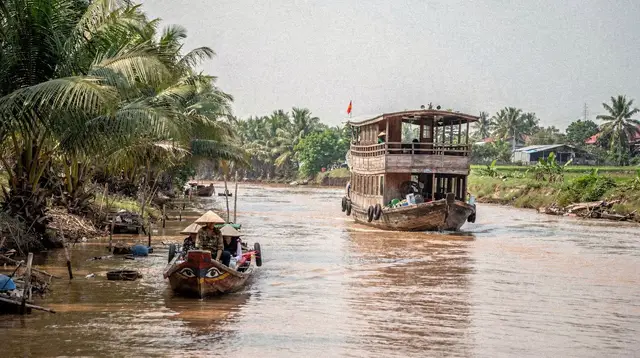
My Tho is the delta town travellers reach first when heading south-west out of the city. Its proximity to Ho Chi Minh City is its defining feature: it is the option for anyone who wants a genuine sense of the delta — the slow brown river, the fruit orchards, the narrow canals lined with coconut palms — without committing a full day or more to getting there and back. This is why so many Mekong Delta day trips from Saigon are built around My Tho rather than a destination further into the delta.
The town itself sits on the northern arm of the Mekong, and its river frontage is the starting point for smaller boats out to the islands and canals nearby. It works well combined with Ben Tre just across the river, which is where the coconut-focused workshops and orchard visits that many My Tho itineraries include actually take place. Together, My Tho and Ben Tre form the standard “quick delta” combination: enough river, enough greenery, enough of a change of pace from the city, all within reach of a single day.
What My Tho does not offer is a floating market of any real note. This is the single most important thing to understand before booking, because it is also the single most common point of confusion among people planning their first delta trip.
Can Tho: The Delta’s Main City, and Home to Cai Rang
Can Tho sits considerably further into the delta than My Tho, and it functions differently: rather than a riverside town oriented toward a handful of nearby sights, it is the delta’s largest city, a working urban centre with its own rhythm, markets and river traffic. Visiting Can Tho is less about a single afternoon on the water and more about spending time in a place where the delta’s economy and daily life are visibly built around the river.
The reason most travellers who reach this guide are actually asking about Can Tho, whether they realise it or not, is the Cai Rang floating market. Cai Rang trades on the river at dawn, boats stacked with produce identifying what they sell by hanging a sample from a tall pole, and it is one of the most photographed scenes in the entire delta. Cai Rang is near Can Tho. It is not near My Tho, and it never has been — a distinction worth repeating because it is so often garbled in casual trip planning and in secondhand advice.
Because Can Tho lies further from the city, seeing it properly, and especially seeing Cai Rang at its best in the early morning light, generally suits an overnight stay rather than a rushed single day. Several two-day Mekong Delta tours are built specifically around an overnight in or near Can Tho for this reason, positioning travellers to be on the water at Cai Rang at dawn rather than arriving well into the morning after the market has thinned out.
The Floating Market Confusion, Addressed Directly
It is worth stating plainly, because the mix-up is so persistent: the Cai Rang floating market is not a My Tho attraction. Some older travel writing, some resold tour packages and a fair amount of word-of-mouth advice conflate the two, presumably because both towns are lumped together under the generic label “Mekong Delta day trip.” If a floating market at dawn is the experience you are after, the itinerary needs to be built around Can Tho, not My Tho. A My Tho-based day trip may include a market stop, but it will be a land-based or canal-side market rather than the sprawling boat-to-boat trading that defines Cai Rang.
This matters for planning because the two towns pull in different directions logistically. My Tho rewards an early but manageable departure and gets you back to the city the same evening. Can Tho, especially if the floating market is the goal, rewards either a very early start on a long single day or, better, an overnight stay so you are already on the water when the market is busiest.
Getting There: Distance and Travel Time
The gap in atmosphere between the two towns starts with the gap in distance. My Tho sits roughly 70 km from Ho Chi Minh City, close enough that the road journey is a manageable opening or closing leg of a single day rather than the day itself. Can Tho is roughly 170 km from the city, reached in about three to three and a half hours on the expressway — a trip that, on its own, already accounts for a meaningful share of a day’s available hours before any time on the water is factored in.
That difference is the practical reason the two towns end up serving different kinds of itineraries rather than being straightforward substitutes for each other. A My Tho day trip spends most of its time actually in the delta, on the river and among the orchards, because so little of the day is consumed getting there and back. A Can Tho trip, especially one built around seeing Cai Rang at dawn, effectively front-loads the travel time the night before by way of an overnight stay, so that what would otherwise be a very long single day becomes an early, short transfer to the water instead.
Other Delta Towns Along the Way
My Tho and Can Tho are the two ends of this particular comparison, but they are not the only stops on the road between them. Cai Be and Vinh Long sit roughly between the two, known for their orchards and brick kilns, and some itineraries use them as a waypoint or an alternative overnight rather than going all the way to Can Tho. Sa Dec, a little further along, is known for its flower village and is sometimes folded into longer routes that continue toward Chau Doc near the Cambodian border. None of these serve as a substitute for the Cai Rang floating market itself, which remains specifically a Can Tho attraction, but they are worth knowing about if the plan is to see more of the delta than a simple My Tho-or-Can Tho choice implies.
Travellers weighing up a route through several of these towns rather than a single gateway can look at the Cai Rang floating market and Mekong Delta tour from Saigon, which threads the floating market into a wider delta itinerary rather than treating Can Tho as an isolated overnight stop.
Side-by-Side Comparison
| My Tho | Can Tho | |
|---|---|---|
| Position in the delta | Closest major town to Ho Chi Minh City | Further south-west, the delta’s main city |
| --- | --- | --- |
| Typical visit length | Manageable as a single day | Better suited to an overnight stay |
| --- | --- | --- |
| Floating market | Not a floating market destination | Base for the Cai Rang floating market |
| --- | --- | --- |
| Character | Riverside town, orchards, canals | Larger city, working river trade, markets |
| --- | --- | --- |
| Often paired with | Ben Tre, across the river | An overnight stop before or after Chau Doc |
| --- | --- | --- |
| Best suited to | A short first taste of the delta | Travellers prioritising Cai Rang and delta depth |
Which One Should You Actually Book?
If your time is limited to a single day and you want a genuine, unhurried sense of the delta without a long trip each way, My Tho is the more practical choice, especially paired with Ben Tre. If the floating market is the reason you are going to the Mekong Delta at all — and for a great many travellers, it is — then the itinerary has to run through Can Tho, and an overnight there is worth considering over a rushed day trip.
Several operators offer both patterns. A standard Mekong Delta tour built around My Tho and Ben Tre gets you onto the water and through the orchards without eating into more than a single day; you can look at options through the Mekong Delta day tour. For travellers set on seeing Cai Rang at its liveliest, a longer itinerary that overnights near Can Tho is the more reliable route, such as the two-day Mekong Delta tour with an overnight near Can Tho.
Those who want to cover ground by bicycle rather than only by boat can also look at the two-day cycling tour that starts from Can Tho, which builds in more time around the city itself rather than just the market run. Travellers looking for a slower, hands-on activity once they’ve reached Can Tho sometimes add the craft workshop available in Can Tho as a change of pace between river excursions.
Combining Both, If Time Allows
Nothing prevents combining the two on a longer route through the delta, and several multi-day itineraries do exactly this, moving from the closer, quieter My Tho area toward the busier, market-driven Can Tho further south-west. This suits travellers who want both the easy first impression that My Tho gives and the fuller delta experience, floating market included, that Can Tho provides. It does mean a longer overall trip, and it is worth deciding upfront whether that additional time is available before building an itinerary around it.
For those planning independently, our guide to choosing a Mekong Delta departure point walks through how the various delta gateways fit together, and our broader look at whether a Mekong Delta day trip is worth it covers the trade-offs between a single rushed day and a longer, more deliberate visit.
Whichever direction you choose, both towns are reached from Ho Chi Minh City by road before continuing by boat once you reach the river, in keeping with how nearly every excursion into the Mekong Delta actually operates. If your base is District 1 or another central neighbourhood, both My Tho and Can Tho tours typically include hotel pickup, so the choice really comes down to what you want to see once you arrive: a compact, close-in taste of the delta at My Tho, or the working river life and dawn market trade that define Can Tho.
Frequently Asked Questions About My Tho and Can Tho for the Mekong Delta
Is the Cai Rang floating market near My Tho or Can Tho?
Cai Rang is near Can Tho, not My Tho. This is one of the most common mix-ups among travellers planning a Mekong Delta trip, and it should drive which town you choose if the floating market is your priority.
Which town is closer to Ho Chi Minh City, My Tho or Can Tho?
My Tho is the closest of the two main delta gateways to Ho Chi Minh City. Can Tho lies further south-west into the delta, making it a longer trip from the city.
Can I see a floating market from My Tho?
My Tho itself is not known for a floating market. Travellers who want that experience typically continue toward Can Tho, where Cai Rang trades on the river at dawn.
Is My Tho worth visiting if I’m also going to Can Tho?
They serve different purposes. My Tho offers an easy first taste of the delta close to the city, while Can Tho is the delta’s main city and the base for the floating market. Some itineraries combine both on a longer route.
Which is better for a first-time visitor with limited time?
My Tho suits travellers who want a shorter, simpler introduction to the delta. Can Tho suits those willing to go further for the floating market and a fuller sense of the delta’s scale.
Do My Tho and Can Tho feel different in character?
Yes. My Tho feels like a compact riverside town close to the orchards and coconut country around it, while Can Tho feels like a genuine delta city, larger and busier, organised around its river and market life.
Are Ben Tre and other delta towns part of this comparison?
No. Ben Tre, Chau Doc and Sa Dec are separate stops covered elsewhere; this guide focuses specifically on the choice between My Tho and Can Tho as gateway towns.
Tour Comparisons
Verified deep-linked GetYourGuide tours. Book through these links and we earn a small commission at no cost to you.
GetYourGuide does not provide a product photo for this activity — the image shows the meeting point, photographed by us.