Cai Be and Vinh Long: A Deeper Mekong Delta Day Trip
What makes Cai Be and Vinh Long different from My Tho and Ben Tre?
Cai Be and Vinh Long sit farther into the Mekong Delta than My Tho and Ben Tre, with narrower canals, quieter orchard islands, and their own small local floating markets rather than the large one at Cai Rang, which belongs to Can Tho further south.
A Quieter Layer of the Mekong Delta
Most first-time visitors to the Mekong Delta from Ho Chi Minh City head straight to My Tho and Ben Tre, the closest towns to the city and the subject of their own My Tho and Ben Tre tour guide.
Cai Be and Vinh Long sit a little farther along the same river system, and the difference shows on arrival: canals narrow, traffic thins out, and the pace of both the water and the towns slows down. This page is about that stretch of the delta specifically — not the closer My Tho-Ben Tre loop, and not Can Tho and its well-known Cai Rang floating market farther south, which have their own dedicated coverage.
Cai Be and Vinh Long are often paired into a single day because they sit close to each other along the same section of river, separated mainly by a scatter of low, green islands rather than by any real distance in travel character. Together they give a picture of delta life that leans more toward orchards, small-scale workshops, and river islands than toward market spectacle.
Cai Be’s Own Floating Market and Orchard Canals
Cai Be has a local floating market of its own. It is genuinely a working market — boats loaded with produce, poles hung with samples of what each vendor is selling — but it operates on a much smaller scale than the market most travelers picture when they hear “Mekong floating market.” That larger, busier market is Cai Rang, and it belongs to the Can Tho section of the delta, not to Cai Be. Confusing the two is common enough that it is worth stating plainly here: Cai Be’s market is real, local, and worth seeing, but it is not Cai Rang, and expecting Cai Rang’s scale at Cai Be leads to disappointment.
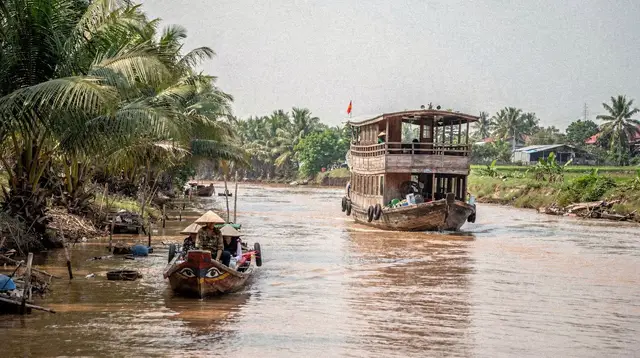
Beyond the market, Cai Be is known for its canal-side orchards and small family workshops. Sampan boats — the narrow, low wooden boats typical of the delta — thread through canals barely wider than the boat itself, passing coconut palms, fruit trees, and modest houses built right up to the waterline. Stops commonly include a coconut candy workshop, a rice-paper or puffed-rice operation, and an orchard where seasonal fruit is served. None of this is staged for scale; it is closer to a slow float through a working rural district than a tour of an attraction.
a small-group boat outing around Tan Phong Island’s orchard canals near Cai Be covers this side of the area well, keeping group sizes down so the narrow canals stay peaceful rather than congested.
Vinh Long: Islands, Brick Kilns and a Quieter Pace
Vinh Long sits a short stretch of river beyond Cai Be, and the two are usually treated as a single day out. The town itself faces a cluster of river islands, reached by sampan, where the orchard-and-canal pattern continues but with its own local character — fewer visitors, more everyday village life visible from the water, and a slower rhythm overall.
One thing that sets the Vinh Long side apart is the presence of old brick kilns along the riverbanks, a legacy of a once-significant local brick and pottery industry. Their tall, rounded kiln structures are still visible from the water in places, giving the landscape a distinctive silhouette that differs from the more purely agricultural scenery around Cai Be. Vinh Long also has its own local floating market, separate again from both Cai Be’s market and from Cai Rang — a third, distinct market rather than a variation on either of the other two.
a village-focused outing through Cai Be that spends time with local families and small household workshops is a good match for travelers who want the human side of this area rather than a market-first itinerary.
Getting There and Combining the Two
Cai Be and Vinh Long are reached from Ho Chi Minh City by road, continuing onto the water once the group reaches the river — the same pattern that applies across the delta, since nearly every departure from the city runs by coach, minibus or private car before switching to boat. Both towns lie farther from the city than My Tho and Ben Tre, and travelers choosing between the two sections should weigh proximity against pace: the closer My Tho-Ben Tre route suits a shorter, simpler outing, while Cai Be and Vinh Long suit those willing to go a bit farther for narrower canals and fewer other visitors.
Because the two towns sit close together along the same stretch of river, most itineraries combine them rather than choosing one over the other, moving between orchard stops on the Cai Be side and island or brick-kiln stops on the Vinh Long side within the same day.
a full day combining Cai Be’s canals and orchards with the river islands and brick kilns around Vinh Long is built around exactly this pairing, moving between the two areas without doubling back to the city in between.
What a Day in Cai Be and Vinh Long Looks Like
A typical day threads together a handful of recurring elements, though the exact order and mix vary by operator:
| Element | What it involves |
|---|---|
| Sampan canal ride | Narrow, low wooden boats moving through shaded orchard canals |
| --- | --- |
| Local floating market stop | Cai Be’s own market, or Vinh Long’s, seen from the water |
| --- | --- |
| Orchard or garden visit | Seasonal fruit tasting on one of the river islands |
| --- | --- |
| Small workshop stop | Coconut candy, rice paper, or a similar household craft |
| --- | --- |
| River island walk | A short stretch on foot between canal-side homes and gardens |
| --- | --- |
| Brick kiln view | Old kiln structures along the Vinh Long riverbank |
None of these stops are timed to a fixed schedule published here — delta boat departures shift with river conditions and group size, and travelers should confirm timing directly with whichever operator they book rather than relying on a printed itinerary.
For travelers who want the region’s cacao side rather than more coconut and rice-paper stops, a farm visit and tasting focused on the cacao grown in the wider delta region near Cai Be makes a useful variation on the standard canal-and-orchard format.
Cai Be and Vinh Long vs Cai Rang and Can Tho
It bears repeating, because it is the single most common point of confusion in this part of the delta: Cai Be and Vinh Long each have their own local floating markets, and neither is Cai Rang. Cai Rang is the delta’s best-known floating market, and it operates near Can Tho, a separate section of the delta with its own dedicated coverage on this site, including a guide focused on the Cai Rang market and Can Tho itself. Travelers hoping to see Cai Rang specifically should look at the Can Tho section rather than a Cai Be or Vinh Long itinerary, since the two are not interchangeable and combining them into a single day is not realistic given the distances involved.
Within their own area, Cai Be and Vinh Long’s markets are worth seeing precisely because they are smaller and less visited — a more authentic look at how delta produce actually moves by water, without the crowds that now surround Cai Rang’s better-known scenes.
Choosing Between My Tho–Ben Tre and Cai Be–Vinh Long
Both pairings sit within the same broader Mekong Delta region reachable from Ho Chi Minh City, and travelers with only one day to spare often have to pick one. A few points of contrast help:
- Distance and pace: My Tho and Ben Tre sit closer to the city and suit a more compact day; Cai Be and Vinh Long go a little farther and reward a slower, more rural pace.
- Canals: My Tho and Ben Tre’s canals tend to be wider near the main river; Cai Be and Vinh Long’s inner canals narrow further, deep into orchard country.
- Markets: Both areas have local floating markets rather than Cai Rang’s scale — none of the towns covered on this page compete with Can Tho on market size, and none should be expected to.
- Distinctive sights: Ben Tre is known for coconut country; Vinh Long adds old brick kilns and river islands not found on the My Tho-Ben Tre route.
Full comparative detail lives on the dedicated My Tho and Ben Tre tour guide; this page focuses on the Cai Be-Vinh Long side of that choice. For travelers still undecided on which delta departure point fits their trip best, the guide to choosing a Mekong Delta departure point lays out the wider set of options, including the two-day route through Can Tho and Cai Rang for travelers with more time.
Planning Notes for Cai Be and Vinh Long
A few practical notes worth keeping in mind, without pinning them to figures that shift by operator and season:
-
Both areas are part of the Mekong Delta region and are reached from Ho Chi Minh City by road before switching to boat, the standard pattern described in the Mekong Delta day trip overview.
-
The delta’s wet season brings short, heavy afternoon downpours rather than all-day rain, so a Cai Be or Vinh Long day generally remains workable outside of the heaviest storms; the dry season offers steadier conditions for the open sections of river.
- Sampan rides through the narrowest canals mean sun exposure and humidity are more relevant than rain most of the year — light clothing, a hat, and water are the practical basics.
-
Travelers wanting an overnight stay rather than a single day can look at the region’s Mekong Delta homestay options, which extend the same canal-and-orchard experience into an evening on the water.
-
For a broader look at how the delta’s various sampan routes compare, the Mekong sampan and canals guide covers boat styles and canal characters across the wider region, not just Cai Be and Vinh Long.
For travelers keen to see the region’s ethnic Khmer heritage sites in the same general direction, the Khmer temples of the Mekong Delta guide points toward destinations farther along, while those wanting a broader look at things to do around this stretch of the delta can check the Mekong Delta activities hub and the Cai Be activities page directly.
For a more community-based angle on the wider delta, beyond the standard canal-and-market format, an eco-tourism day trip built around a local farming community and traditional folk games offers a different rhythm than the Cai Be-Vinh Long boat circuit, for travelers who want to compare formats before deciding.
Cai Be and Vinh Long FAQ
Is the Cai Be floating market the same as Cai Rang?
No. Cai Be has its own local floating market, much smaller and quieter than the well-known Cai Rang floating market, which trades near Can Tho, well beyond Cai Be and Vinh Long.
Does Vinh Long also have a floating market?
Yes, Vinh Long has a small local floating market of its own, distinct from both Cai Be’s and from Cai Rang. All three are separate markets in different parts of the delta.
Should I visit My Tho and Ben Tre or Cai Be and Vinh Long?
They are different sections of the same delta. My Tho and Ben Tre sit closer to Ho Chi Minh City and are covered on their own page; Cai Be and Vinh Long are a little farther in, with narrower canals and a quieter feel.
Can I see Cai Rang floating market from Cai Be or Vinh Long?
Not on the same short outing. Cai Rang is near Can Tho, farther into the delta, and is best planned as part of a Can Tho visit rather than a Cai Be or Vinh Long day trip.
What do people actually do in Cai Be and Vinh Long?
Typical activities include sampan rides through narrow orchard canals, stops at fruit gardens and small workshops such as coconut candy or brick kilns, a look at the local floating market, and a boat trip around the river islands near Vinh Long.
Is Cai Be part of the Mekong Delta or a separate region?
Cai Be and Vinh Long are both part of the Mekong Delta, positioned between the My Tho and Ben Tre area and the Can Tho area farther south and west.
Are Cai Be and Vinh Long good for a first Mekong Delta visit?
They work well for travelers who want a quieter, more rural feel than the busier My Tho and Ben Tre routes, though those closer towns remain a common first choice for a shorter day trip.
Mekong Delta Cruises and Floating Markets
Verified deep-linked GetYourGuide tours. Book through these links and we earn a small commission at no cost to you.
GetYourGuide does not provide a product photo for this activity — the image shows the meeting point, photographed by us.