Coconut Country, Not My Tho
Ben Tre gets folded into conversations about My Tho so often that many visitors leave the Mekong Delta without realizing they are, in fact, two different provinces. They sit close together, connected by a bridge and by the same wide stretch of river, and a great many day trips from Ho Chi Minh City visit both in a single outing.
That closeness is exactly why the two get blurred into one place in people’s memory afterward. They are not one place. My Tho is a provincial capital and the delta’s most visited gateway town, built around a busy riverfront and a market. Ben Tre is its own province, reached by crossing the river, and it has a noticeably different feel: narrower canals, denser coconut groves, and a rural, craft-based economy that has grown up specifically around the coconut palm.
This page treats Ben Tre on its own terms, as coconut country, rather than repeating the general orientation to the delta already covered on the Mekong Delta hub page. If you have not read that page yet, it is the better starting point for understanding how My Tho, Ben Tre, Cai Be, Vinh Long, Sa Dec, Can Tho, Chau Doc and Ca Mau relate to one another and to Ho Chi Minh City. Here, the focus stays narrow: what makes Ben Tre distinct, why it is worth treating as its own stop rather than an extension of My Tho, and where to look for practical detail on what to actually do there.
Why the Confusion Happens
The confusion between Ben Tre and My Tho is understandable and comes from three overlapping habits. First, geography: the two sit directly across the river from one another, close enough that a single boat crossing links them, so a tour that “visits My Tho” very often continues straight into Ben Tre without a clear signal that the province has changed.
Second, marketing shorthand: many day-trip itineraries are simply labeled “My Tho and Ben Tre” as a pair, which trains travelers to think of the combination as a single destination rather than two adjoining ones. Third, appearance: from a boat seat, one stretch of brown river and green riverbank can look much like the next, and without a guide pointing out the crossing, it is easy to assume the scenery has stayed within the same province the whole time.
The distinction matters for reasons beyond trivia. Ben Tre’s canals are narrower than the main channels around My Tho, which changes the kind of boat trip on offer — smaller sampans, tighter turns beneath overhanging palms, a quieter and more intimate feel than the wider My Tho waterfront. Ben Tre’s economy and craft tradition are also built around a single crop in a way My Tho’s is not: the coconut. Recognizing Ben Tre as its own province, rather than as “the other side of My Tho,” is the difference between remembering a blurred half-day and remembering a specific place with its own character.
Coconut Country
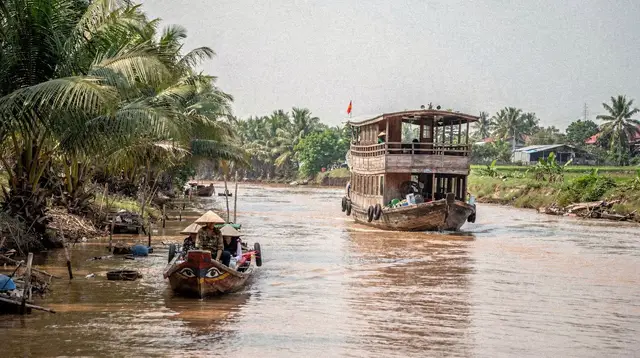
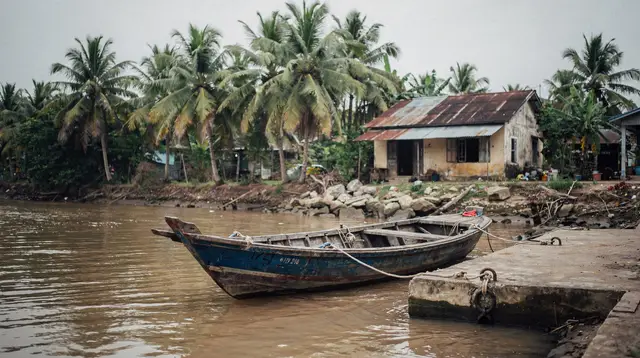
The nickname fits. Ben Tre’s landscape is dominated by coconut palms, planted in dense rows along the province’s many small canals, and the coconut shapes daily life here far more visibly than in most of the rest of the delta. Boats loaded with coconuts move along the waterways. Roadside stalls sell coconut candy wrapped by hand. Workshops process the fruit into a range of goods: the sweet, chewy candy that Ben Tre is best known for, along with handicrafts, mats, and construction materials made from coconut fiber and shell. Walking or paddling through a Ben Tre canal means passing under a nearly continuous canopy of palm fronds, with the sound of small workshops and the smell of coconut caramel drifting from open-sided sheds along the bank.
This concentration of coconut-based craft is Ben Tre’s clearest point of difference from neighboring provinces. My Tho does not have the same density of coconut workshops; Cai Be and Vinh Long are known more for their orchards and floating trade than for a single defined craft. Ben Tre’s identity as coconut country is specific to Ben Tre, and it is the reason a short stop here reads differently from a stop anywhere else nearby in the delta.
For a fuller look at what a coconut workshop visit or a canal boat ride actually involves, this site’s dedicated activity guides go into more depth than a destination overview should. The craft workshops category page covers coconut candy-making and other hands-on workshops found in Ben Tre and elsewhere in the delta, and the river cruises category page covers the range of boat trips, from wide-channel cruises to the narrow sampan paddles that Ben Tre’s canals are particularly suited to. Rather than repeat that detail here, this page points to those pages for anyone planning the specifics of a visit.
Getting There and Getting Around
Ben Tre sits close enough to Ho Chi Minh City to work as a day trip, on a similar footing to My Tho in terms of how the journey is usually arranged: by road, in a coach, a minibus, or a private car, often with a short river crossing folded into the route. Because Ben Tre and My Tho are so often visited together, many travelers reach Ben Tre as the second half of a combined outing rather than as a standalone destination, crossing the river once the My Tho stop is finished. It is equally possible to arrange a trip that focuses on Ben Tre specifically, without treating it as an add-on.
Once in Ben Tre itself, movement tends to slow down. The province’s narrow canals are not well suited to large boats, so getting around the water usually means transferring into a smaller rowing boat or a motorized sampan for the stretches where the channel narrows beneath the palms. On land, short distances between a boat dock, a coconut workshop, and a roadside stop are often covered on foot or by a local bicycle or motorbike taxi rather than by the larger vehicle that brought visitors from the city. This mix of transport — road, river crossing, small boat, short walks — is part of what gives a Ben Tre visit its unhurried, close-to-the-water character, distinct from the more market-and-riverfront pace of a My Tho stop.
How Ben Tre Fits with the Rest of the Delta
Ben Tre is one stop among several that make up the wider Mekong Delta region covered by this site, alongside My Tho, Cai Be, Vinh Long, Sa Dec, Can Tho, Chau Doc and Ca Mau. Each of these places has its own character, and Ben Tre’s is defined by the coconut.
Cai Be and Vinh Long, a little further along the river, are known more for orchards, floating trade, and brick kilns than for a single crop; Can Tho, deeper into the delta, is the region’s main city and the base for the well-known dawn floating market; Chau Doc, near the Cambodian border, is shaped by its position on the frontier and by nearby Sam Mountain. Ben Tre’s coconut groves and craft workshops give it a distinct, quieter identity within that lineup.
For travelers deciding how to structure a Mekong Delta trip and where Ben Tre should fit into it, the choosing a Mekong Delta departure point guide lays out the trade-offs between the different starting points and combinations in more detail than makes sense to repeat on a single destination page.
Anyone planning a longer loop through the delta, rather than a single day trip, may also find it useful to look at the two-day Mekong Delta itinerary that routes through several of these provinces in sequence, and to compare Ben Tre against a My Tho and Ben Tre combined tour versus a Cai Be and Vinh Long tour further downriver.
What a Ben Tre Visit Typically Includes
A typical Ben Tre stop is built around water and craft rather than around monuments or markets. The centerpiece is usually a boat segment: a transfer along a wider channel followed by a switch into a smaller rowing boat for the narrower canals, gliding beneath overhanging coconut palms in a way that feels distinctly different from a wider-channel cruise elsewhere in the delta. Alongside the boat trip, most visits include a stop at a coconut workshop, where the process of turning raw coconut into candy, and sometimes into handicrafts or building material, is demonstrated close up. Some visits add a short cycling segment along the raised paths between canals, or a stop to sample local fruit grown in the surrounding orchards.
Because this page is meant as an orientation to Ben Tre rather than a full activity breakdown, the detail on specific workshop formats, boat trip lengths, and combination options belongs on this site’s dedicated guides. The craft workshops and river cruises category pages are the right place to compare formats, and the sampan canal guide covers the narrow-canal rowing-boat experience that Ben Tre is particularly known for in more depth.
Travelers weighing whether to spend a single night in the delta rather than doing everything as a day trip can also look at the Mekong Delta homestay guide, since Ben Tre’s quieter canals are among the settings where an overnight stay changes the pace of a visit most noticeably.
Booking a Ben Tre Visit
Most travelers visit Ben Tre as part of a packaged day trip rather than arranging the boat transfers and workshop stops independently, since the logistics of crossing between wider and narrower channels are easier with a local operator. The full-day tour focused on Ben Tre’s canals and coconut workshops is built specifically around this province rather than treating it as an afterthought to My Tho.
For travelers who prefer the traditional combined route, the joint My Tho and Ben Tre day trip covers both provinces in one outing, which is the most common way first-time visitors experience Ben Tre. For a shorter, more focused taste of the narrow-canal rowing-boat experience described above, the tuktuk and rowing-boat trip through Ben Tre’s canals pairs a short land transfer with the small-boat canal segment that defines a Ben Tre visit.
Travelers who want to see Ben Tre alongside destinations well outside the delta, on a longer single outing from Ho Chi Minh City, sometimes look at combination itineraries that pair a delta stop with the Cu Chi Tunnels northwest of the city; the Cu Chi Tunnels and Mekong Delta day trip guide explains how that kind of long, combined day is usually structured, and whether it makes sense compared with focusing a single day on the delta alone.
Cycling Ben Tre’s Canal Paths
Beyond the boat segment, Ben Tre is also one of the more rewarding places in the delta to get onto a bicycle. The raised paths that run alongside the canals were built for foot and bicycle traffic long before they carried tourists, and pedaling along them under a continuous line of coconut palms gives a different vantage point on the same landscape a rowing boat moves through more slowly. Distances between hamlets are short, the terrain is flat, and the pace suits travelers who want to cover more ground than a single canal paddle allows without resorting to a motor vehicle. A cycling segment is often folded into a longer Ben Tre itinerary alongside the boat ride and the coconut workshop stop, rather than offered as a separate activity, since the paths, the canals, and the workshops sit close enough together to combine naturally in a single half day.
Travelers who want to compare cycling options across the wider delta, rather than in Ben Tre specifically, can look at this site’s cycling day trip guide, which covers where a bicycle segment fits well against a purely boat-based itinerary and where it does not.
Staying Overnight in Ben Tre
Most visitors treat Ben Tre as a stop of a few hours within a longer day trip, but the province is also one of the delta destinations where an overnight stay changes the experience meaningfully. Because the appeal here is the quiet of the canals rather than a market or a monument that can be seen quickly, an evening and an early morning on the water — after the day-trip boats have left and before the next batch arrives — show a side of Ben Tre that a rushed afternoon visit does not. A homestay set directly on one of the narrower canals, reached only by the smaller rowing boats described above, is a common way to extend a Ben Tre stop without adding a second full day trip from Ho Chi Minh City.
This site’s Mekong Delta homestay guide already covers the trade-offs of an overnight stay versus a single-day visit in more general terms; Ben Tre is one of the settings that guide has in mind, alongside quieter stretches of river near Cai Be and Vinh Long.
Ben Tre Within a Longer Mekong Loop
Because Ben Tre sits close to the start of the delta rather than deep within it, it also works as one stop on longer, multi-day routes that continue past My Tho toward Can Tho, Chau Doc, and the Cambodian border, rather than as a destination that has to be visited on its own. A traveler with several days rather than a single afternoon can fold a Ben Tre canal segment into a route that also reaches Can Tho and its dawn floating market, or continues toward Chau Doc near the border, where Sam Mountain and the Tra Su cajuput forest are the main draws.
The three-day Mekong Delta tour through Ben Tre and Tra Vinh is built around exactly this kind of extended route, spending more time on Ben Tre’s canals than a single day trip allows before continuing further into the delta.
For travelers weighing a shorter overnight option against a longer multi-day loop, the two-day Mekong Delta trip covering My Tho, Ben Tre and Cai Rang market combines a Ben Tre canal visit with an early start at the Cai Rang floating market near Can Tho, which trades at dawn and is a separate stop from anything in Ben Tre itself. A shared small-group version, the two-day, one-night shared Mekong Delta tour, offers a similar structure at a lower cost for solo travelers or couples who do not need a private vehicle.
Readers deciding between a single Ben Tre day trip and one of these longer combinations may also want to compare the My Tho versus Can Tho guide, which addresses a related but distinct question: how far into the delta a first-time visitor should plan to go, and what gets left out of a shorter, closer trip that includes stops like Ben Tre and My Tho but not Can Tho or Chau Doc.