Can Gio Mangrove Biosphere Reserve: A Complete Guide
What is the Can Gio Mangrove Biosphere Reserve?
It is a large replanted mangrove forest in Can Gio, a coastal district of Ho Chi Minh City, recognised by UNESCO as a Biosphere Reserve in 2000. It sits on tidal channels of the Saigon River system near the South China Sea, and it has no geographic connection to the Mekong Delta further south.
An urban mangrove forest built back from nothing
Most visitors picture Ho Chi Minh City as District 1 traffic and river-view towers, so it comes as a surprise that one of the city’s own districts is a working mangrove wilderness. Can Gio sits on the low, tidal ground where the Saigon River system fans out toward the South China Sea, and its forest is thick enough, and quiet enough, that the change from downtown traffic to still, brackish water feels immediate.
The forest is not a fragment of untouched wilderness. It is a replanted landscape, grown back deliberately over the decades since Vietnam War-era defoliation stripped the district of its original mangrove cover. The scale and success of that replanting is precisely why UNESCO named Can Gio a Biosphere Reserve in 2000: it is held up internationally as a model of ecological recovery paired with a functioning local economy of fishing, aquaculture and, more recently, tourism.
This page stays with the reserve itself — what the mangrove is, how it is organised, what the boardwalks and waterways actually show a visitor, and the geography that people repeatedly get wrong. The practical shape of a day trip from Saigon, timings and how to put the visit together, lives on this site’s separate Can Gio day trip page. The reserve’s well-known resident macaques and other wildlife have their own page too, at Can Gio Monkey Island and wildlife. Keeping the ecosystem separate from the animals and separate from the logistics is deliberate — each of those is its own subject.
The confusion to clear up first: this is not the Mekong Delta
Almost every description of southern Vietnam’s mangroves gets grouped together in travellers’ minds, and Can Gio is the most commonly misplaced of them. It is worth saying plainly: Can Gio is a coastal district of Ho Chi Minh City, not a part of the Mekong Delta. The delta lies further south and west, drained by the branches of the Mekong River as it approaches the sea near towns like My Tho, Ben Tre and Can Tho. Can Gio’s mangrove, by contrast, grows on sediment carried down by the Saigon River and its network of coastal channels, an entirely separate hydrological system with its own history and its own ecology.
The two landscapes look superficially alike from a boat — tidal water, arching mangrove roots, narrow green channels — and both regions have communities that fish and farm the brackish water for a living. But treating Can Gio as an outpost of the Mekong Delta misses what makes it distinctive: it is a forest inside the boundaries of one of Asia’s largest cities, close enough to skyscrapers that some viewpoints show both at once. For anyone comparing the two experiences, the Mekong Delta’s mangrove-adjacent scenery is covered separately, including at Tra Su cajeput forest and in the broader Mekong Delta bird watching guide.
UNESCO Biosphere Reserve, not World Heritage Site
The other confusion worth heading off is what kind of UNESCO recognition Can Gio actually holds. It was designated a Biosphere Reserve in 2000, under UNESCO’s Man and the Biosphere Programme. That programme is built around a different idea from the World Heritage List: rather than protecting a monument or landscape purely for its intrinsic value, a Biosphere Reserve recognises a working arrangement in which conservation, research and the livelihoods of local communities coexist within the same zoned area.
No destination covered on this site — Can Gio included — is inscribed on the UNESCO World Heritage List. The inland forest reserve at Cat Tien, covered in its own Cat Tien National Park guide, holds the same Biosphere Reserve status, granted the following year, in 2001. Vietnam’s actual World Heritage Sites are concentrated in the centre and north of the country, far outside the territory this site covers, so they are not discussed here.
What the mangrove forest is made of
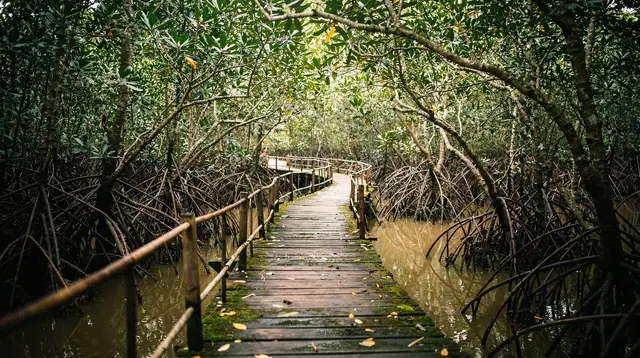
Can Gio’s forest is a tidal ecosystem, which means its character changes with the rise and fall of the water rather than staying fixed the way a dry-land forest does. At high tide, the mangrove’s arching prop roots and pneumatophores — the pencil-like breathing roots that push up through the mud — sit half submerged, and boats can nose into channels that are impassable a few hours later. At low tide, the exposed mudflats reveal crabs, mudskippers and wading birds working the shallows, and the scale of the root systems becomes visible in a way the water otherwise hides.
The dominant tree across most of the reserve is a fast-growing mangrove species chosen deliberately during the postwar replanting programme for its ability to stabilise the sediment quickly and re-establish a canopy. Denser, more mature stands and a wider mix of mangrove species are found in the reserve’s more protected core zones, reached mainly by water rather than on foot. The contrast between the two — young, uniform plantation-style forest near the entrances and older, denser stands further in — is one of the more interesting things to notice on a visit, because it shows the recovery in progress rather than as a finished, static landscape.
Boardwalks, forest paths and the waterways
Two ways of moving through Can Gio complement each other, and most visits combine both.
Raised wooden boardwalks and forest paths let people walk directly into the mangrove without stepping into the tidal mud beneath it. These walkways are built up on stilts through sections of the forest, close enough to the canopy that the aerial root systems are within arm’s reach, and they are the easiest way to get a slow, close look at how a mangrove tree actually stands in its own tidal ground. Interpretive stops along some of these paths point out the reserve’s replanting history and its role in coastal protection.
Boats along the narrow waterways reach parts of the forest the boardwalks cannot, particularly the denser interior stands and the open tidal channels where the mangrove opens onto wider water. Moving by boat also changes the pace of the visit — quieter, slower, and better suited to watching for birds and other wildlife along the banks than a walking path can be, though the wildlife itself is covered on its own page rather than here.
Neither the boardwalks nor the boat routes are described here with fixed distances or durations, since how much of the reserve a given visit covers depends entirely on which programme or tour a visitor books, and that detail belongs with the day trip planning rather than with the ecosystem itself.
A reserve organised in zones
Biosphere Reserves are typically structured in zones, and Can Gio follows that pattern: a strictly protected core area where the mangrove is least disturbed, a surrounding buffer zone that allows regulated activity such as research and controlled tourism, and an outer transition zone where the district’s fishing and aquaculture communities live and work. Understanding this zoning explains why a visit to Can Gio can feel like moving between very different kinds of landscape within a short stretch of water — dense, quiet forest in one channel, working fish pens and stilted houses in the next — without the reserve losing its overall coherence as a single, managed ecosystem.
This zoned structure is also the practical reason the reserve supports both conservation and a living local economy at the same time, which is the core idea behind the Biosphere Reserve designation in the first place. Can Gio’s fishing and small aquaculture operations sit in the transition zone, working the same tidal waters that the core mangrove protects further in.
Why the mangrove matters beyond the view from a boardwalk
A mangrove forest of Can Gio’s scale does work that is easy to miss from a boat. Its dense root systems trap and stabilise the sediment the Saigon River carries down toward the sea, which slows coastal erosion and helps buffer the city itself against storm surge. The brackish water among the roots functions as a nursery for fish, shrimp and crab larvae, which is part of what sustains the aquaculture and fishing communities living in the reserve’s outer zones.
None of this is visible at a glance the way the trees themselves are, but it is the underlying reason the reserve draws researchers as well as visitors, and why its recovery since the postwar replanting effort is treated as a genuine conservation success rather than simply a scenic forest close to the city.
Comparing Can Gio with other mangrove and wetland sites on this site
| Site | Region | Type of landscape | UNESCO status |
|---|---|---|---|
| Can Gio | Coastal Ho Chi Minh City | Tidal mangrove forest | Biosphere Reserve (2000) |
| --- | --- | --- | --- |
| Cat Tien | Inland, north of the city | Lowland tropical forest | Biosphere Reserve (2001) |
| --- | --- | --- | --- |
| Tra Su | Mekong Delta, near Chau Doc | Seasonally flooded cajeput forest | Not a Biosphere Reserve |
| --- | --- | --- | --- |
| Cai Rang area | Mekong Delta, at Can Tho | River and floating market waterways | Not a Biosphere Reserve |
The comparison is worth making because Can Gio is sometimes booked as an alternative to a Mekong Delta trip, or combined with one, on the assumption the two show the same kind of scenery. They are related in feel — tidal water, mangrove or flooded forest, boats as the main way to move — but they belong to different river systems, different regions and, in Cat Tien’s case, a different UNESCO designation entirely.
Combining Can Gio with the wider coast
Can Gio’s position on the coastal edge of Ho Chi Minh City also makes it a natural stop for people arriving by sea rather than by road. Cruise ships calling at the city dock well outside the centre, at Phu My port, and several shore excursion itineraries route through Can Gio’s mangrove on the way into or out of the city rather than heading straight downtown.
a cycling shore excursion from Phu My port is one way cruise passengers combine a look at the coastal countryside with limited time ashore, and a flexible Phu My port tour covering the city, Cu Chi or the Mekong Delta shows how operators bundle Can Gio’s coastal side into a broader menu of options from the same dock.
Travellers continuing along the coast rather than back into the city sometimes pair a mangrove morning with a stop in Vung Tau; a private guided tour of Vung Tau is a straightforward way to add that stretch of coastline to the same trip.
For visitors based in the city itself who want to see the mangrove without any of that coastal or cruise routing, a guided day tour into the Can Gio Mangrove Biosphere Reserve is the direct option, built specifically around the forest, its boardwalks and its waterways rather than around a wider coastal itinerary.
Where this fits in a broader southern Vietnam itinerary
Can Gio works well as a contrast to the more built-up, historical sights closer to central Ho Chi Minh City, and it does not require the longer travel time that the Mekong Delta or the far coast demands. Travellers weighing it against other nearby half-day and full-day options — Cu Chi Tunnels, a Saigon River cruise, or the markets and pagodas of Cholon — are looking at a genuinely different kind of morning: quiet water and forest canopy rather than tunnels, temples or traffic.
Anyone building a longer stay around the city can see how a Can Gio morning slots into a wider week by checking this site’s guide to how many days to spend in southern Vietnam, or by comparing it against a Mekong Delta day out directly in is a Mekong Delta day trip worth it, since the two are the region’s two classic half-day-to-full-day nature excursions and are frequently weighed against each other when time is limited.
Can Gio Biosphere Reserve: frequently asked questions
Is Can Gio part of the Mekong Delta?
No. Can Gio is a coastal district of Ho Chi Minh City itself, built on the tidal mudflats where the Saigon River system meets the sea. The Mekong Delta lies further south and is drained by an entirely different river system; the two mangrove landscapes are often confused but are not connected.
Is Can Gio a UNESCO World Heritage Site?
No. Can Gio was named a UNESCO Biosphere Reserve in 2000, which is a different programme recognising a working balance between conservation and local livelihoods. No site covered on this guide, including Can Gio, is inscribed on the UNESCO World Heritage List.
What kind of forest is at Can Gio?
It is almost entirely replanted mangrove, grown back after the district’s original forest was destroyed during the Vietnam War. Decades of replanting have restored a dense, tidal, brackish-water forest that is now a recognised ecological success story.
What can I actually walk through at Can Gio?
The reserve is threaded with raised wooden boardwalks and forest paths that let visitors move through the mangrove without wading into the tidal mud, alongside narrow waterways that boats use to reach the denser stands of trees.
Will I see monkeys or wildlife at Can Gio?
Can Gio does host wildlife, including a well-known population of long-tailed macaques, but the animals and the practicalities of seeing them are covered on their own page rather than here, which focuses on the mangrove ecosystem itself.
How do I actually get to Can Gio and plan the visit?
Getting there, how the day is usually organised, and what to arrange in advance are covered on this site’s dedicated Can Gio day trip page rather than here, since this page is about the reserve and its ecosystem, not the logistics of the trip.
Why is the mangrove important beyond scenery?
Mangrove forests like Can Gio stabilise coastal sediment, buffer the city from storm surge and salt intrusion, and provide a nursery habitat for fish, crabs and shrimp that support local fishing communities, which is part of why UNESCO recognised the site.
Can Gio Mangrove and Cat Tien National Park
Verified deep-linked GetYourGuide tours. Book through these links and we earn a small commission at no cost to you.
GetYourGuide does not provide a product photo for this activity — the image shows the meeting point, photographed by us.