Mui Ne and Mekong Delta Combo Tour: Linking Two Regions
Can Mui Ne and the Mekong Delta be visited on one combined trip?
Yes, but they are separate regions on opposite sides of Ho Chi Minh City rather than one continuous route. A combined trip means treating it as two distinct legs joined by a stop in the city, not a single day trip covering both.
Two regions that sit on opposite sides of the city
Travelers planning a longer stay in southern Vietnam sometimes assume Mui Ne and the Mekong Delta are neighboring stops on the same road. They are not. Mui Ne, with its sand dunes and fishing harbour, belongs to Binh Thuan province on the south-central coast, north-east of Ho Chi Minh City. The Mekong Delta unfolds in the opposite direction, south-west of the city, across a flat landscape of rivers, canals and orchards. A combined itinerary that visits both is really two separate trips joined by a stay in the city between them, and understanding that shape early makes planning much simpler.
This distinction matters because the two regions get lumped together in casual conversation more often than almost any other pairing on this site. Both are commonly recommended as an escape from the city, both appear on many travelers’ shortlists, and both are reachable without an internal flight. But the similarities end there. One is coastal and dry, built around dunes, a fishing town and a long beachfront strip of resorts. The other is a river world, humid and green, organized around boat travel, floating markets and canal villages. A combo tour, done properly, respects that difference rather than blurring it.
Why pair them at all
The logic for combining Mui Ne and the Mekong Delta usually comes down to time and contrast. A traveler with enough days in southern Vietnam to go beyond a single add-on trip from the city often wants two very different experiences rather than two similar ones. Mui Ne offers dunes, a slower beach pace and a different landscape entirely from anything else on this coast. The delta offers water travel, rural life and a look at how much of southern Vietnam’s food and produce is actually grown and moved. Together they bracket a Ho Chi Minh City stay with two contrasting regional experiences instead of one repeated theme.
It also suits travelers who are not in a rush. Because the two legs sit on opposite sides of the city, a combo trip naturally builds in time back in District 1 and the surrounding neighborhoods between the two excursions, which works well for anyone who wants to split up transit days with proper city time rather than travel every single day.
How the route actually works
There is no single road or route number linking Mui Ne to the Mekong Delta. In practice, a combo trip is built as two out-and-back or one-way legs from Ho Chi Minh City:
- A coastal leg north-east to Mui Ne and Phan Thiet, along the road that also passes the white and red sand dunes and the Fairy Stream.
- A delta leg south-west toward towns such as My Tho, Vinh Long or Can Tho, where river and canal travel takes over from the road.
The city sits at the hinge between the two. Most itineraries either open in Ho Chi Minh City, head out to one region, return to the city, then head out to the other, or they treat the city as a base and do each leg as a distinct block of days without retracing the same road twice. Neither leg overlaps with the other geographically, so there is no shortcut that visits both regions on the same drive.
Distances and travel times for both legs
Putting rough numbers next to each leg helps explain why the combo works better as two blocks than as one loop. Mui Ne and Phan Thiet sit roughly 200 km from Ho Chi Minh City along the coast, and since the expressway opened that drive takes about three to four hours each way. The Mekong Delta side is made up of several separate destinations rather than one town, so the distance depends on which one is the target: My Tho, the closest delta town, is roughly 70 km out, while Can Tho, the delta’s main city and the base for the Cai Rang floating market, is roughly 170 km away and takes about three to three and a half hours on the expressway. Vinh Long and Cai Be sit in between those two.
None of these numbers overlap with the Mui Ne road, which is the practical reason a single day cannot cover both regions. A day trip to the delta and a multi-hour drive to the coast are each already a half-day of travel in one direction; stacking both into the same day would leave almost no time actually spent in either place.
Suggested shape of a combined trip
A workable combo trip generally follows one of two shapes, both built around the city as the pivot point.
Delta first, coast second. Start in Ho Chi Minh City, head into the Mekong Delta for a day trip or a longer stay that might include the Cai Rang floating market near Can Tho, return to the city for a night or two, then head north-east to Mui Ne for the dunes, the coast and a different pace entirely before returning to the city to fly onward.
Coast first, delta second. The reverse order works just as well: open with Mui Ne’s dunes and beach time, return to the city, then head into the delta as a slower, greener close to the trip. Some travelers prefer this order because it saves the more languid, boat-based pace of the delta for the end of a trip, after the more active desert and beach days.
Either order avoids the mistake of trying to compress both regions into back-to-back days without a break in the city, which tends to leave both legs feeling rushed and the transit time uncomfortably heavy relative to time spent actually seeing either place.
What each leg contributes
The two regions are deliberately different, and a combo trip works best when that contrast is treated as the point rather than smoothed over.
| Region | Landscape | Typical focus | Pace |
|---|---|---|---|
| Mui Ne / Binh Thuan | Coastal, sand dunes, fishing harbour | Dunes, Fairy Stream, beach resorts | Active by day, relaxed by evening |
| --- | --- | --- | --- |
| Mekong Delta | Flat river delta, canals, orchards | Floating markets, boat travel, village life | Slow, water-based, early starts for markets |
Mui Ne’s landscape is unusual for Vietnam: rolling sand dunes in white and red sit alongside a working fishing harbour and a long beachfront strip. The Fairy Stream walk and dune visits are typically done in the cooler parts of the day, leaving afternoons and evenings for the beach or resort pools.
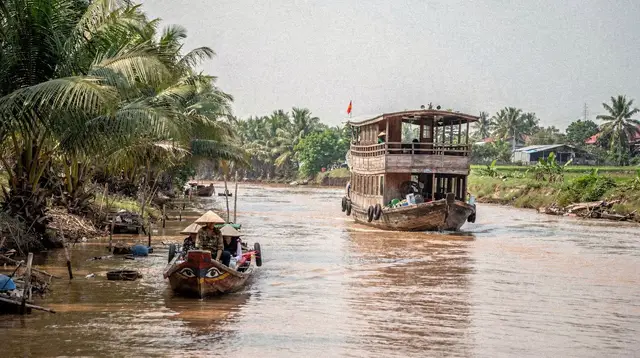
The Mekong Delta, by contrast, runs on boat time. The best-known experience, the Cai Rang floating market near Can Tho, trades in the early morning, which shapes the whole rhythm of a delta visit around dawn departures and boat transfers between canals, orchards and riverside towns.
Booking the two legs
Because the two regions are not physically connected by a single route, tour products generally cover one leg or the other rather than the full combined trip in one booking. A Mui Ne based operator can arrange transport and activities for the coastal leg, including desert and dune excursions such as an ATV and jeep tour across the dunes or a local jeep tour combining the dunes with cultural stops.
For the delta leg, tours are usually booked either from Ho Chi Minh City or, for travelers already based in Mui Ne, as a longer private day trip that covers the transfer both ways, such as a private day trip from Mui Ne into the Mekong Delta, or a broader Mekong Delta experience departing from Mui Ne.
Travelers who also want to fit in a stop at the Cu Chi Tunnels while based in the city between the two legs can look at a full-day Cu Chi Tunnels tour from Ho Chi Minh City as a way to use the in-between days productively rather than treating them purely as transit.
Booking each leg separately, rather than searching for a single all-in-one combo product, gives more control over pacing and lets the choice of departure point for the delta leg (see choosing a Mekong Delta departure point) match whichever city itinerary is already in place.
Extending either leg into a multi-day stay
Because both legs already involve real travel time from the city, many travelers doing this combo choose to turn the delta portion into more than a single day rather than rushing back to Ho Chi Minh City the same evening. A 2 or 3 day Mekong Delta tour or a 3 day Mekong Delta tour with lodging covers towns such as Cai Be, Vinh Long and Can Tho at a slower pace, with overnight stays replacing the long same-day return drive.
Travelers who want to push further into the delta, toward Chau Doc and the Tra Su cajuput forest, can look at a 3 day Mekong Delta tour with Tra Su Forest instead, which reaches further south-west than a standard one-day itinerary.
The same logic applies to the coastal leg: a Mui Ne stay is rarely done as a single day from the city given the drive time involved, so most combo trips already treat it as at least an overnight, which pairs naturally with a delta leg that has also been extended rather than compressed. Building both legs as short multi-day stays, rather than two rushed day trips either side of the city, tends to produce a much less exhausting version of the same combined itinerary.
Planning notes specific to this pairing
A few practical points are worth keeping in mind when the trip spans both regions rather than just one.
-
Treat the city stop as a real stage, not just a layover. Because both legs return through Ho Chi Minh City, the days spent there are a natural point to handle laundry, book the next leg, or simply rest between two different paces of travel.
-
Don’t try to compress both legs into one continuous loop. The regions are on opposite sides of the city, so a route that visits both without returning to the city in between usually means unnecessary backtracking.
-
Match the order to interests, not convention. There is no fixed “correct” sequence; travelers who prioritize the coast often do Mui Ne first, while those most drawn to the delta’s markets often save it for last.
- Keep the seasons in mind. Southern Vietnam runs on a wet and dry season rather than four distinct seasons, and that pattern affects both the coast and the delta similarly, so there is no single leg that is reliably better timed than the other within the same trip.
-
Watch for Tet. The lunar new year falls on a different date each year and can disrupt transport and close family-run businesses in both regions at once, so a combined trip planned around that period needs extra buffer.
For travelers still deciding whether this pairing suits their available time at all, it helps to compare it against the alternative of picking just one region and going deeper — see how many days to plan for southern Vietnam and planning a trip across the city, delta and coast for the wider framing, or Vung Tau versus Mui Ne for the beach if the coastal leg itself is still undecided.
Those weighing a single delta excursion against a longer stay can also compare a one-day Mekong Delta trip against a two-day tour before deciding how much time to give that leg within the larger combo. A ready-made multi-day framework that already links these regions is outlined in the five-day Saigon, Mekong and Mui Ne grand tour itinerary, which can be used as a starting point and adjusted.
FAQ: combining Mui Ne with a Mekong Delta trip
Is Mui Ne part of the Mekong Delta?
No. Mui Ne sits on the south-central coast in Binh Thuan province, to the north-east of Ho Chi Minh City, while the Mekong Delta lies to the south-west. They are on opposite sides of the city and are frequently confused because both are popular add-ons to a Ho Chi Minh City stay.
Can Mui Ne and the Mekong Delta be visited in a single day?
No single day trip links both. Each is its own excursion or overnight stay from Ho Chi Minh City, and a combined trip works by treating them as two separate legs either side of a stay in the city, not as one continuous loop.
What order should the two regions be visited in?
Either order works. Some travelers open with the Mekong Delta as a slower, rural start and finish on the coast at Mui Ne; others do the reverse, using the desert landscapes as a first stop before the delta’s rivers and markets. The city sits in the middle either way.
Do combined tours exist, or does each leg need booking separately?
Most bookable tours cover one region or the other rather than the whole route in a single product. A combined trip is generally built by pairing a Mui Ne based tour or transfer with a separate Mekong Delta departure, both anchored to time spent in Ho Chi Minh City.
Is a private car or a scheduled coach better for linking the two legs?
Both are used. Scheduled coaches and shared minibuses run the coastal route to Mui Ne and separate transfers serve the delta towns; a private car or driver adds flexibility for stops but does not shorten the fact that this is two separate journeys, not one road.
Does the combo suit a first visit to southern Vietnam?
It suits travelers who already plan enough time to see more than just the city, since it adds two distinct regions rather than one quick add-on. Those with limited time are usually better served by choosing a single region and going deeper into it.
Mekong Delta Cruises and Floating Markets
Verified deep-linked GetYourGuide tours. Book through these links and we earn a small commission at no cost to you.
GetYourGuide does not provide a product photo for this activity — the image shows the meeting point, photographed by us.