The Mekong Delta's Other Communities: Khmer, Cham and Hoa
Is the Mekong Delta culturally homogeneous and entirely Kinh Vietnamese?
No. Alongside the Kinh Vietnamese majority, the delta has long-established Khmer Krom, Cham and Hoa (ethnic Chinese) communities with their own temples, festivals and languages. You'll notice this most clearly around Soc Trang, Tra Vinh, Chau Doc and the old Chinese quarters of towns like Sa Dec and Can Tho.
A Delta That Isn’t Just Kinh
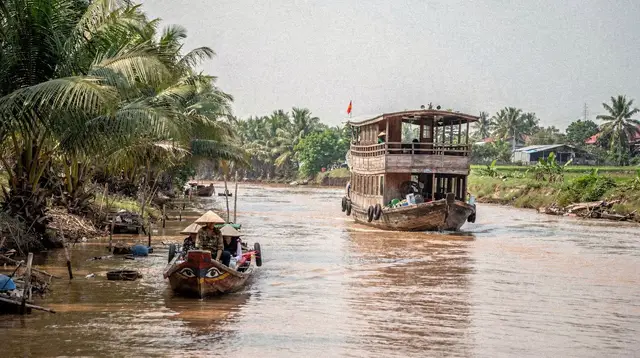
The first time I took a boat out past My Tho toward the wider Mekong Delta, I assumed I already understood what I was looking at: rice paddies, coconut groves, a river culture that was simply Vietnamese, full stop. It took a wrong turn near Soc Trang — a market day, a temple gate I didn’t recognise, a language on a signboard that wasn’t Vietnamese script at all — to correct me. The delta isn’t one culture wearing one face. It’s layered, and has been for a very long time.
This isn’t a page about general Vietnamese customs; that’s covered elsewhere on this site. This is about something narrower and, to me, more interesting: the Khmer Krom, Cham and Hoa communities who have called this delta home for generations, often longer than it has been part of Vietnam at all, and who still shape what you see, hear and eat as you move through it.
The Khmer Krom, Older Than the Border
The most visible of the three groups, at least to a visitor, are the Khmer Krom. Long before the delta became Vietnamese territory, this land was Khmer country, and the Khmer Krom never left. What struck me most, travelling through Soc Trang and the surrounding countryside, was the architecture.
Where Vietnamese pagodas tend toward a Mahayana Buddhist style, the Khmer temples here follow the Theravada tradition of Cambodia — steep, layered roofs, gold trim, guardian figures with sharp, angular faces that look nothing like the softer Vietnamese equivalents. I stopped at one on a quiet back road, not even a particularly famous one, and a monk in saffron robes was sweeping the courtyard in a silence that felt older than the buildings around it.
If you want to see this concentration for yourself, Soc Trang province holds the densest cluster of Khmer pagodas in the country, and you’ll also find Khmer communities scattered through parts of Tra Vinh and the countryside around Can Tho. Festivals here, tied to the Khmer lunar calendar, are entirely separate celebrations from Tet, and if you happen to pass through during one, the temple grounds fill in a way that has nothing to do with the Vietnamese holiday calendar at all.
For anyone curious to go deeper than a passing glance, I’d point toward a proper look at the Khmer Temples of the Mekong Delta: A Living Heritage guide, which covers the architecture and etiquette in more detail than I can here.
The Cham, Near the Cambodian Border
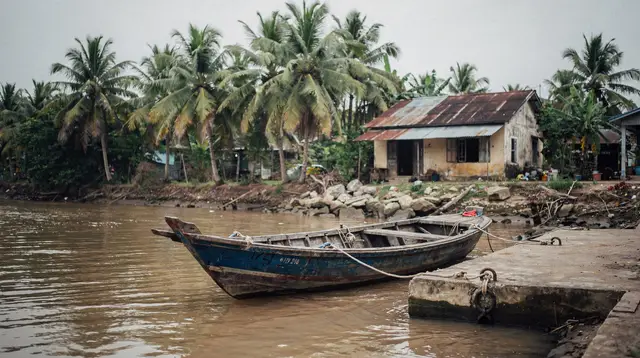
Further west, around Chau Doc, I met a different community entirely. The Cham here trace their ancestry to the old kingdom of Champa, the same root as the Cham communities of central Vietnam, but centuries of separate history have made them distinct. Around Chau Doc, the Cham community is largely Muslim, and it shows in small, everyday details — a mosque with its own quiet rhythm of prayer, women in headscarves in the market, houses built on stilts along the river in a style slightly different from their Kinh neighbours.
I wouldn’t have known to look for this without asking, which is part of why I think it’s worth saying plainly here: this isn’t the same Cham culture you might read about near Phan Thiet or further north. It’s its own community, shaped by proximity to Cambodia and by the river itself, which has always moved people and ideas across borders that only exist on paper. If Chau Doc is on your route, even a short walk past the floating houses near the river gives you a sense of this that no description quite manages.
The Hoa and the Trading Towns
The third thread is the Hoa, ethnic Vietnamese of Chinese descent, and their imprint on the delta is less about temples and more about towns. Wandering through Sa Dec, I noticed it in the old shopfronts — narrow, deep buildings with family altars visible from the street, faded Chinese characters still legible above some doorways, incense in the air outside buildings that function as community halls rather than temples. The Hoa became associated with commerce here generations ago, and towns that grew around trade, including parts of Can Tho and smaller river towns further along, still carry that layer of history in their architecture even where the community itself has partly assimilated.
It’s easy to walk past this entirely if you’re only looking at the delta as a landscape of rice fields and canals. Slowing down in a market town like Vinh Long or Cai Be and actually reading the buildings changes what the trip feels like.
Why This Gets Flattened So Often
I understand why the delta gets described as culturally uniform. Most day trips move fast — a boat, a market, a lunch stop, back to the city — and there’s rarely time built in to notice a temple roofline or ask who built a particular shopfront. But treating the delta as simply “rural Vietnam” erases three communities with their own long histories, languages and beliefs, sitting right alongside the Kinh majority rather than folded invisibly into it.
If this is the kind of detail you want built into your own trip, a slower, more deliberate route through the delta gives you the room for it. A Mekong Delta Homestay: What Staying With a Local Family Is Really Like stay, or a longer route toward Chau Doc like the one described in Multi-Day Mekong Cruise to Chau Doc and Cambodia, tends to surface far more of this than a single rushed day does.
For most visitors starting from the city, though, the standard small-group day trip into the delta or the classic one-day Mekong Delta tour at least passes through towns where this layered history is visible, if you know to look. Travellers combining the delta with the tunnels often take the Cu Chi Tunnels and Mekong Delta day tour, and a version of the same combination runs as the Cu Chi Tunnels Mekong Delta tour from Ho Chi Minh City.
Choosing Where to Go for This
Not every delta itinerary passes near these communities in the same way. If this is genuinely what you’re after rather than a bonus discovery, it’s worth reading Choosing Your Mekong Delta Departure Point from Saigon before booking anything, since the route toward Chau Doc and the Cham community is a different direction entirely from the classic loop through My Tho and Ben Tre.
A longer route, like the ones outlined in Two Days in the Mekong Delta: Can Tho and Cai Rang Floating Market or Four Days: Saigon to the Deep Mekong Delta, Can Tho and Chau Doc, buys you the time to actually stop at a Khmer pagoda or wander a Hoa trading street rather than seeing it from a moving boat.
None of this makes the delta any less Vietnamese. It makes it something more interesting than the postcard version: a place where several old communities have shared a river for a very long time, each with a distinct way of marking a temple gate, a market stall, or a house by the water.
FAQ: Ethnic Communities of the Mekong Delta
Who are the Khmer Krom?
The Khmer Krom are ethnic Khmer people who have lived in the delta for centuries, well before it became part of Vietnam. Their Theravada Buddhist pagodas, distinct from Vietnamese Mahayana temples, are especially visible around Soc Trang and Tra Vinh.
Where do I see Khmer culture most clearly in the delta?
Soc Trang province has the highest concentration of Khmer pagodas, some dating back centuries, with distinctive tiered roofs and gold ornamentation. You’ll also find Khmer communities and temples scattered around Tra Vinh and parts of Can Tho province.
Is the Cham community in the Mekong Delta the same as the Cham in central Vietnam?
They share ancestry from the former kingdom of Champa, but the Cham community around Chau Doc, near the Cambodian border, is smaller, largely Muslim, and distinct in daily life and dress from the Hindu and Muslim Cham communities of central Vietnam.
Who are the Hoa and why are they concentrated in certain towns?
The Hoa are Vietnamese of Chinese descent, many tracing their arrival to waves of migration over past centuries. In the delta they became associated with trade and market towns, which is why places like Sa Dec and Can Tho still have older shopfronts, family altars and community halls tied to Chinese lineage associations.
Can I visit a Khmer pagoda as a traveller?
Yes, most are open to respectful visitors. Dress modestly, remove your shoes where indicated, and keep in mind these are active places of worship, not museums, so a guide who can explain context is worth having.
Does this mean the whole delta feels different from the rest of Vietnam?
Not uniformly. Large parts of the delta are majority Kinh, and the ethnic presence is more concentrated in specific provinces and towns rather than spread evenly everywhere you go.
Is this the same topic as general Vietnamese etiquette?
No, general customs and etiquette across Vietnam are covered separately. This page is specifically about the delta’s own long-standing ethnic communities and what makes them distinct from the Kinh majority.
Mekong Delta Cruises and Floating Markets
Verified deep-linked GetYourGuide tours. Book through these links and we earn a small commission at no cost to you.
GetYourGuide does not provide a product photo for this activity — the image shows the meeting point, photographed by us.