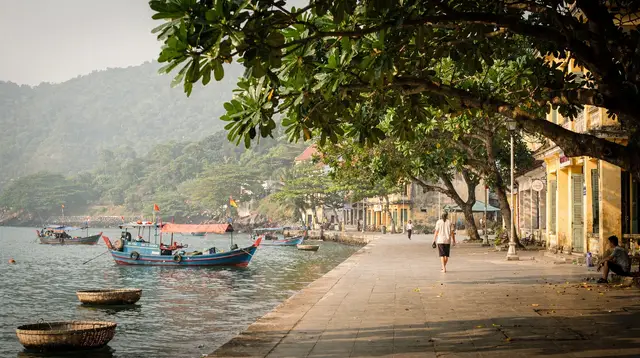
Vung Tau Day Trip: Is It Worth It From Ho Chi Minh City?
Can you visit Vung Tau as a day trip from Ho Chi Minh City?
Yes. Vung Tau is a coastal city in Ba Ria-Vung Tau province, reached from Ho Chi Minh City by road or by river transfer, and a day trip is a realistic way to see its coastline and hilltop statue without an overnight stay. It has nothing to do with the Mekong Delta or with Con Dao, which is a separate island group reached only by air or boat.
Planning the logistics of a coastal day away from Saigon
Vung Tau turns up constantly in trip-planning searches for Ho Chi Minh City, and for good reason: it is the closest proper stretch of coastline to the city, a seaside city in its own right rather than a resort strip, and it sits close enough that a single day is genuinely enough to get a feel for it. But “close enough for a day trip” still means committing a full day to travel, arrival, a few hours on the coast, and the return.
This page is about that logistics question — how you get there, how much time you’re realistically working with once you arrive, and whether a day trip is the right shape for your itinerary at all — rather than about the beaches or the boat crossing themselves, which each have their own dedicated coverage on this site.
Where Vung Tau actually sits
Vung Tau is a coastal city in Ba Ria-Vung Tau province, on a small peninsula that juts out into the sea on the south-east side of Ho Chi Minh City. That geography matters more than it looks, because it puts Vung Tau in a completely different direction — and a completely different travel logic — from two places it regularly gets confused with.
First, Vung Tau is not part of the Mekong Delta. The delta lies to the south-west of Ho Chi Minh City, across an entirely different set of roads and river systems, built around towns like My Tho, Can Tho and Chau Doc. Vung Tau lies to the south-east, on the coast, and the two regions are never reached by the same route.
If you’re weighing a day trip to “somewhere near Saigon with water,” it’s worth being clear from the start about whether you mean the delta’s rivers and canals or Vung Tau’s open coastline — they are different trips with different departure points, and this site treats them as separate day-trip regions for that reason. The same logic applies to the north-west day trips out to Cu Chi and Tay Ninh: different direction, different roads, never combined with a coastal day.
Second, and more often confused, Vung Tau is not Con Dao. Con Dao is an archipelago far out in the sea, well beyond where a road can reach, and it is accessed only by air or by boat — never by a same-day road trip. Vung Tau, by contrast, is on the mainland and connected to Ho Chi Minh City by ordinary roads (and, for part of the journey, by a river and coastal boat transfer).
The names sound similar in conversation and both come up under “beaches near Saigon,” but one is a short trip on wheels or water you can do and be home the same evening, and the other is a genuinely separate, multi-day destination with its own island logistics. If you were picturing Con Dao’s national park or its offshore diving when you searched for a Vung Tau day trip, you want a different page entirely — see the dedicated guide to the Con Dao archipelago for that.
Two ways to get there: road and river
There are two practical ways to reach Vung Tau from Ho Chi Minh City, and the choice between them is really the first decision in planning the day.
The road route is the straightforward option: a car, a private vehicle, or an organized coach or minibus trip runs out of the city and down to the coast, arriving directly into Vung Tau. This is the more flexible route in terms of pickup points and drop-off, and it’s the one used by most organized day-trip tours, including sightseeing itineraries that combine the drive with stops along the way.
The river and coastal route is the more distinctive option: part or all of the journey runs by boat, following the Saigon River out toward the coast before the crossing continues to Vung Tau. This is a genuinely different experience from a coach ride — it turns the transfer itself into part of the day rather than just a means of getting there — and it has its own separate write-up on this site covering how that crossing works, since the practicalities (where you board, what the crossing is like, what to expect on the water) deserve their own space rather than a summary here.
Neither route is objectively “better” for a day trip; the road is generally the more time-efficient and flexible choice, while the river transfer is the pick for travelers who want the crossing itself to be part of the experience. What matters for planning purposes is that both exist, both are used for legitimate day trips, and choosing between them is really a question of what kind of day you want, not a question of which one “counts” as the real way to reach Vung Tau.
| Route | What it involves | Best suited to |
|---|---|---|
| By road | Car, private driver, or organized coach/minibus direct from the city | Flexible pickup, straightforward logistics, combining with a guided sightseeing stop |
| --- | --- | --- |
| By river and coast | Boat departure along the Saigon River, continuing to the coast | Travelers who want the transfer itself to be part of the day |
| --- | --- | --- |
| Organized day tour | Bundled transport (usually by road) plus a set sightseeing plan | First-time visitors who prefer not to arrange transport separately |
For travelers who’d rather not arrange transport themselves, an organized option bundles the logistics with a set plan for the day. One version of that is the day trip from Ho Chi Minh City to Vung Tau, which handles the road journey and a run through the main sights in one booking, and a closely related option is the Vung Tau beach and sightseeing day trip, aimed more squarely at the coastline itself.
What a day in Vung Tau actually looks like
Because travel time eats into the day on both ends, a Vung Tau day trip works best with a clear, limited priority rather than an ambitious checklist. In practice, most day-trip itineraries settle around one or two anchors: time on the coastline itself, and a visit up to the hilltop where Vung Tau’s landmark statue overlooks the sea and the peninsula. Both are covered in detail on their own pages — the beaches guide goes into the different stretches of coast and what distinguishes them, and there’s a separate comparison for travelers deciding between Vung Tau and other coastal options near Saigon — so this page won’t re-describe them here.
What’s worth flagging at the planning stage is simply that a day trip compresses things. You are not going to comfortably fit an extended beach afternoon, the hilltop viewpoint, a proper seafood meal, and a stop at an inland attraction like the hot springs at Binh Chau all into the same day alongside a return journey to the city. Pick a focus — the coast, the views, or a specific activity — and build the day around it, rather than trying to see everything Ba Ria-Vung Tau province has to offer in a single outing.
For travelers who do want to widen the day slightly, some tours pair Vung Tau with an inland stop rather than sightseeing along the coast alone. The Binh Chau hot springs entry is one way to add that kind of stop for those with a bit more flexibility, though it does mean less time on the coast itself.
When a day trip isn’t the right shape
A day trip is not the only way to see Vung Tau, and for some travelers it isn’t the best one. If your main interest is unhurried beach time, or you’re arriving in the region already relaxed and don’t want the day bookended by travel, an overnight stay removes the pressure of a return journey and lets the coast breathe a little. Vung Tau also functions differently for cruise passengers: because it sits closer to the Phu My deep-water port than central Ho Chi Minh City does, some travelers arriving by ship find Vung Tau a more comfortable use of their time ashore than a trip all the way into the city center.
That routing — and how it compares with heading into Saigon or out toward Cu Chi and the Mekong Delta instead — is covered on its own page, and the broader picture of what a cruise call at Phu My looks like is laid out in the Phu My cruise port overview. One version of the coastal routing is bookable as the Phu My Port shore excursion covering Ho Chi Minh City, Cu Chi, the Mekong Delta, or Vung Tau.
If your itinerary already includes a night or two of flexibility, it’s also worth looking at how a Vung Tau visit fits alongside other coastal time near Saigon before committing to the single-day version — the comparison guide covering that decision lays out the trade-offs without repeating the beach detail found elsewhere on the site.
Fitting Vung Tau into a wider south Vietnam itinerary
Vung Tau rarely needs to be the only thing planned around a Ho Chi Minh City base, and it doesn’t compete for the same day as trips to Cu Chi, Tay Ninh, or the Mekong Delta — those run in the opposite direction and have entirely separate logistics.
Travelers building a longer route through the south sometimes fold a coastal stop into a broader loop that also takes in the delta and the desert landscapes further along the coast, such as the sand dunes around Mui Ne; the grand tour of south Vietnam lays out how those pieces can connect across several days rather than one, and the five-day Saigon, Mekong and Mui Ne grand tour is one concrete version of it. For a shorter version of the same idea, a two-day itinerary combining Saigon with the Vung Tau coast is a practical middle ground between a rushed single day and a full multi-day loop.
Getting to and from the city itself is the more mundane but essential piece underpinning any of this: knowing how transport within Ho Chi Minh City works, and understanding the transfer options if you’re heading straight from the airport into an early departure, both make the difference between a smooth start to the day and a stressful one. Neither piece is specific to Vung Tau, but both are worth checking before booking an early tour departure.
The bottom line on planning a Vung Tau day trip
Vung Tau earns its place on a Ho Chi Minh City itinerary because it delivers a real stretch of coastline within striking distance of the city, reachable by a straightforward road journey or by a more distinctive river and coastal transfer. It is not the Mekong Delta, and it is not Con Dao — two mix-ups worth clearing up before you book anything, since all three sit in different directions and involve entirely different kinds of travel.
Once that’s settled, the planning question is really just about pace: choose a route that suits how you want to spend the transfer, choose one clear priority for the time on the beaches, and treat the day as a focused escape rather than an attempt to cover the whole province at once. Travelers still deciding whether Vung Tau is the right regional pick at all may also want the wider framing in how many days to plan for southern Vietnam before locking in a single-day version of the trip.
Vung Tau day trip: frequently asked questions
Is Vung Tau part of the Mekong Delta?
No. Vung Tau sits on the south-east coast in Ba Ria-Vung Tau province, on the opposite side of Ho Chi Minh City from the Mekong Delta, which lies to the south-west. The two are separate day-trip regions with separate roads out of the city, and they are not combined into one itinerary.
Is Vung Tau the same as Con Dao?
No, and this is the most common mix-up. Vung Tau is a mainland coastal city you can reach by road in a single day. Con Dao is a remote archipelago far offshore, reached only by air or by sea, and it is never a same-day trip from Ho Chi Minh City.
Should I go to Vung Tau by road or by river?
Both routes exist and both are used for day trips. The road route runs by car, coach or minibus; the river route uses a boat transfer that crosses open water for part of the way. Each has its own detailed page on this site, since the choice depends more on comfort and interest in the crossing than on the destination itself.
How much time do I actually get in Vung Tau on a day trip?
Enough for a focused visit to the coastline and the hilltop statue, plus a meal, but not enough to add a second region on the same day. The travel there and back takes up a meaningful share of the day, so a day trip works best with one clear priority rather than a long list.
Can I combine Vung Tau with the Mekong Delta or with Cu Chi in one day?
No. Vung Tau lies in the opposite direction from both, and each of those trips already fills a day on its own. Travelers who want to see more than one region need separate days or a multi-day route through the south, not a single combined day trip.
Is a day trip enough, or should I stay overnight in Vung Tau?
A day trip covers the highlights well for travelers with limited time, but Vung Tau also works as a relaxed overnight stop, particularly for anyone arriving via the Phu My cruise port or wanting unhurried beach time. Neither option is wrong; it depends on how much of the day you want to spend in transit versus on the coast.
Does a Vung Tau day trip work for cruise passengers docking at Phu My?
Yes, Vung Tau is often the easier option for cruise passengers compared with a trip all the way into central Ho Chi Minh City, since it sits closer to the Phu My port. That routing has its own considerations and is covered separately.
Vung Tau, Ho Tram and the Con Dao Islands
Verified deep-linked GetYourGuide tours. Book through these links and we earn a small commission at no cost to you.
GetYourGuide does not provide a product photo for this activity — the image shows the meeting point, photographed by us.