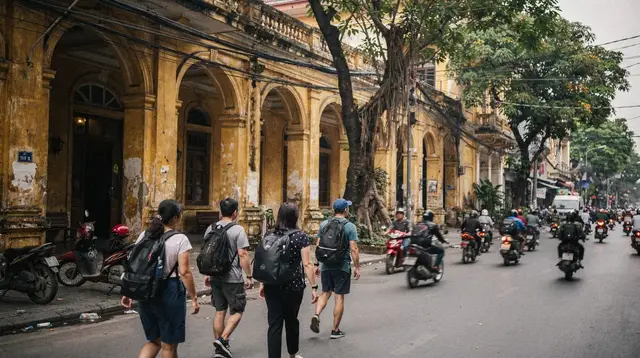
Getting Around Ho Chi Minh City
What is the best way to get around Ho Chi Minh City?
Most visitors combine walking for short central stretches with ride-hailing apps like Grab for everything else. Metered taxis and motorbike taxis remain useful backups, while buses and the new metro line serve specific corridors. Day trips to the Mekong Delta or the coast are arranged separately and are not part of everyday city transport.
Matching the Right Transport to the Neighborhood
Ho Chi Minh City does not have a single “best” way to get around. It has several good ones, and the right choice depends on where you are starting from, where you are going, and how far apart the two points sit on the map. The city sprawls across the Saigon River and beyond, from the dense grid of District 1 to the leafy, low-rise streets of Thao Dien across the water, and no single mode of transport is ideal for the whole territory.
This guide is a map of that decision, not a manual for any one option. If you already know you want to hire a driver-guide, understand the licensing rules before renting a scooter, or learn exactly how the metro or bus network is laid out, the dedicated guides on Grab and taxis, renting a scooter and the metro and city buses go into that detail. Here, the goal is simply to help you pick the right tool for a given trip, and to draw a clear line between getting around the city itself and heading out to the Mekong Delta or the coast, which is a different kind of journey entirely.
Walking in District 1 and the Central Areas
For visitors staying in or near District 1, walking covers more ground than it might first appear. The cluster around Ben Thanh Market, the Nguyen Hue walking street, Dong Khoi and the riverside is compact enough that moving between sights on foot is often simpler than waiting for a car to navigate the same short stretch through traffic. The area around the Reunification Palace, the Notre-Dame Cathedral Basilica and the Central Post Office forms another walkable pocket, and the backpacker streets around Bui Vien reward slow, on-foot exploring after dark.
Walking has real limits, though. Sidewalks are frequently used for parking, vending or seating, heat and humidity make sustained walking tiring for much of the year, and crossing wide junctions requires a particular technique covered in the crossing the street guide. Once a destination sits more than a few blocks away, or requires crossing into District 3, District 4 or over to Binh Thanh, it makes more sense to switch to a vehicle rather than push a walk past its comfortable range.
Grab, Be and Xanh SM: The Default for Most Visitors
For nearly everything beyond a short walk, ride-hailing apps have become the default choice for most travelers, and increasingly for locals too. Grab is the best known, alongside Be and the newer Xanh SM, and all three let you book a car or a motorbike taxi from a phone, see the driver and vehicle before they arrive, and follow the route on a map rather than relying on a spoken address. This removes much of the friction that used to come with hailing transport on the street, particularly for visitors who do not speak Vietnamese.
These apps work well across the whole city, from central District 1 out to Cholon and across the river to Thao Dien. They are equally useful for a short crosstown hop and for a longer trip to the edge of the city, and most visitors end up using one of them for the bulk of their daily movement. The full mechanics of setting up and using these apps, including how to book a car versus a motorbike, are covered separately in the Grab and taxis guide.
Metered Taxis: Still a Reliable Option
Before ride-hailing apps became common, metered taxis from established Vietnamese companies were the standard way for visitors to get around, and they remain a perfectly good option today. A taxi rank is usually easy to find outside hotels, malls and major sights, and hailing one directly on the street works reliably in busy central areas. Some visitors simply prefer the familiarity of stepping into a taxi over navigating an app, especially on a first trip.
The trade-off is less transparency before the ride starts: no advance view of the driver, vehicle or route, and a need to communicate the destination clearly, ideally by showing it written down or on a map. In practice, most visitors treat taxis as an equally valid alternative to ride-hailing apps rather than a fallback, and the choice often comes down to personal comfort rather than one option being clearly better. The specifics of choosing a reputable taxi company are laid out in the Grab and taxis guide.
Scooters and Motorbike Taxis: Moving Like a Local
Ho Chi Minh City is, more than almost anywhere else in the country, a motorbike city. Streams of scooters fill every avenue, and moving with that current, either as a passenger or at the handlebars, is how most residents get around every day. For visitors, the easiest way into this world is as a passenger: a motorbike taxi booked through a ride-hailing app is fast, cheap relative to a car, and well suited to weaving through the kind of dense, slow traffic where a four-wheeled vehicle makes little progress.
Some visitors go further and rent a scooter to drive themselves, which offers real independence for exploring further-flung corners of the city and even day trips into the surrounding countryside. This comes with genuine responsibilities: the right kind of license, comfort with local traffic conventions, and insurance implications that many visitors underestimate.
None of that is covered here in detail; the renting a scooter and motorbike license guide sets out what is actually required. For a first taste of the city from the back of a bike without the responsibility of driving, a guided motorbike tour is a popular alternative, whether through the everyday streets or at night when the traffic and neon take on a different character.
riding pillion through the city’s neighborhoods on a guided motorbike tour is one way to experience this side of Saigon without needing a license or local traffic experience of your own, and a similar option after dark, a panoramic night tour that takes in the illuminated skyline and riverside, shows a very different mood of the same streets.
Buses and the New Metro Line
Public buses cover an extensive network across the city and cost very little, making them a genuine option for budget-conscious visitors willing to plan a route in advance. They are less geared toward first-time visitors than Grab or taxis, since stops and destinations are typically only in Vietnamese and schedules are not always intuitive to follow without local knowledge.
The city’s first metro line, running from the central area out past Thao Dien toward Thu Duc, opened more recently and offers an air-conditioned, traffic-free alternative for that specific corridor. It does not yet reach most of the city, so it complements rather than replaces Grab, taxis and motorbikes for the majority of trips. Both networks, along with how to plan around them, are detailed in the metro and city buses guide.
Choosing by Distance and Neighborhood
A rough way to think about it: for anything within the walkable core of District 1, walk. For a crosstown trip within the city, whether that is to Cholon, across to Thao Dien or up to Binh Thanh, reach for Grab, a taxi or a motorbike taxi. If your route happens to run along the metro corridor, that line is worth considering for its comfort and predictability.
Renting your own scooter makes most sense once you are confident navigating local traffic and want repeated, flexible access to several neighborhoods over multiple days, something covered further in the guide to where to stay in Saigon by neighborhood, since your base affects how much you will lean on any of these options.
None of this changes much by area of the city; District 3, District 4 and Cholon are all reachable by the same mix of Grab, taxis and motorbikes, just with slightly different densities of traffic and slightly different availability of taxis waiting on the street. The underlying logic, matching distance and comfort level to the right mode, holds across the whole city.
City Transport vs Day Trips to the Delta and the Coast
The single most common point of confusion for first-time visitors is assuming that getting around Ho Chi Minh City and getting out to the surrounding region work the same way. They do not. Everything described above, walking, Grab, taxis, motorbikes and buses, is for movement inside the city itself: between districts, across the river, or out to the airport for a transfer.
Trips to the Mekong Delta, to Cu Chi and Tay Ninh, or out to the coast around Vung Tau, fall into an entirely different category. These are organized separately, usually as a guided tour, a private car with driver, or a scheduled coach, and they are covered in dedicated guides such as the Mekong Delta day trip guide and the guide to getting to the Mekong Delta and coast by bus, van or boat.
Renting a scooter or hopping on Grab is not how these longer regional trips are typically done. If you are still deciding how much time to split between the city and these outlying regions, the guide on how many days to spend in southern Vietnam is the better starting point than any transport guide.
Keeping this distinction in mind saves confusion when planning: think of everyday transport and regional excursions as two separate questions, each with its own answer, rather than a single continuous scale of options.
FAQ: Getting Around Ho Chi Minh City
Should I walk or take Grab in District 1?
Short hops between adjacent sights in District 1, such as around Ben Thanh Market or along Dong Khoi, are usually faster on foot than waiting for a car in dense traffic. Anything beyond a comfortable walking distance, or a trip crossing into another district, is better handled with Grab.
Is Grab better than a metered taxi in Saigon?
Both are widely used and generally reliable. Grab shows the driver, vehicle and route in advance, which many visitors find reassuring, while metered taxis from established companies remain a solid option, especially where hailing one directly is easy. Neither is objectively superior; comfort with the app is often the deciding factor.
Can I use the same transport for the city and for day trips to the Mekong Delta?
No. City transport such as Grab, taxis and scooters covers Ho Chi Minh City itself. Trips out to the Mekong Delta, Cu Chi, Tay Ninh or the coast are organized separately, typically as a tour, a private car or a scheduled coach, and are covered in dedicated day-trip guides rather than in everyday city transport.
Is it normal to rely on motorbikes to get everywhere in Saigon?
Yes. Ho Chi Minh City has one of the highest concentrations of motorbikes of any city in the country, and both residents and many visitors use them, whether as a passenger on a motorbike taxi or by renting one directly. It is one of several valid ways to move around, alongside Grab, taxis, walking and buses.
Does the new metro line replace the need for Grab or taxis?
No. The metro line that opened running from the central area out toward Thu Duc is useful for that specific corridor, but it does not yet cover most of the city. Grab, taxis and motorbikes remain the default for destinations off that line.
Which neighborhoods are easiest to explore on foot?
Central District 1 around Ben Thanh Market, the Nguyen Hue walking street and Dong Khoi is the most walkable part of the city. Cholon’s market streets and District 3’s quieter lanes are also pleasant on foot, though longer distances between these areas still call for Grab, a taxi or a motorbike.
Do I need to rent a scooter to get around the city?
No. Renting a scooter is optional and suits visitors who want full independence, but it is not required. Most people who prefer not to drive themselves rely on Grab, taxis or motorbike taxis instead, all of which cover the same ground without the licensing and traffic considerations of self-driving.
If you would rather leave the navigating to someone else entirely for a first orientation to the city, a guided option such as an easy, local-style introduction to the city’s streets and neighborhoods or a classic open-air jeep tour through the main districts can be a relaxed way to get your bearings before deciding which everyday transport option suits you best for the rest of your stay.
Getting Around Ho Chi Minh City
Verified deep-linked GetYourGuide tours. Book through these links and we earn a small commission at no cost to you.
GetYourGuide does not provide a product photo for this activity — the image shows the meeting point, photographed by us.