The Grand Tour of South Vietnam: Linking City, Delta and Coast
What is a grand tour of South Vietnam?
It is a multi-day itinerary that links several regions covered by this site — Ho Chi Minh City, Cu Chi and Tay Ninh, the Mekong Delta, and the south-eastern coast — into a single continuous trip rather than a day trip to just one of them. It stays entirely within southern Vietnam and does not extend to central or northern Vietnam.
What sets a multi-region tour apart from a single-area trip
Most visitors to Ho Chi Minh City choose one thing to do beyond the city itself: a day at the Cu Chi Tunnels, a day trip into the Mekong Delta, or a couple of nights on the coast. A grand tour is a different kind of planning decision. Instead of picking one of those regions, it links several of them into a single itinerary that starts and usually ends in the city, moving through the territory this site covers rather than sampling one corner of it.
That territory has a clear shape. Ho Chi Minh City sits on the Saigon River in the south of the country, with Cu Chi and Tay Ninh to the north-west, the Mekong Delta stretching south-west toward Cambodia, and the coast — Vung Tau, the quieter beaches beyond it, and the dune country around Mui Ne — running south-east and then north-east along the South China Sea. A grand tour is, in effect, a loop or a line drawn through two, three or all four of these areas, arranged so that the road distances between them make sense rather than backtracking across the map.
This is worth stating plainly because the phrase “grand tour” gets used loosely. On this site it specifically means a route that stays inside southern Vietnam. It does not extend north to Hue, Hoi An, Danang or Hanoi — that is a different, longer journey through central and northern Vietnam, well outside what this site covers, and travellers researching that route should look elsewhere. The confusion is common enough to flag directly: a “grand tour of Vietnam” in general conversation often means north-to-south or south-to-north; a “grand tour of South Vietnam,” as covered here, means a wider loop that never leaves the south.
Why combine regions instead of doing separate day trips
The Cu Chi Tunnels, the Mekong Delta and the coast are each reachable as their own day trip from Saigon, and for travellers with only a couple of spare days that is usually the more sensible choice — see the comparison between a single day trip and a longer loop for how to weigh that decision. But a day trip to any one of these places returns to the city by evening, which caps how far it can go and how much of a region it can show.
My Tho and Ben Tre, the closest delta towns, work well as a day trip; Can Tho and the Cai Rang floating market sit far enough away that a day trip there is a long day rather than a relaxed one, and seeing the delta in more depth — Vinh Long’s orchards, Chau Doc near the Cambodian border, the Khmer pagodas around Soc Trang — realistically needs more than a single day.
A grand tour solves this by treating the regions as one continuous route rather than a series of separate round trips from the same base. Instead of driving back to Ho Chi Minh City after Cu Chi and then driving out again toward the delta a day or two later, the itinerary moves forward: city, then Cu Chi and Tay Ninh, then on into the delta, then either back through the city or out to the coast, without retracing the same stretch of highway twice.
That is the practical argument for linking regions — less duplicated driving, and more time actually spent in each place — rather than any claim that a grand tour is inherently superior to focused day trips. For travellers who already know they want to spend most of their time in one region, a dedicated Mekong Delta day trip or a longer two-day Mekong itinerary remains the more efficient choice.
The regions a grand tour typically links
Ho Chi Minh City itself anchors the route at both ends in most itineraries. District 1’s landmarks — Ben Thanh Market, the Reunification Palace, the War Remnants Museum, Notre-Dame Cathedral Basilica of Saigon — sit alongside Cholon’s Chinatown streets and the newer skyline across the river at Landmark 81 and Thao Dien. A grand tour usually spends time here at the start, before heading out, and often again at the end.
Cu Chi and Tay Ninh, to the north-west, are usually combined with each other on the same day within a longer tour, since the Cu Chi Tunnels and the Cao Dai Holy See at Tay Ninh sit along a similar direction out of the city, even though Cu Chi is technically part of Ho Chi Minh City’s own district structure and Tay Ninh is a separate province. Some grand tours fold the Black Virgin Mountain into the same leg for travellers with an extra day to spare.
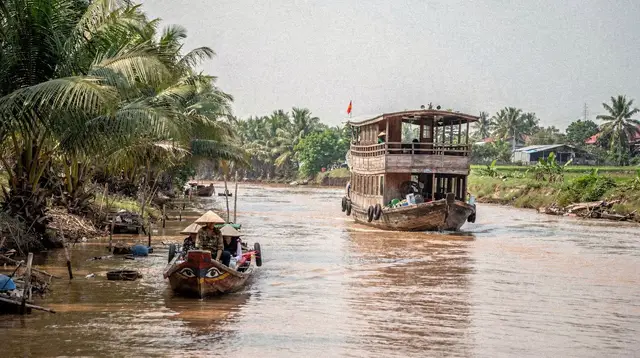
The Mekong Delta, to the south-west, is the region most grand tours give the most time to, because it rewards more than a single day. My Tho and Ben Tre near the city, Vinh Long and Cai Be further in, and Can Tho with the Cai Rang floating market all sit along the same general route, with Chau Doc near the Cambodian border marking a natural far point before the itinerary turns back or continues elsewhere.
The coast, to the south-east, offers a different kind of stop after the delta’s rivers and canals — Vung Tau’s beaches and hilltop statue, the quieter sand at Ho Tram and Long Hai, or the dune country further north-east around Mui Ne and Phan Thiet. Mui Ne sits on a separate stretch of coast from the delta and from Vung Tau, so a grand tour that includes it usually treats it as a distinct final leg rather than an extension of the same coastal road.
Con Dao, the offshore archipelago reached only by air or fast ferry, is the one region this site covers that rarely folds neatly into a road-based grand tour; it is more often booked as its own separate extension before or after the main loop, precisely because it cannot be linked by the same vehicle and driver as the rest of the route.
How the route logic typically works
The general pattern most grand tours in this territory follow is: start in Ho Chi Minh City, head north-west for Cu Chi and Tay Ninh, return to the city or a delta town, head south-west and deeper into the Mekong Delta, then either loop back through the city toward the coast or finish directly on the coast before transferring back for a flight out. The delta and the coast sit on opposite sides of the city’s road network, which is why most itineraries treat them as separate legs rather than trying to connect one directly to the other without passing back near Ho Chi Minh City.
| Region | Direction from the city | What it typically adds to a grand tour |
|---|---|---|
| Ho Chi Minh City | — | Start and end point; markets, museums, temples, skyline |
| --- | --- | --- |
| Cu Chi & Tay Ninh | North-west | War history, tunnels, the Cao Dai Holy See, Black Virgin Mountain |
| --- | --- | --- |
| Mekong Delta | South-west | Rivers, canals, orchards, floating markets, Khmer heritage |
| --- | --- | --- |
| Coast (Vung Tau, Mui Ne) | South-east / north-east | Beaches, dunes, a change of pace from rivers and city streets |
| --- | --- | --- |
| Con Dao (separate extension) | Offshore | Islands, national park, history — reached only by air or fast ferry |
This is a description of how the pieces fit together, not a fixed schedule: the itineraries section of this site lays out several ready-made routes at different lengths and paces, from a five-day version that links the city, the delta and Mui Ne, to a fuller south Vietnam grand loop, up to the most complete ten-day version that gives each region more breathing room.
Choosing between them is really a question of how much time is available and how deep into each region a traveller wants to go — a question this site’s guide to how many days to allow in southern Vietnam covers in more depth.
Booking a grand tour: group, private, or building it piece by piece
There are three broad ways travellers arrange a grand tour of this kind. The first is a ready-made multi-day tour that already links several of these regions in one booking, which removes the need to arrange transport and guides separately for each leg.
a week-long tour through the south that strings together the city, the delta and the coast is built around exactly this kind of multi-region route, and a shorter option covering the same general ground is the five-day southern Vietnam tour out of Ho Chi Minh City, for travellers with less time to give the loop.
The second approach is to book the regions separately and let a private driver or a series of local guides carry a traveller from one to the next — closer to building a custom private tour than a single packaged product. This suits travellers who want to spend an extra night in one region or skip another entirely. The trade-off between these two approaches — a fixed group product against a more flexible private arrangement — is covered in more detail in this site’s comparison of group and private touring in southern Vietnam.
The third approach treats each region as its own booking. A grand tour built this way might combine a general Mekong Delta tour for the river leg with a more specific option such as a rural biking tour around Can Tho for a slower, closer look at delta life, then a private guided day in Vung Tau to cover the coastal leg on the way back. Piecing a route together this way takes more planning than a single packaged tour, but it lets each region be matched to the traveller’s own pace rather than a fixed schedule.
Getting the sequence and logistics right
A few practical points matter more on a multi-region tour than on a single day trip. First, luggage and hotel changes: unlike a day trip that returns to the same Ho Chi Minh City hotel each night, a grand tour usually means checking in and out of accommodation in the delta or on the coast, so packing light and confirming each leg’s transfer in advance avoids wasted time. Second, where a traveller chooses to stay in Ho Chi Minh City at the start and end of the loop affects how easy the transfers to and from Tan Son Nhat Airport are, since most grand tours begin and conclude with an international flight through the city rather than through a regional airport.
Third, the choice between the wet and dry season matters more over a longer, multi-region trip than over a single day out, simply because more days means more exposure to the south’s weather pattern of a hot, mostly dry period from roughly December to April and a wetter period the rest of the year, when afternoon downpours are typically short and heavy rather than an all-day event. A grand tour planned in the wetter months is still workable; it simply benefits from building some slack into the schedule for the regions — particularly the delta’s boat legs — most affected by heavy rain.
Finally, it is worth remembering what a grand tour deliberately leaves out. This route stays inside the four regions this site covers south and west of Ho Chi Minh City; it does not attempt to reach the north or centre of the country, and Con Dao is generally handled as a separate add-on rather than a stop along the main loop. Travellers who want to compare this southern focus against the alternative of heading north instead can see how the two compare in this site’s Ho Chi Minh City versus Hanoi guide — a useful check before assuming a “grand tour” automatically means the length of the whole country.
FAQ: planning a grand tour that links several regions of South Vietnam
Does a grand tour of South Vietnam include central or northern Vietnam?
No. This site’s grand tour stays within the southern region it covers — Ho Chi Minh City, Cu Chi and Tay Ninh, the Mekong Delta and the south-eastern coast. A trip that continues to Hue, Hoi An, Danang or Hanoi is a different, longer journey and is outside this site’s scope.
How is a grand tour different from a single day trip to the Mekong Delta or the coast?
A single day trip, such as one to My Tho or Can Tho, returns to Ho Chi Minh City the same day and covers one river town or one stretch of coast. A grand tour instead moves through several regions in sequence, sleeping outside the city for at least part of the trip and combining destinations that a day trip cannot reach together.
Which regions can realistically be combined in one grand tour?
The four regions this site covers south and west of Ho Chi Minh City combine naturally: the city itself, the Cu Chi and Tay Ninh area to the north-west, the Mekong Delta to the south-west, and the coast around Vung Tau or the dunes around Mui Ne. Con Dao, reached only by air or fast ferry, is usually treated as a separate extension rather than folded into a road-based loop.
Should a grand tour be arranged as a group tour or a private car?
Both exist for this route. A group tour follows a fixed itinerary and a shared vehicle at a lower cost, while a private car or driver allows the pace and stops to be adjusted, which matters more over several linked regions than on a single day trip. Neither option is inherently better; it depends on flexibility versus cost.
Does the order of regions matter on a grand tour?
Most itineraries start in Ho Chi Minh City, move north-west to Cu Chi and Tay Ninh or south-west into the Mekong Delta first, and finish on the coast or back in the city, since the coastal roads and the delta roads run in different directions from the centre. Reversing the order is possible but usually adds driving time rather than saving it.
Is a grand tour of South Vietnam suitable for a first visit?
Yes, and it is a common way to see the region’s range in one trip rather than choosing a single area. Travellers who already know Ho Chi Minh City well, or who have limited time, more often pick one region in depth instead — the Mekong Delta alone, or the coast alone.
Does a grand tour also work for cruise passengers arriving through Phu My?
Not usually. Cruise calls at Phu My typically allow only a single day ashore, which suits one destination such as the city centre or Cu Chi, not a multi-region loop. A grand tour assumes several consecutive days based in or around Ho Chi Minh City.
Multi-Day Tours to the Mekong Delta and Mui Ne
Verified deep-linked GetYourGuide tours. Book through these links and we earn a small commission at no cost to you.
GetYourGuide does not provide a product photo for this activity — the image shows the meeting point, photographed by us.