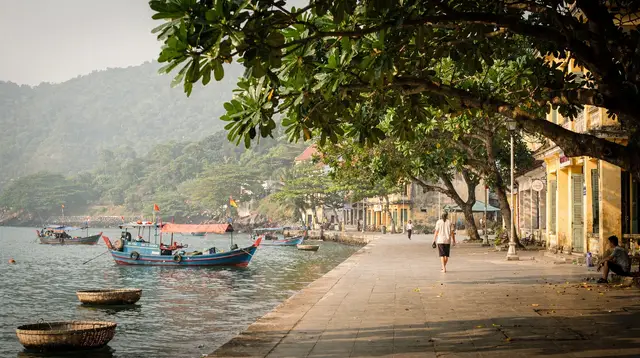
Vung Tau, Ho Tram or Con Dao: Choosing a Beach Near Saigon
Which is better: Vung Tau, Ho Tram or Con Dao?
Vung Tau suits a short day trip by road with a lively city feel; Ho Tram suits a quieter overnight by road with fewer crowds; Con Dao is a separate island archipelago reached only by air or fast ferry, best for travelers with several days to spare.
Which coastal escape actually fits your trip
Ho Chi Minh City sits inland on the Saigon River, so every beach worth mentioning lies outside the city itself, along the south-east coast or offshore. Three names come up again and again: Vung Tau, Ho Tram and Con Dao. Each already has its own full guide on this site describing what there is to do there, so this page does something different. It sets the three side by side on the three things that actually decide which one is right for a given trip: how you get there, what kind of place it is once you arrive, and how much time it realistically asks for.
The short version: Vung Tau and Ho Tram share a coastline and a mode of access, reached by road along the same general direction out of the city. Con Dao is not on that coastline at all. It is an archipelago set well off the mainland, and the only ways in are by air or by a fast ferry service. That single fact does more to separate these three places than anything about their beaches, their food or their hotels.
A fourth name, Mui Ne, sometimes gets thrown into the same conversation. It belongs to Binh Thuan province, further along the coast to the north-east, and it is treated separately on this site under its own category. It is not part of this comparison.
Access: road versus sea and air
Vung Tau and Ho Tram are both reached from Ho Chi Minh City by road. Coaches, private cars and self-drive options all run this route, and the road itself is the same general corridor for both destinations, with Ho Tram lying further along it than Vung Tau. Because both are road trips, they can be combined in a single itinerary or treated as alternate options depending on how much driving a traveler wants to do. Neither involves a flight or a ferry crossing.
Con Dao works completely differently. It is a group of islands set out in open water, with no bridge or causeway connecting it to the mainland. Getting there means either a flight or a fast ferry service; there is no road option at all, not even a partial one. This is the detail most often missed by travelers assuming Con Dao is “just another coastal town like Vung Tau” — it isn’t reachable the same way, and treating it as a quick add-on to a Vung Tau or Ho Tram trip usually leads to disappointment or a missed connection.
This access difference also shapes how each place gets used. Vung Tau’s road connection makes it a natural day trip from the city, something that can be woven into a short stay without committing extra travel days. Ho Tram, being a little further along the same road, tends to work better as an overnight or multi-night stay rather than a rushed same-day visit, even though the mode of transport is identical. Con Dao, because it needs an actual crossing by air or sea, is essentially never treated as a day trip; it asks for its own dedicated stretch of the itinerary.
Atmosphere: city energy, quiet coast, or island remoteness
Vung Tau is a genuine city with a beach attached, not a resort enclave. It has a working port, hillside temples and statues, seafront promenades and a mix of local and visitor life running side by side. That gives it energy and convenience — services, transport options and food choices are all close together — but it also means the atmosphere is closer to an active seaside city than to a secluded getaway.
Ho Tram sits at the other end of that spectrum along the same general coast. It has grown around a smaller cluster of resort properties rather than a dense urban core, and its shoreline is noticeably quieter than Vung Tau’s. It suits travelers who want the same road-trip convenience as Vung Tau but a calmer, less built-up stretch of coast to spend their time on.
Con Dao is different in kind rather than just in degree. Its remoteness — the fact that it can only be reached by air or by sea — keeps development limited and gives the archipelago a national-park character that neither Vung Tau nor Ho Tram shares. It draws travelers interested in nature, diving and snorkeling around its reefs, and a weighty layer of history tied to its former prison sites, rather than travelers looking for a straightforward beach afternoon.
Comparing the three at a glance
| Vung Tau | Ho Tram | Con Dao | |
|---|---|---|---|
| How you get there | By road from Ho Chi Minh City | By road from Ho Chi Minh City, further along the same coast | By air or fast ferry only — no road access |
| --- | --- | --- | --- |
| General atmosphere | Active seaside city with a working port | Quieter resort coastline | Remote archipelago, national park character |
| --- | --- | --- | --- |
| Typical use | Day trip or short stay | Overnight or multi-night stay | Its own dedicated leg of a longer trip |
| --- | --- | --- | --- |
| What stands out | Hillside landmarks, city convenience | Calm coastline, fewer crowds | Diving, snorkeling, wildlife, history |
| --- | --- | --- | --- |
| Combines easily with | Ho Tram (same coast road) | Vung Tau (same coast road) | Best planned separately from the other two |
Choosing based on time available
For a traveler with a single free day and no interest in an overnight stay, Vung Tau is the realistic option among the three, precisely because it is the only one that comfortably fits a same-day round trip by road from the city. A guided city tour that pairs its beaches with its landmark statues or a straightforward full-day beach trip both work within that single day.
For a traveler with two or three days to spend on the coast and a preference for something calmer than a city beach, Ho Tram is the better fit. The road journey is the same kind of trip as Vung Tau’s, just carried a little further, and the extra time is spent on the coastline itself rather than in transit.
For a traveler with several days to commit — enough to absorb a flight or ferry crossing at both ends — Con Dao rewards the extra planning with something the other two simply don’t offer: diving and snorkeling around genuine reef and wildlife, a slower island pace, and a serious historical dimension. It is not a place to squeeze in on short notice or between other stops on a Ho Chi Minh City itinerary; it works best as its own destination within a longer trip through southern Vietnam, alongside stops such as the Mekong Delta or Ho Chi Minh City itself.
Combining destinations sensibly
Because Vung Tau and Ho Tram share the same road corridor, an itinerary that touches both is straightforward to plan — see the dedicated two-day Saigon and Vung Tau coast itinerary for one way to structure it. Trying to fold Con Dao into the same short window is where plans tend to go wrong: its access by air or fast ferry means it needs its own arrival and departure, not a same-day detour from a road trip already built around Vung Tau or Ho Tram. Travelers set on including the archipelago are better served by a longer itinerary such as the five-day Con Dao island extension, planned as a separate block of time rather than an add-on.
It’s also worth remembering that Phu My, the deep-water port used by cruise ships calling at Ho Chi Minh City, sits along the same general direction as Vung Tau. Cruise passengers with limited time ashore sometimes weigh a coastal stop against a city visit — a decision covered in more depth in the cruise port overview — and the same road-versus-sea distinction applies there too.
None of this replaces the destination pages themselves. For what to actually do once you’ve decided where to go, the full guides to Vung Tau, Ho Tram and Con Dao cover the detail — this page exists only to help decide which of the three deserves the time in the first place.
For travelers leaning toward Vung Tau, a few ways to structure the visit are worth flagging directly. A tour built around its quieter beach coves and the hillside statue at Pig Hill suits those who want the headline sights without the busiest stretches of shoreline. A more straightforward full-day beach trip from Ho Chi Minh City covers the round road journey and enough coastal time for a single-day visit.
Travelers who want the city’s landmarks alongside its coastline can take a guided city tour that pairs the beaches with Vung Tau’s statues and viewpoints. For a slower pace with a private vehicle rather than a group schedule, a private day trip covering Vung Tau’s coastal and heritage sites gives more flexibility over timing.
Flights, ferries and cruise-port connections
Con Dao’s air link is short even though the sea crossing it replaces is not: flights from Ho Chi Minh City take around 45 minutes, which is why most travelers who commit to the archipelago fly rather than take the fast ferry. That short flight time is also what makes Con Dao workable at all within a normal southern Vietnam itinerary — the archipelago itself sits roughly 230 km offshore, far enough that a road or even a slow boat option was never realistic. Anyone weighing Con Dao against a longer stay on the mainland coast should read it as “45 minutes each way plus several days on the island,” not as a same-day possibility.
Cruise passengers face a related but different question. Ships calling at Ho Chi Minh City actually dock at Phu My, a deep-water port that itself sits roughly two hours from the city centre and along the same general direction as Vung Tau. With limited hours ashore, some passengers skip the transfer into the city altogether and instead take a shorter run out to Vung Tau’s beaches and statues, an option covered directly by a Vung Tau beach day tour departing from either Ho Chi Minh City or Phu My port. It’s worth comparing this against the city-focused alternative in the Phu My cruise port overview before deciding how to spend a single shore day — Con Dao and Ho Tram are both out of reach on a cruise call, but Vung Tau is not.
Matching the choice to the traveler, not just the map
A solo traveler or a couple with exactly one open day, no vehicle of their own and no interest in organizing transport, is usually better served by a set tour than by piecing together transfers. A private one-day escape to Vung Tau removes that planning entirely and still fits inside the single-day window that rules out Ho Tram and Con Dao. Travelers who want the beach paired with something to see on the way, rather than a straight there-and-back, sometimes add a stop at the wartime sites around Long Tan and Nui Dat before the coast — a combination built into a Long Tan and Nui Dat base tour with Vung Tau beach time.
For a broader side-by-side of Vung Tau specifically against the other main beach option further up the coast — rather than the three destinations covered here — the dedicated Vung Tau versus Mui Ne comparison picks up where this page leaves off, since Mui Ne sits outside this comparison’s scope. And for a rundown of Vung Tau’s individual beaches once the destination itself is decided, the Vung Tau beaches guide covers which stretches of coast suit swimming, which suit sunset views, and which are quietest outside weekends.
A contextualized FAQ on picking a beach near Saigon
Can I visit Vung Tau, Ho Tram and Con Dao in one trip?
Vung Tau and Ho Tram sit on the same stretch of coast reached by road, so they combine easily. Con Dao is a separate archipelago reached only by air or by fast ferry, so it needs its own leg of the trip rather than a quick add-on.
Is Con Dao reachable by road from Ho Chi Minh City?
No. Con Dao is an offshore archipelago with no road or bridge connection to the mainland. It is reached by air or by fast ferry, never by road, which is the main reason it needs more planning than Vung Tau or Ho Tram.
Which of the three is closest to Ho Chi Minh City?
Vung Tau is the closest of the three and the most common day-trip choice by road. Ho Tram sits further along the same coast road. Con Dao is offshore and is not comparable by road distance at all.
Which is quietest: Vung Tau, Ho Tram or Con Dao?
Vung Tau is a working seaside city with the busiest atmosphere of the three. Ho Tram is calmer, built around a smaller number of resorts along a quieter shoreline. Con Dao is the most remote and undeveloped, valued for its national park and its history rather than a resort scene.
Is Mui Ne part of this comparison?
No. Mui Ne and Phan Thiet sit further along the coast in Binh Thuan province and belong to a different category on this site. This comparison covers only Vung Tau, Ho Tram and Con Dao.
Do I need extra time to add Con Dao to a Vung Tau or Ho Tram trip?
Yes. Because Con Dao is reached only by air or fast ferry and sits apart from the mainland coast, it is planned as a separate leg with its own arrival and departure, not folded into a day that also covers Vung Tau or Ho Tram.
Which is better for a short trip with only one day free?
Vung Tau is the realistic choice for a single free day, since it is the only one of the three reached comfortably by road within a day. Ho Tram and Con Dao both suit a longer stay rather than a rushed one-day visit.
Which has the most history to see?
Con Dao carries the most historical weight, centered on its national park and its former prison sites. Vung Tau has its own colonial-era and religious landmarks on its headlands. Ho Tram is the least historically focused of the three, built mainly around its coastline.
Vung Tau, Ho Tram and the Con Dao Islands
Verified deep-linked GetYourGuide tours. Book through these links and we earn a small commission at no cost to you.
GetYourGuide does not provide a product photo for this activity — the image shows the meeting point, photographed by us.