Tan Son Nhat Airport Transfer to Ho Chi Minh City
What is the best way to get from Tan Son Nhat Airport to central Ho Chi Minh City?
For a daytime arrival, a pre-booked private pick-up or a ride-hailing app car are the simplest options, since the airport sits inside the city's built-up area rather than far outside it. Metered taxis, public buses and, for parts of the city, the metro are also available; there is no airport rail link.
Why this airport feels closer than it looks on a map
Most travelers arriving somewhere for the first time brace themselves for a long haul between the airport and the city they came to see. Tan Son Nhat International Airport breaks that pattern. It sits inside the urban fabric of Ho Chi Minh City itself, only a short distance from District 1, rather than on a distant outskirt reached by a dedicated expressway.
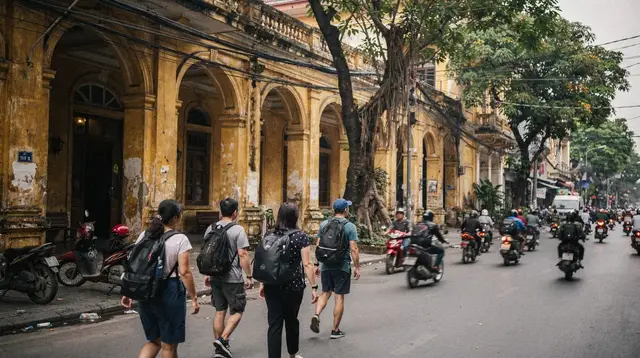
Passengers stepping outside the terminal are often surprised at how quickly the runway perimeter gives way to ordinary streets, motorbike traffic and roadside shopfronts. This is not a suburban or exurban airport in the way some regional hubs are; it functions almost as a downtown airport, woven into the same grid of districts covered throughout this site.
That proximity shapes everything else in this guide. Because the distance is short, the transfer choice matters less for getting there at all and more for comfort, luggage and how much you want to plan in advance. This page covers the ordinary case: a daytime arrival on a normal flight, heading into the central city. It does not cover arriving late at night, when bus schedules thin out and different planning applies — that scenario has its own dedicated guide, linked below. It also does not cover the much longer transfers that continue straight from the airport toward the coast or the Mekong Delta, which are a different kind of trip entirely and are treated separately later in this guide.
With such a short run into District 1, the main thing a pre-booked car buys you is certainty on arrival, so check that the driver tracks your flight, that the drop-off address is spelled out clearly, and that the fare is confirmed in full before you pay. Heavy luggage or a tired family makes this worth arranging ahead, and you can reserve a private car through Kiwitaxi for your airport pick-up.
The options at a glance
There is no single “correct” way to leave Tan Son Nhat for the city center. The right choice depends on how much luggage you are carrying, whether you would rather have a driver waiting with your name on a board, and how comfortable you are navigating on the spot versus booking ahead.
| Option | Best for | What to expect |
|---|---|---|
| Pre-booked private pick-up | First arrivals, families, heavy luggage | A driver waits inside the terminal with a name board; no negotiation needed |
| --- | --- | --- |
| Ride-hailing app (Grab, Be, Xanh SM) | Flexibility, comparing cars on arrival | Requested from a designated pickup area outside the terminal |
| --- | --- | --- |
| Metered taxi | Travelers who prefer a traditional taxi rank | Licensed taxis queue at the terminal; confirm the meter is running |
| --- | --- | --- |
| Public bus | Light packers watching their budget | Cheapest option, but more walking, waiting and no door-to-door service |
| --- | --- | --- |
| Metro (Line 1) | Travelers already near a station on the line | Does not serve the airport terminal directly; useful only for onward legs |
Getting from the arrivals hall to a vehicle
After collecting luggage and clearing the arrivals hall, the different options branch out from slightly different points around the terminal building. Metered taxis and public buses use designated stands directly outside; ride-hailing cars use a separate pickup zone, usually a short walk further along, since local rules keep app-based vehicles apart from the taxi rank. A pre-booked private transfer is the most straightforward of all: the driver is typically waiting just past the arrivals doors or in the terminal’s public area, holding a sign, which removes the need to find a stand or compare cars at all.
If your flight lands very early or very late relative to typical daytime hours, or if you are arriving after midnight, treat this page as a starting point only and read the separate guide on arriving in Saigon at night, since driver availability and bus frequency change once the ordinary daytime flow of arrivals tapers off.
a private pick-up service that meets you at Tan Son Nhat Airport is the simplest way to remove that first-arrival guesswork, particularly useful after a long-haul flight, with a young family, or with more luggage than you want to wheel across a crowded arrivals hall while getting your bearings in a new country.
Private transfer and ride-hailing apps
For most visitors staying in central districts, a private transfer or a ride-hailing app car covers the trip comfortably. The private option is pre-arranged before you land: you know in advance that a driver will be there, which matters more than it might sound after an overnight flight when the last thing you want is to solve a logistics problem in an unfamiliar country. It also tends to suit travelers heading to accommodation in Thao Dien or other addresses slightly outside the core of District 1, where explaining the destination to a driver in advance avoids any confusion.
Ride-hailing apps — Grab, Be and Xanh SM are the three names you will see everywhere in the city — are the choice for travelers who would rather decide on arrival rather than book ahead. They work exactly as they do elsewhere: you request a car from the app, see the driver’s details and the vehicle before it arrives, and pay through the same channel most of the time.
The trade-off against a private pick-up is that you handle the request yourself in the arrivals area, which is easy enough once you know where the pickup zone is, but is one more thing to manage fresh off a flight. For a fuller comparison of these apps against other ways of moving around once you are settled in the city, see the guide to Grab, Be and taxis in Ho Chi Minh City.
Licensed metered taxis remain a completely normal choice too, and many travelers still prefer the familiarity of stepping into a taxi and watching a meter run. As at airport taxi ranks everywhere, it is worth sticking to recognized companies and confirming the meter starts rather than accepting a quoted flat fare from someone approaching you before you reach the official rank.
Public buses and the metro
Public buses connect Tan Son Nhat to several parts of the city and are the least expensive of all the options. They ask more of you in return: finding the right stop, waiting for the next departure, and carrying your own luggage on and off rather than having it handled for you. For a light backpack and an unhurried schedule, this is a perfectly workable way to start a trip; for a family with suitcases, it usually is not the most practical first move.
The city’s new metro, Line 1, opened in December 2024 and runs from the center out toward Thu Duc City, but it does not have a station at the airport terminal itself, so it plays no direct part in the airport transfer. It becomes relevant afterward, once you are already based somewhere along its route and want to explore neighborhoods like Binh Thanh without a car. The fuller picture of buses, the metro line and how they fit together is laid out in the guide to getting around Saigon, which is worth a look before your first full day in the city rather than at the airport itself.
Where you are actually going
Because the airport sits so close to the center, most transfers head straight into District 1 or one of the neighboring central districts. If you have not yet settled on where to stay, the guide to where to stay in Saigon by neighborhood breaks down the practical differences between staying in District 1 itself, quieter District 3, or across the river in Thao Dien — a distinction that matters more for your transfer than the distance alone, since drivers need the exact address or hotel name rather than just a district.
Having that written down, saved in a translation app, or shown as a booking confirmation on your phone smooths the handover with any driver, private or otherwise.
Travelers whose first stop in the city is the riverfront rather than a hotel sometimes head straight toward the Saigon River area for an evening cruise or a walk along Dong Khoi and the Nguyen Hue walking street; the transfer itself does not change for this, only the drop-off point you give your driver.
What this transfer is not
It is worth being explicit about the boundary of this guide, because the confusion is common: this page describes the ordinary daytime transfer between the airport and the central city, nothing further. It is not the same trip as continuing straight from the airport toward Mui Ne or the beaches of Phan Thiet, and it is not the same as pushing on toward the Mekong Delta without a stop in the city first.
Those are considerably longer road journeys with their own dedicated vehicles, typically a private car or a long-distance coach rather than an airport pickup car, and they deserve their own planning rather than being treated as an extension of the airport run. The full picture on those longer legs is in the guide to long-distance transfers to Mui Ne and the delta.
If your itinerary genuinely starts at the airport and heads straight out of the city without an overnight stop in Ho Chi Minh City, dedicated private cars cover that too. a private car directly from the airport to Mui Ne and a private car from the airport to Ho Tram on the coast are built for exactly that use case, and are worth knowing about even if they are not the subject of this particular page.
Before you land: a few practical notes
A handful of details make the arrival smoother regardless of which transfer option you choose. Vietnam runs on UTC+7 year-round with no daylight saving, so there is no clock adjustment to think about once you land. Sockets in Vietnam are mainly the flat two-pin and round two-pin types at 220V, so travelers arriving from a three-pin-plug country will want an adapter before they need to charge a phone at the hotel. A local SIM or eSIM, covered in the separate guide on SIM cards and eSIMs in Vietnam, is worth sorting either before departure or right at the arrivals hall, since having data working the moment you land makes booking a ride-hailing car or confirming an address with a driver far easier.
Cash still matters once you are in the city, particularly for street food and smaller vendors, so it is common to withdraw or exchange some Vietnamese dong soon after arrival rather than relying only on cards. None of this changes the transfer itself, but it shapes how smooth the first hour in the city feels.
Waiting for a delayed or overnight flight
If your own flight is scheduled for very early morning or late at night on departure, rather than arrival, a different kind of comfort becomes relevant: somewhere quiet to wait before boarding. lounge access at Tan Son Nhat International Airport gives a calmer alternative to the general terminal seating for travelers with a long wait ahead of a flight out, which is worth considering on the return leg of a trip even though it has nothing to do with the arrival transfer covered above.
A short first day
For travelers whose plane lands with enough of the day left to explore, the transfer described here can lead straight into sightseeing rather than a rest stop at the hotel. The one-day Ho Chi Minh City highlights itinerary is built around exactly that kind of arrival, sequencing the center’s main sights so a short first afternoon or evening still feels productive rather than rushed. It is not necessary to plan that far ahead before landing, but it is useful to know it exists once you are settled into whichever car got you into the city.
Frequently asked questions about the Tan Son Nhat airport transfer
Is Tan Son Nhat Airport far from central Ho Chi Minh City?
No. Unlike many large international airports, Tan Son Nhat sits inside the built-up fabric of the city, close to District 1, rather than on a distant outskirt. Arriving passengers are struck by how quickly the runways give way to ordinary city streets.
Is there a train from Tan Son Nhat Airport into the city?
There is no rail link to the airport. Line 1 of the new metro network runs from central Ho Chi Minh City out toward Thu Duc, but it does not serve the airport terminal, so the choice comes down to road transport.
Should I book a private transfer or just use a ride-hailing app?
Both work well for a standard daytime arrival. A pre-booked private pick-up means a driver is waiting with a name board, which some travelers prefer after a long flight; a ride-hailing app gives more flexibility and lets you compare cars as they become available.
Can I just take a metered taxi from the airport?
Yes, licensed metered taxis operate from designated ranks at the terminal and are a normal, widely used option. As with any airport taxi rank worldwide, it helps to use a recognized company and confirm the meter is running rather than agreeing to a flat fare with an unofficial driver.
Do public buses run from Tan Son Nhat to the city center?
Yes, several public bus routes connect the airport to central districts and are the cheapest option, though they involve more walking, waiting and luggage handling than a car, and are better suited to travelers without much baggage.
Is the airport transfer different if I arrive at night?
The route and the airport’s location do not change, but a late or overnight arrival carries its own considerations around bus schedules and driver availability, which is covered separately rather than folded into this daytime overview.
Does this transfer apply if I am heading straight to Mui Ne or the Mekong Delta?
No, this guide covers the standard transfer into central Ho Chi Minh City. Heading straight from the airport to the coast or the delta is a longer, separate journey with its own vehicles and considerations.
Getting Around Ho Chi Minh City
Verified deep-linked GetYourGuide tours. Book through these links and we earn a small commission at no cost to you.
GetYourGuide does not provide a product photo for this activity — the image shows the meeting point, photographed by us.