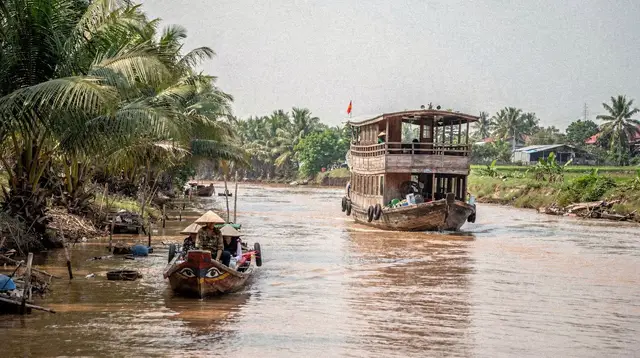
Mekong Delta Two-Day Tour: How the Overnight Format Works
What does a two-day Mekong Delta tour actually cover?
A two-day, one-night tour links two or three neighboring delta provinces at a slower pace than a single-day trip, usually with an overnight stay in a local hotel or homestay. It covers a coherent slice of the delta, not the whole region, which stretches far beyond what two days can reach.
Why add a second day to a Mekong Delta trip
The Mekong Delta is not a single place that can be ticked off in an afternoon. It is a network of provinces, branching river channels and canals stretching from My Tho in the north-east down toward Can Tho, Chau Doc and beyond. A Mekong Delta day trip from Saigon covers a single corridor efficiently but keeps everyone on a tight clock, moving from boat to bus to market with little room to slow down.
Adding a second day and an overnight stay changes the shape of the trip rather than simply extending it. Instead of racing through one province and turning back toward Ho Chi Minh City, a two-day format lets an itinerary spread across two or three neighboring provinces, add an extra excursion in the early morning of day two, and give the whole trip a noticeably calmer pace. This page covers that specific format: two days, one night, a connected cluster of provinces. It does not repeat the mechanics of the single-day version, and it does not cover the longer overnight river cruises that continue toward Chau Doc and across the border into Cambodia, which belong to their own multi-day category.
What a typical two-day structure looks like
Operators build their two-day itineraries around a single travel corridor so that road time between stops stays sensible. Two common patterns illustrate the idea without prescribing exact routes, since operators vary the details:
- A corridor built around My Tho and Ben Tre, staying close to Ho Chi Minh City and focused on canal boats, orchards and coconut-country villages.
- A corridor built around Can Tho, with excursions to Cai Be and Vinh Long, going deeper into the delta and built around the early-morning rhythm of the Cai Rang floating market.
Day one generally moves from Ho Chi Minh City into the delta, taking in boat rides on smaller canals, an orchard or workshop visit, and a first taste of the region’s cooking, before settling into a hotel or homestay for the night. Day two typically starts early, since much of the delta’s most photographed activity — market boats loading and trading produce — happens at dawn, then continues with a further stop or two before the return journey to the city in the afternoon or evening.
A two-day tour is not the whole Mekong Delta
The single biggest misunderstanding about this format is scope. The Mekong Delta extends across provinces stretching from Sa Dec and its flower village to Soc Trang, Rach Gia and Ca Mau at the country’s southern tip. No two-day itinerary reaches all of that, and it isn’t meant to. What a well-built two-day tour delivers is a coherent, connected slice — typically two or three neighboring provinces along one river corridor — explored at a pace that a single day cannot allow.
Travelers who want to go further into the delta, staying longer or venturing toward the Cambodian border, are better served by the multi-day Mekong cruise toward Chau Doc and Cambodia, which is a distinct product built around river travel rather than a road-based two-day loop.
Two-day tour versus other Mekong Delta formats
| Format | Duration | Typical scope | Overnight |
|---|---|---|---|
| Day trip | Single day | One province, a handful of stops | None, returns to Ho Chi Minh City |
| --- | --- | --- | --- |
| Two-day, one-night tour (this page) | Two days | Two or three neighboring provinces | Local hotel or homestay |
| --- | --- | --- | --- |
| Multi-day river cruise | Several days | Deep delta toward Chau Doc, onward to Cambodia | Cruise cabin or riverside stops |
| --- | --- | --- | --- |
| Homestay experience | Varies | Centered on one family stay rather than a touring route | With a local family |
Where the overnight stay fits in
Accommodation on a two-day tour is usually either a modest hotel in a provincial town such as Can Tho or Vinh Long, or a homestay with a local family along one of the canals. The homestay option deserves its own explanation of what it involves, how meals and rooms typically work, and what to expect from staying with a family rather than in a hotel; that detail lives on the dedicated Mekong Delta homestay page rather than here.
What matters for planning a two-day itinerary is simply that the overnight break is the structural feature that separates this format from a single-day trip, giving the schedule room to breathe and letting the second day begin with an early departure toward the floating market or another dawn activity.
What the extra day is used for
The additional day is rarely filler. It typically goes toward one or more of the following, depending on which provinces the itinerary links:
- An early start for the Cai Rang floating market, which trades at dawn and rewards being on the water before the morning crowds arrive.
- A visit to orchards, brick kilns or rice-paper workshops around Cai Be and Vinh Long, reached by smaller sampan boats along the narrower canals.
- A cycling or walking segment through a village that a single-day itinerary would have to skip for lack of time.
- A cooking demonstration or hands-on class using produce from the morning market, which pairs naturally with the slower rhythm of a two-day format. Travelers who want cycling and cooking combined into one structured day can look at the Can Tho bike tour with cooking class, which fits well as either a standalone excursion or a component built into a longer stay.
Getting from Ho Chi Minh City into the delta
Every two-day itinerary starts the same way: a road transfer out of Ho Chi Minh City toward whichever provincial corridor the tour covers. My Tho, the closest delta town, sits roughly 70 km from the city, while Can Tho, the delta’s main city and the usual base for itineraries built around the floating market, is roughly 170 km away and reached in about three to three and a half hours on the expressway.
That distance is one reason the two-day format exists in the first place: a Can Tho-based loop is workable as a very long single day, but a two-day structure turns the same distance into a relaxed visit rather than a race against the return drive. Travelers deciding between the two approaches can compare the trade-offs directly on the Mekong Delta day trip versus two-day tour page, which sets the single-day and two-day formats side by side.
Groups that would rather not commit to a two-day, one-night structure can also look at the Mekong Delta small group day trip format for a lighter alternative, or read how many days in southern Vietnam makes sense overall before deciding how much of the trip the delta should occupy.
Choosing which provinces to combine
Because two days still cannot cover the entire delta, the practical planning question is which cluster of provinces to pick rather than how to see everything. A few considerations help:
- Proximity to Ho Chi Minh City. A corridor built around My Tho and Ben Tre sits closer to the city, which leaves more time in the delta itself relative to time on the road.
- Interest in the floating market. Travelers who specifically want to see Cai Rang need an itinerary built around Can Tho, since the market is there and not near My Tho.
- Appetite for a slower, more rural pace. Corridors that include Sa Dec or reach toward Chau Doc tend to feel more rural and less touristed than the routes closest to Ho Chi Minh City.
For a broader comparison of how to decide on a departure point and route through the delta before committing to any single itinerary, see choosing a Mekong Delta departure point.
How this fits into a wider southern Vietnam trip
A two-day Mekong Delta tour works well as a self-contained addition to a longer stay based in Ho Chi Minh City, typically slotted in after the city’s core sights and before or after a separate excursion toward Cu Chi or the coast.
Combining the delta with another region in the same trip is possible but stretches the itinerary considerably, since each region — the delta, the coast around Vung Tau, or Mui Ne to the north-east — sits in a different direction from the city. Travelers weighing whether the extra day and night are worth the additional time can also read is a Mekong Delta day trip worth it, which lays out the trade-off between the single-day and multi-day formats in more detail.
Who a two-day tour suits
A two-day format tends to suit travelers who already know a single day in the delta would feel rushed, but who are not looking for the multi-day river cruise experience that continues toward Chau Doc and the Cambodian border. That makes it a natural fit for couples and small groups who want the floating market at Cai Rang at a comfortable dawn hour rather than after a pre-dawn departure from Ho Chi Minh City, and for anyone who wants one unhurried night away from the city without committing to a longer multi-day trip. It is less suited to travelers on a tight schedule who only have a single free day, for whom the day trip from Saigon remains the more efficient option, and less suited to travelers who specifically want the extended, deeper route toward Chau Doc and beyond, who are better served by the multi-day cruise format.
Families traveling with children can generally manage a two-day tour comfortably, since the overnight break removes the single biggest source of fatigue on a long single-day itinerary — the late-evening drive back to the city. The mix of boat rides, market visits and a change of scenery over two days tends to hold children’s attention better than a single long day of transport interspersed with brief stops.
Booking a two-day Mekong Delta tour
Two-day itineraries are typically sold as fixed departures with a small group, or as private tours with a driver and guide for a more flexible pace. The standard two-day, one-night Mekong Delta tour is the straightforward version of the format described above. For travelers who want the overnight stay built specifically around a family homestay rather than a hotel, the two-day Mekong Delta tour with a deep local homestay goes further into rural life along the canals.
An option built around river accommodation rather than a hotel or family stay is the two-day Mekong Delta overnight cruise with a local experience, which keeps the traveling and sleeping arrangements centered on the water itself. Travelers who want cycling and a cooking class worked into their two-day stay around Can Tho can look at the Can Tho Mekong Delta bike tour with cooking class as an add-on or a structuring element for one of the two days.
A more general Mekong Delta 2 days, 1 night option is worth comparing against the more specialized homestay and cruise formats above, since operators package the same basic two-day, one-night structure with different mixes of inclusions, group sizes and starting corridors. Reading the specific itinerary for each option before booking is the only reliable way to confirm which provinces, meals and boat segments are actually included, since two tours both labelled “two-day Mekong Delta tour” can still cover different ground.
Mekong Delta two-day tour: frequently asked questions
Is two days enough to see the whole Mekong Delta?
No. The Mekong Delta spans many provinces from My Tho to Ca Mau. A two-day tour covers a connected cluster of two or three provinces in reasonable depth, not the entire delta.
How is a two-day tour different from a Mekong Delta day trip?
A day trip returns to Ho Chi Minh City the same evening and moves quickly between a handful of stops. A two-day tour spreads the same region over more time, adds an overnight stay, and allows for a slower, less rushed rhythm.
Where do travelers sleep on a two-day Mekong Delta tour?
Typically in a local hotel in one of the delta’s provincial towns, or with a family on a homestay basis. Homestay experiences have their own dedicated coverage elsewhere on this site.
Does a two-day tour include the multi-day cruise to Chau Doc and Cambodia?
No. Multi-day river cruises that continue toward Chau Doc and across the border into Cambodia are a separate, longer format covered on its own page, distinct from the two-day, one-night pattern described here.
Which provinces are usually combined on a two-day itinerary?
Operators typically link neighboring provinces along one travel corridor, such as My Tho and Ben Tre, or Can Tho with Cai Be and Vinh Long, so that road time stays reasonable between stops.
Is a two-day Mekong Delta tour physically demanding?
It is considerably gentler than a single long day, since the itinerary is spread over two days with an overnight break. Expect a mix of road travel, boat trips on canals, and walking through markets and orchards.
Can a two-day tour be combined with Cu Chi or the coast?
The Mekong Delta and destinations like Cu Chi or the south-eastern coast are usually treated as separate itineraries, since combining a two-day delta stay with another region stretches a trip considerably.
Mekong Delta Cruises and Floating Markets
Verified deep-linked GetYourGuide tours. Book through these links and we earn a small commission at no cost to you.
GetYourGuide does not provide a product photo for this activity — the image shows the meeting point, photographed by us.