Mekong Delta Craft Workshops: Coconut, Rice and Pottery
Where can I see traditional craft workshops in the Mekong Delta?
Craft workshops are spread across several delta provinces rather than gathered in one place. Coconut-processing workshops cluster around Ben Tre, puffed-rice and rice-paper making is common around Cai Be and Sa Dec, and small pottery workshops appear near Vinh Long. Most visits combine two or three of these on the same boat or road trip.
Where the Mekong Delta’s traditional crafts are actually made
Ask about “craft workshops in the Mekong Delta” and it is tempting to picture one dedicated craft village, the way some parts of Vietnam have a single street of lacquer workers or a single ceramics town. The Mekong Delta does not work that way. Its traditional, non-culinary crafts — turning coconuts into candy and fibre products, puffing rice into snacks, drying sheets of rice paper, throwing small clay pots by hand — are scattered across several separate provinces, each shaped by what grows or is dug up locally.
Coconut work concentrates around Ben Tre, because Ben Tre is coconut country in a way few other Vietnamese provinces are. Puffed rice and rice paper are commonly demonstrated around Cai Be and Vinh Long, where rice fields and river channels sit side by side. Small family pottery workshops, working river clay by hand rather than on an industrial scale, also cluster near Vinh Long. None of this is on the way to becoming a single craft hub, and a visitor who expects to find “the craft village” in one place will be looking in the wrong spot.
This is worth stating plainly because the confusion is common, and it changes how a day should be planned. A single stop rarely covers more than one or two of these crafts. A workshop day built around Ben Tre coconut country looks different from one built around Cai Be and Vinh Long, and a trip that goes further to Sa Dec opens up its own additions, including the flower village Sa Dec is separately known for. Most organised trips solve this by linking two or three workshop stops along a single boat or road route rather than trying to see everything in one province.
It is also worth separating these workshops clearly from the Mekong Delta’s cooking classes, which sit in a neighbouring but distinct category. A cooking class puts you in a kitchen, teaches a specific dish, and the result is a meal. A craft workshop visit is usually shorter, non-culinary, and centred on watching — and sometimes briefly trying — a manual skill: pulling coconut candy off a hot pan, shaping rice paper on a bamboo tray, turning a small clay pot on a simple wheel. Some full-day itineraries combine both categories, with a craft stop in the morning and a cooking element later, but they remain conceptually different things, and this page focuses only on the craft side.
Coconut country: Ben Tre and the coconut-processing workshops
Ben Tre earns its “coconut kingdom” reputation from the sheer density of coconut palms along its canals, and a large share of the province’s small-scale industry runs on what the palm produces. Family workshops here process coconuts into several products in the same visit: the flesh is grated and pressed for coconut milk, the milk is cooked down with sugar into the chewy coconut candy sold across southern Vietnam, and the husk fibre is spun into rope, mats and brushes. Watching the candy stage is usually the highlight for visitors — the mixture is worked by hand on a hot surface, cut while still warm, and wrapped in rice-paper skins by workers moving quickly enough that it looks almost mechanical.
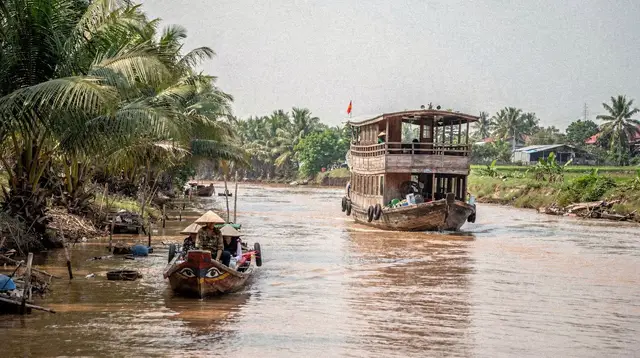
These workshops are typically small, family-run operations reached by a short boat ride along Ben Tre’s canals rather than by road, which is part of why they are usually visited as part of a river-based itinerary rather than a standalone stop. Boat trips through Ben Tre’s canals commonly include a coconut workshop stop alongside a taste of the local coconut candy and sometimes a short ride by horse-cart along the riverbank.
Puffed rice, rice paper and weaving around Cai Be and Vinh Long
Further along the delta, the area around Cai Be and Vinh Long is better known for rice-based crafts than for coconut. Puffed rice — rice that is roasted or fried until it expands into a light, crisp snack — is made in small workshops using simple equipment that has changed little over generations, and it is often shown alongside rice-paper production: thin batter spread by hand across a woven surface, steamed briefly, then laid out to dry in the sun on bamboo racks that are a familiar sight along the riverbanks here. Some workshops in this area also demonstrate reed-mat or basket weaving using dried water hyacinth or bamboo strips, a craft that overlaps with the delta’s broader riverine way of life rather than belonging to one town alone.
Vinh Long is also where some of the delta’s small pottery workshops are found. Working clay dug from the riverbank rather than imported material, these are modest, family-scale operations rather than large ceramic centres, producing everyday items — pots, jars, roof tiles in some cases — by hand on simple wheels. It is a different tradition from the larger, better-known ceramic towns found elsewhere in Vietnam, smaller in scale and much less geared toward large-scale visitor traffic.
Because Cai Be and Vinh Long sit close together on the river, they are frequently combined into a single day, sometimes alongside a stop at a floating market or an orchard visit. Trips departing from My Tho and Ben Tre sometimes extend this far, and a dedicated Cai Be and Vinh Long day trip is a common way to focus on this stretch of the river without also trying to cover Ben Tre’s coconut country on the same day.
How workshop stops usually fit into a day trip
Because these crafts are spread across separate provinces, a single “craft workshops” tour rarely exists as its own product — instead, workshop stops are folded into broader Mekong Delta day trips and multi-day tours that also cover boat rides, orchards and, in some cases, a market or a homestay night. The table below gives a rough sense of where each craft cluster sits and what usually accompanies it, without pinning down exact timings or prices, which change often enough that they are best confirmed on the specific tour you book.
| Craft focus | Typical location | Usually paired with |
|---|---|---|
| Coconut candy and coconut fibre | Ben Tre canals | Canal boat ride, coconut-palm scenery, horse-cart ride |
| --- | --- | --- |
| Puffed rice and rice paper | Cai Be area | Floating market glimpse, orchard visit |
| --- | --- | --- |
| Small pottery workshops | Near Vinh Long | Brick-kiln scenery, river crossing to Cai Be |
| --- | --- | --- |
| Weaving (mats, baskets) | Various delta canals | Village walk, canal boat |
| --- | --- | --- |
| Flower and ornamental village crafts | Sa Dec | Riverside walk, flower nursery |
A multi-day Mekong Delta tour or a two-day itinerary makes it easier to string several of these stops together without rushing, since the workshops themselves sit some distance apart by road or canal. A single long day trip from Ho Chi Minh City can still cover one or two workshop stops comfortably, particularly when the route is built around Ben Tre or around Cai Be and Vinh Long rather than trying to touch both.
Craft-focused tours worth booking directly
A handful of bookable tours are built specifically around hands-on craft experiences rather than a general sightseeing loop. A day trip that includes time with a conical hat–making artisan puts the weaving side of delta craft front and centre, watching a hat take shape from palm leaf and bamboo frame under a craftsperson’s hands.
A trip built around incense-stick making covers a craft that rarely gets attention on standard delta itineraries, following the process from bamboo core to finished, dyed sticks drying in bundles. For something a little different again, a charm-bracelet workshop near Can Tho gives a more interactive, take-home-something angle on the same broad theme of small-scale handwork.
Travellers who want to see craft workshops as part of a fuller regional trip rather than a single afternoon can look at a two-day Mekong Delta tour covering several towns and villages over two days, or a two-day trip with a homestay night deep in the delta, which tends to slow the pace enough to fit in more than one workshop stop alongside the usual boat rides and orchard visits.
Choosing between a craft-focused stop and a general delta tour
Not every visitor wants to prioritise craft workshops, and it is worth being honest about the trade-off. A general delta day trip built around the floating market at Can Tho or orchards near My Tho will often include a brief craft stop as one item among several — a quick look at a coconut-candy pan on the way to the boat dock, for instance — without dwelling on it. A trip chosen specifically for its craft content, by contrast, slows down at the workshop, explains more of the process, and sometimes lets visitors try a step themselves.
Neither approach is wrong; it depends on whether the handwork itself is the draw or simply one stop among many on a boat-and-market day. Guidance on choosing a Mekong Delta departure point and comparing My Tho against Can Tho as a base is useful background for working out which shape of day trip suits the rest of a Ho Chi Minh City itinerary.
Travellers staying overnight in the delta rather than doing a single long day from the city have more flexibility to fit in multiple workshop stops without feeling rushed. A Mekong Delta homestay night, in particular, often sits close enough to a rice-paper or pottery workshop that a visit can be added the next morning before heading back, rather than squeezed into an already packed single day trip departing from Ho Chi Minh City.
Further afield: Tay Ninh’s craft village and Tra Vinh’s Khmer coconut work
Two less-visited stops widen the picture beyond the usual Ben Tre–Cai Be–Vinh Long triangle, though both sit further from the standard delta loop and suit travellers with a bit more time.
Tay Ninh is usually visited for the Cao Dai Holy See rather than for crafts, but a Tay Ninh craft village experience covering rice paper and local salt-making shows a side of the province most day-trippers never see. Tay Ninh’s rice paper is dried using local methods distinct from those around Cai Be, and the province’s seasoned salt mixes — often flavoured with chilli or shrimp — are a genuinely regional product rather than something sold delta-wide. Because Tay Ninh sits north-west of the city rather than in the delta proper, this is worth treating as a separate outing rather than an add-on to a Ben Tre or Vinh Long day.
Further south, Tra Vinh is home to a sizeable ethnic Khmer community, and its coconut-growing areas produce macapuno, a soft-fleshed coconut variety distinct from the standard coconuts processed around Ben Tre. A Tra Vinh trip combining macapuno coconut with Khmer culture pairs a coconut-processing stop with a look at Khmer pagoda architecture, which is a distinct tradition from the Chinese-style temples found in Cholon back in the city. This kind of trip suits travellers who have already done a standard Ben Tre or Cai Be day and want a craft stop that does not repeat what they have already seen.
Practical tips for a craft-workshop stop
A few points make these stops easier to plan around, whether they land inside a day trip or a longer delta itinerary.
Morning visits see more activity. Rice paper needs sun to dry and is typically laid out earlier in the day, and coconut-candy pans tend to be busiest during the morning production run. A workshop visited in the early afternoon may show the same setup but with less actually happening in front of you, simply because the day’s batch has already been made.
These are working operations, not stage sets. The families running coconut, rice-paper and pottery workshops sell what they produce, and browsing or buying a small item is a normal, low-pressure part of the visit rather than an obligation. Prices for candy, rice paper or small pottery pieces are modest and vary by workshop, so it is worth having a little small cash on hand rather than expecting to pay by card.
Combine, don’t over-schedule. Because the workshops sit apart from one another by boat or road, cramming three or four craft stops plus a market and an orchard into a single day usually means rushing each one. A day built around one craft cluster — Ben Tre coconut work, or the Cai Be–Vinh Long combination — with time to actually watch a process through tends to feel less hurried than a day that tries to touch every craft at once. Anyone weighing a single busy day against spreading the same ground over two is better served by reading Mekong Delta day trip vs a two-day tour before booking.
Boats and coconut country go together. Because many of the Ben Tre workshops are reached by sampan along narrow canals, a workshop stop there is rarely a purely road-based visit. Travellers who specifically want the boat element alongside the coconut theme are well served by a Coconut Kingdom full-day tour from Ho Chi Minh City, which threads canal boat rides between workshop stops rather than treating the boat as a single short add-on.
Children generally do fine, with a few cautions. As noted above, the visual, hands-on nature of these crafts tends to hold children’s attention better than a standard temple or museum stop, though hot sugar pans and open flames in coconut-candy workshops call for the same close supervision any kitchen-adjacent activity would.
Getting a sense of scale before you go
It helps to arrive with realistic expectations about scale. These are small, often family-run operations, not factories built for tour groups, and outputs are modest by design — a few trays of rice paper drying at a time, a handful of coconut-candy batches cooked through the morning, one or two potters working at a wheel. That is part of the appeal for many visitors, but it also means a workshop can occasionally be quiet or between batches when a boat happens to stop, especially outside the morning hours when most of the daily production tends to happen.
Treating a workshop stop as one enjoyable part of a longer river day, rather than the single reason for the trip, tends to make for a more relaxed visit overall. For the wider planning picture, the Mekong Delta day trip from Saigon guide and the overview of things to do in the Mekong Delta both cover how craft stops sit alongside the region’s boat rides, markets and orchards.
Mekong Delta Cruises and Floating Markets
Verified deep-linked GetYourGuide tours. Book through these links and we earn a small commission at no cost to you.
GetYourGuide does not provide a product photo for this activity — the image shows the meeting point, photographed by us.