Vinh Trang Pagoda in My Tho: A Mekong Delta Temple, Not a Saigon One
Is Vinh Trang Pagoda in Ho Chi Minh City?
No. Vinh Trang Pagoda is in My Tho, the Mekong Delta town roughly 70 km south-west of Ho Chi Minh City. It is included in day trips that leave the city rather than being a Ho Chi Minh City sight itself.
Where Vinh Trang Pagoda Actually Stands
A surprising number of travellers picture Vinh Trang Pagoda as a Ho Chi Minh City landmark, filed mentally alongside the Jade Emperor Pagoda or the temples of Cholon. It is not. Vinh Trang Pagoda sits on the outskirts of My Tho, the Mekong Delta town that most day trips from the city use as their gateway.
The confusion is understandable: the pagoda is sold almost exclusively as part of a Ho Chi Minh City tour package, printed on the same itinerary sheet as pickup times from a District 1 hotel, so its name becomes attached to the city that sends the tour bus rather than the delta town where the temple has stood for well over a century.
This page treats Vinh Trang Pagoda as what it is: a single, specific religious site with its own history and architecture, worth understanding on its own terms before it gets folded into the logistics of a wider excursion. For the practicalities of getting to the delta and back — bus versus private car, what else to combine with the day — the dedicated day-trip and departure-point guides linked throughout this page cover that ground. This one stays with the pagoda itself.
A Pagoda Built From Several Traditions at Once
Vinh Trang Pagoda’s most distinctive quality is visual rather than doctrinal: it does not read as a single, pure architectural style. Walk the grounds and the influences layer on top of each other — Vietnamese temple roof forms sit beside Chinese decorative motifs, Khmer touches nod to the delta’s ethnic Khmer communities, and European-influenced arches and ornamentation reflect the colonial-era decades in which the pagoda took much of its current shape. The result is a facade that many visitors describe as ornate almost to the point of being busy, and that is precisely the point: it is a physical record of the delta’s layered cultural history rather than an attempt at architectural purity.
Inside the grounds, two large Buddha figures anchor the site: a seated Buddha and, separately, a reclining Buddha, both large enough to be visible above the surrounding garden greenery. Neither is described here by height or by any other measurement, because those figures — like the pagoda’s opening hours and any entrance arrangement — are exactly the kind of detail that changes without much notice and is better checked at the point of booking or on arrival than printed as a fixed fact on a guide page. What can be said reliably is that the statues, the courtyards, the bonsai-style garden plantings and the ornamental gateway together make Vinh Trang Pagoda a photogenic stop that rewards slow walking rather than a quick drive-by glance.
The pagoda remains a working monastery. Monks live and study on the grounds, and local Buddhist worshippers visit for ordinary religious practice, not for tourism. Visitors are guests in an active place of worship rather than patrons of a heritage museum, which is worth keeping in mind for dress and behaviour: modest clothing and a quiet, respectful pace fit the setting far better than the kind of energetic sightseeing pace suited to a market or a viewpoint.
Why the Ho Chi Minh City Confusion Persists
The mix-up over Vinh Trang Pagoda’s location is not random. Almost every operator selling the pagoda as a stop is based in Ho Chi Minh City, because My Tho is the closest Mekong Delta town to the city and the natural first stop for a delta day trip. A traveller researching things to do from a District 1 hotel base finds Vinh Trang Pagoda listed on a Ho Chi Minh City tour company’s website, under a Ho Chi Minh City-facing itinerary, often without a clear statement of which town the pagoda is actually in. The pagoda’s name attaches itself to the seller’s city rather than to its own.
The clearest way to keep the geography straight: Ho Chi Minh City is the departure point, and My Tho, with Vinh Trang Pagoda on its edge, is the destination reached after a road journey of roughly 70 km. Nothing about the pagoda’s physical location changes based on which city sells the tour. The same logic applies to nearby stops that get bundled into the same day — the orchard islands around Cai Be and Vinh Long, the coconut country of Ben Tre — all of which belong to the delta, not to the city.
It is also worth separating Vinh Trang Pagoda from Ho Chi Minh City’s own religious landmarks, which have their own distinct character and their own dedicated pages: the Jade Emperor Pagoda in the city centre, and the temples of Cholon in the historic Chinatown district. Those are genuinely city-based sights, reachable on foot or by a short ride within Ho Chi Minh City itself, and they make a reasonable substitute for travellers who want a temple visit without leaving the city on a longer excursion. Vinh Trang Pagoda is a different kind of stop: a delta temple seen as part of a wider countryside and river day, not a city errand.
How Vinh Trang Pagoda Fits Into a Mekong Delta Day
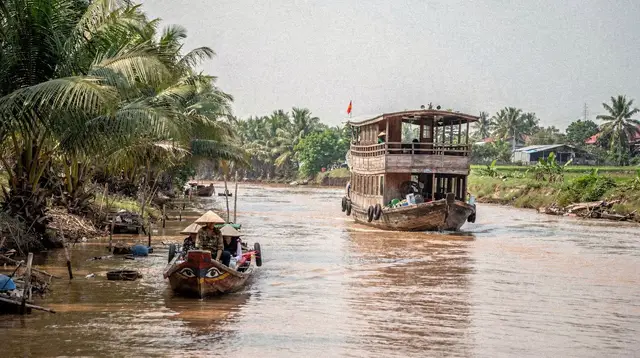
Vinh Trang Pagoda rarely appears as a stand-alone destination. It is almost always one stop within a broader Mekong Delta day trip from Saigon, slotted in alongside a boat ride on the river, a stop at an orchard or a coconut-candy workshop, and sometimes a rowing-boat passage through narrower canals. The pagoda’s role in that sequence is usually cultural counterpoint: after time on the water and among orchard islands, the pagoda offers a quieter, architecturally rich pause before the return drive to the city.
Because My Tho sits closest to Ho Chi Minh City among the delta’s main towns, it is also the default choice for travellers with limited time who still want a genuine taste of the Mekong Delta without committing to the longer drive out to Can Tho. That distinction matters for planning: the famous Cai Rang floating market trades at dawn near Can Tho, well beyond My Tho, so it is not realistically paired with Vinh Trang Pagoda on the same day trip.
Operators instead combine the pagoda with closer river and orchard stops around My Tho, Cai Be or Ben Tre. Travellers deciding between the two approaches — a My Tho-based day built around Vinh Trang Pagoda, or a longer push toward Can Tho for the floating market — will find the trade-offs laid out directly in the guide to choosing a Mekong Delta departure point and in the comparison of My Tho versus Can Tho for the Mekong Delta.
For travellers who prefer a slower pace or want to see more of the delta than a single day allows, the two-day Mekong Delta itinerary covering Can Tho and Cai Rang or the more general Mekong Delta day trip versus two-day tour comparison both help frame how much of the delta — pagoda included — realistically fits into the time available.
Vinh Trang Pagoda Among the Delta’s Other Temples
My Tho and the wider delta hold a number of religious sites shaped by the same layered history that gives Vinh Trang Pagoda its distinctive look. Communities descended from ethnic Khmer settlers maintain their own temples across the delta, architecturally distinct from Vietnamese Buddhist pagodas, and travellers curious about that broader picture will find it addressed in the guide to Khmer temples of the Mekong Delta. Vinh Trang Pagoda itself is Vietnamese Buddhist in tradition, but its decorative borrowings from Khmer, Chinese and European sources place it at a genuine crossroads of the delta’s religious architecture rather than in a single, isolated tradition.
Comparisons with the Cao Dai Holy See at Tay Ninh or with the Jade Emperor Pagoda in Ho Chi Minh City are natural, since all three draw travellers interested in Vietnam’s religious diversity. But the comparison is more useful as context than as a ranking: Tay Ninh belongs to a separate excursion north-west of the city, usually paired with the Cu Chi Tunnels rather than with anything in the delta, while the Jade Emperor Pagoda is a compact city-centre stop suited to a half day rather than a full delta excursion. Vinh Trang Pagoda’s identity is tied specifically to My Tho and to the delta’s river landscape around it.
Booking a Day Trip That Includes Vinh Trang Pagoda
Because Vinh Trang Pagoda is sold as part of a broader itinerary rather than as a stand-alone ticketed attraction, the practical decision travellers face is which style of Mekong Delta day trip to book, not how to reach the pagoda directly. Several styles of departure suit different priorities.
Travellers who want the orchard-island and floating-market side of My Tho alongside the pagoda can look at the tour covering the Tan Phong floating market at Cai Be together with a Vinh Trang Pagoda stop, which keeps the day within a compact stretch of the delta near My Tho. For a more comfortable, higher-end version of the same region, the upgraded day tour through My Tho and Ben Tre trades a larger group bus for smaller-group or private transport while covering similar ground.
Travellers interested in a craft-focused day can add a stop at a local workshop to the temple and river itinerary: the day trip built around a conical hat-making artisan and the day trip centred on incense-stick making both fold a hands-on craft visit into the same general My Tho and delta framework that includes Vinh Trang Pagoda.
Those who prefer to extend the day into the evening, rather than returning to Ho Chi Minh City by late afternoon, can look at the My Tho and Ben Tre day trip that continues into a firefly-watching evening on the river, which pairs the pagoda and orchard stops earlier in the day with a very different, after-dark experience on the water.
Setting Expectations Before the Trip
A few points are worth setting straight before booking, precisely because they are the details most often garbled by the same city-versus-delta confusion that surrounds the pagoda’s location. First, Vinh Trang Pagoda is not part of any UNESCO World Heritage listing — no site anywhere in the Ho Chi Minh City and southern Vietnam region carries that status, and the region’s UNESCO recognitions that do exist, at Can Gio and Cat Tien, belong to the separate Biosphere Reserve programme and have nothing to do with religious architecture.
Second, ticket prices, opening hours and how long a visit takes in practice all shift over time and depend on which tour operator is running the day, so none of those figures are printed here; check them directly against the operator or listing at the time of booking rather than relying on a fixed number from a guide page. Third, remember that a visit to Vinh Trang Pagoda is one component of a longer day that also involves road time from Ho Chi Minh City and time on the river — planning the day around the pagoda alone, without accounting for that surrounding travel, tends to lead to disappointment about how little time is actually spent at the temple itself.
For a wider view of how a My Tho day compares with other Mekong Delta approaches, the guide to whether a Mekong Delta day trip is worth it and the general My Tho and Ben Tre tour guide both give useful additional framing before deciding which specific itinerary, and which specific booking, fits best.
Vinh Trang Pagoda: Frequently Asked Questions
Is Vinh Trang Pagoda in Ho Chi Minh City or in the Mekong Delta?
It is in the Mekong Delta, on the edge of My Tho. Visitors sometimes assume it is a city-centre temple because it appears on Ho Chi Minh City tour itineraries, but the pagoda itself never moves from My Tho.
Why does Vinh Trang Pagoda appear on Ho Chi Minh City tours?
Because My Tho is the closest Mekong Delta town to Ho Chi Minh City and the usual starting point for a delta day trip. Tour operators based in the city sell the excursion, which creates the impression that the temple sits within the city itself.
What makes Vinh Trang Pagoda distinctive?
Its architecture blends Vietnamese, Chinese, Khmer and European decorative elements in a single complex, along with a large seated Buddha figure and a reclining Buddha figure in the grounds, making it visually different from the pagodas of central Ho Chi Minh City.
Can Vinh Trang Pagoda be visited on its own, without a Mekong Delta tour?
Independent travel is possible by road from Ho Chi Minh City, but almost everyone sees it as one stop within a broader My Tho or Mekong Delta itinerary that also covers the river and its orchard islands.
Is Vinh Trang Pagoda a UNESCO World Heritage Site?
No. No site in the Ho Chi Minh City and southern Vietnam region carries UNESCO World Heritage status. Vinh Trang Pagoda is a heritage-listed Vietnamese religious site, which is a different, national-level recognition.
Is Vinh Trang Pagoda still an active place of worship?
Yes. It functions as a working Buddhist monastery and pagoda, not a museum, so visitors share the grounds with monks and local worshippers going about ordinary religious life.
Should Vinh Trang Pagoda be combined with the Cai Rang floating market?
Not usually on the same day trip. Cai Rang trades at dawn near Can Tho, which is well beyond My Tho, so operators pair Vinh Trang Pagoda with closer Mekong stops such as the orchard islands, Cai Be or Ben Tre rather than with Can Tho.
Mekong Delta Cruises and Floating Markets
Verified deep-linked GetYourGuide tours. Book through these links and we earn a small commission at no cost to you.
GetYourGuide does not provide a product photo for this activity — the image shows the meeting point, photographed by us.