Mekong Delta by Speedboat: The Fast Way Between Delta Hubs
What is a Mekong Delta speedboat tour, and how is it different from a sampan ride?
A Mekong Delta speedboat is a fast motorised transfer that covers longer stretches of open river between towns or provinces, replacing a slower van or long boat leg. It is not the same experience as a sampan, the small motorised or paddled boat used to explore narrow canals at walking pace, which stays the way to see that side of the delta up close.
Getting Between Delta Towns the Fast Way
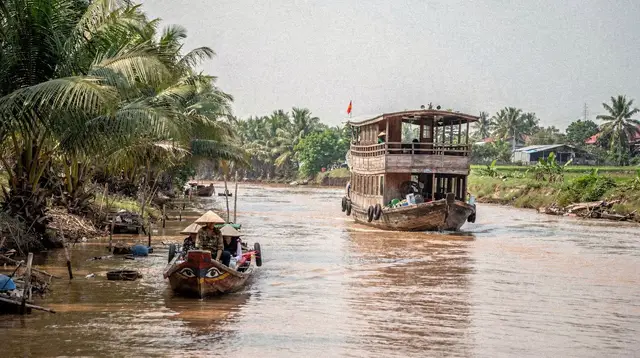
The Mekong Delta is criss-crossed by two very different kinds of water transport, and it is easy to mix them up before a first visit. One is the sampan: a small, low boat, motorised or paddled, that carries a handful of passengers through narrow, overhung canals at a gentle pace, close enough to touch the banana leaves on either side.
The other is the speedboat: a larger, faster hull built to cover open stretches of the main river channels, moving people between towns and provinces rather than exploring the small waterways. This page is about the second kind. If you are looking for the slow, intimate canal experience, that belongs on its own page — see the guide to sampan rides through the delta canals — and this article will not repeat it.
The confusion is understandable, because both are boats, both are wet, and both show up in the same delta itineraries. But they solve different problems. A sampan is the vehicle for seeing a specific stretch of the delta closely, at the pace that makes the canals worth visiting in the first place. A speedboat is the vehicle for getting somewhere, when a stretch of river separates two points that a van or car cannot easily reach, or when covering that distance by slow boat would eat into the rest of the day. Understanding which job each one does makes it much easier to read a tour itinerary and know what to expect at each stage.
What a Mekong Delta Speedboat Actually Does
In practical terms, a speedboat transfer is a connector. It picks up a role that a road vehicle cannot fill — because the two points it links are both on the water, or because one of them is only reachable by river — and it fills that role quickly, without the stops, narration and slow drifting that define a canal cruise. Operators use speedboats to link a departure point on the outskirts of Ho Chi Minh City or a delta town to another point further along the Saigon River system or one of the delta’s own river branches, or to move a group between two provincial hubs without doubling back onto the road network.
Because the delta’s road bridges and ferries do not always follow the shortest line between two riverside towns, a stretch of open water can sometimes be the more direct route, and a speedboat is the tool that makes that route practical for a group with a schedule to keep. It is also the option an operator reaches for when a full day already includes a slow canal cruise, a market visit and a meal stop, and adding another slow boat leg on top would simply not fit.
Speedboat, Sampan or Road: Which Does What
The table below is a quick way to keep the three modes straight when reading through delta tour descriptions, without attaching numbers that vary by operator, season and route.
| Mode | Typical role | What it feels like |
|---|---|---|
| Speedboat | Covers longer, open-water legs between towns or provinces | Fast, open or lightly covered, some spray and engine noise |
| --- | --- | --- |
| Sampan | Explores narrow canals at close range | Slow, quiet, shaded, close to the banks |
| --- | --- | --- |
| Road vehicle (car, van, coach) | Covers the approach from Ho Chi Minh City and any leg with no practical river route | Air-conditioned, steady, the default between fixed points on land |
A well-built delta itinerary usually combines all three: road out from the city, a working boat leg where the river offers the more sensible path, and a sampan session where the point of the visit is the canal itself rather than the distance covered.
Where Speedboat Routes Typically Connect
Delta operators structure their speedboat legs around the geography of the region rather than around a fixed national network, so the exact route depends on the itinerary. In general terms, a speedboat is more likely to appear on a route that links a point near the outskirts of the city or a delta departure town — often somewhere along the approach through My Tho or Ben Tre — onward toward a hub further along the river system, or on a leg that shortcuts between two towns that the road network does not connect directly.
Can Tho, as the delta’s main city, sits at the centre of a lot of this movement, and boats of various kinds fan out from it toward smaller towns and orchard areas. That said, the specific dawn visit to the Cai Rang floating market is its own separate leg, run on a smaller local boat timed to the market’s own rhythm rather than on the longer-distance speedboat used for point-to-point transfers — worth flagging because the two are often assumed to be the same boat when they are not.
If you are deciding where to base a delta visit around, the comparison in choosing a Mekong Delta departure point covers how My Tho, Ben Tre, Vinh Long and Can Tho relate to each other as starting points, independent of which boat covers which leg.
Further out, Chau Doc near the Cambodian border is another point where river transport plays a bigger role than road transport in a traveller’s itinerary, since some routes toward and beyond it rely on the river rather than parallel roads. None of this means every itinerary touching these towns includes a speedboat leg — many rely entirely on road transfers and a slow boat session — so it is worth checking the specific tour description for how each stage is actually covered rather than assuming.
Booking a Speedboat Leg as Part of a Longer Trip
Very few travellers book a speedboat transfer as a standalone product. In practice, the fast boat leg is a component built into a wider Mekong Delta itinerary, alongside orchard visits, a meal, a market stop and usually a slower canal session. A single-day trip out of the city, such as the Mekong Delta day trip from Saigon, may or may not include a speedboat stretch depending on which towns it covers; a longer overnight structure, such as the two-day Mekong Delta tour, has more room to combine a faster transfer with a proper slow-boat session on a different day.
For a two-day format built around Can Tho and the delta’s deeper hubs, the two-day Can Tho and Cai Rang itinerary lays out how a fast transfer, a market visit and a slower canal session typically sit alongside each other across two days. Among bookable options, a two-day Mekong Delta tour is a common structure that mixes transfer types across its itinerary, and a two-day overnight Mekong Delta cruise with a local experience takes a similar shape with an overnight stay built in.
Travellers who want the deeper, village-level side of the delta alongside a mix of transport modes sometimes look at a Can Tho bike tour with a cooking class, which pairs land and water legs across a single day out of Can Tho.
None of these listings promise a specific number of minutes on a speedboat, a fixed price for the leg, or a set departure time, because that detail sits with each operator and changes by season and group size. What matters when comparing options is which legs of the day are covered by which mode of transport, and whether that matches what you actually want to see.
Comfort, Luggage and What to Expect on Board
A speedboat is a working transfer, not a scenic cruise, and it is worth setting expectations accordingly. Seating is usually simple bench-style, sometimes under a partial canopy and sometimes open to the weather, and the ride can involve noticeable engine noise and occasional spray, especially compared to the quiet drift of a sampan. Life jackets are standard equipment on organised tours, and a reputable operator will have them ready before boarding rather than after a request. Luggage space is limited, so day-bag-only packing makes sense for any leg that includes a speedboat transfer, with larger bags typically routed separately by road when a tour includes both.
Because the ride is faster and less sheltered than a canal boat, anyone sensitive to motion, sun exposure or noise should mention it when booking, so the operator can advise on the specific vessel used for that route. This is a reasonable question to ask before choosing a speedboat-inclusive itinerary over one built entirely around road transfers and a single slow-boat session.
Combining a Speedboat Leg with Can Tho and the Floating Market
Because Can Tho functions as the delta’s main hub, it is common for an itinerary to use a faster boat to reach the Can Tho area and then switch to smaller local boats for the close-range parts of the visit, including the dawn approach to Cai Rang. The Cai Rang floating market at sunrise guide covers that specific leg on its own terms, including why the market visit runs on its own boat and its own clock rather than folding into a longer-distance transfer.
If Can Tho sits at the centre of your plan, it is worth deciding in advance how much of your time on the water you want to spend covering distance versus exploring slowly, since a day that tries to combine a long speedboat transfer, the floating market and a full canal session can end up feeling rushed. Spreading those elements across two days, as the two-day Can Tho and Cai Rang itinerary does, generally gives each mode of transport room to do the job it is actually good at.
Speedboat Transfers in the Wet and Dry Season
The Mekong Delta runs on the same two-season pattern as the rest of southern Vietnam: a drier stretch roughly from December to April, and a wetter stretch roughly from May to November, when rain typically arrives as a short, heavy downpour in the late afternoon rather than as all-day drizzle.
On the open stretches of river a speedboat covers, wind and light rain are more noticeable than they would be inside a sheltered canal, so a wet-season transfer scheduled around the middle of the day, ahead of the typical afternoon downpour, tends to be the more comfortable choice. This is a scheduling consideration for the operator managing your itinerary rather than something to plan around yourself, and it is one more reason the speedboat leg is usually built into a wider tour rather than booked as an independent trip.
Choosing Between a Speedboat, a Van and a Slow Boat
The honest answer for most travellers is that they will end up using more than one of these modes on the same trip, because each covers a different kind of ground. A road vehicle handles the approach from Ho Chi Minh City and any leg where a bridge or paved road already does the job. A speedboat picks up a leg where the river genuinely shortcuts the road, or where a group needs to cover open water without spending the better part of a day drifting through it. A sampan takes over the moment the point of the visit becomes the canal itself, rather than the destination at the far end of it.
If your priority is the deep, quiet canal experience, structure your day or your operator choice around the sampan session and treat any speedboat leg as a practical bridge to reach it, not the highlight in its own right.
If your priority is covering more ground across a longer route — say, a loop that touches Cu Chi and the delta on the same trip, as in the combined Cu Chi Tunnels and Mekong Delta day trip or the four-day HCMC and Mekong Delta homestay tour — a faster boat leg is simply one of the tools that makes covering that ground in a reasonable time possible. Either way, the choice comes down to matching the transport to the purpose of that stretch of the trip, not to picking the fastest option by default.
Frequently Asked Questions About Mekong Delta Speedboat Transfers
Is a Mekong Delta speedboat tour the same as a sampan ride through the canals?
No. A speedboat runs on the main river channels between fixed points, while a sampan is a small boat that threads narrow, shaded canals at a slow pace. Most visitors do both on the same trip, for different purposes.
Does the speedboat go to the Cai Rang floating market?
Cai Rang is usually reached from Can Tho by a smaller local boat timed around dawn, not by the longer-distance speedboat routes described here. The two are separate legs of a delta itinerary.
Can I take a speedboat directly from Ho Chi Minh City into the delta?
Most itineraries still start with a road transfer from Ho Chi Minh City to a delta town, then switch to water once they reach the river system. The speedboat segment typically covers the river leg between delta towns rather than the initial approach from the city.
Is a speedboat transfer suitable for people who get seasick or have mobility limitations?
A speedboat moves faster and can feel bumpier than a slow sampan or a covered tourist boat, so anyone prone to motion sickness or with limited mobility should ask an operator about the specific vessel and boarding conditions before choosing this option over a calmer alternative.
Do I need to book the speedboat leg separately from the rest of the tour?
On an organised multi-day Mekong Delta tour, the speedboat or other boat transfers are normally built into the itinerary and handled by the operator, so there is nothing extra to arrange.
Is the speedboat leg included on every Mekong Delta tour?
No. Some itineraries rely on road transfers and slow boats only, others add a faster boat leg between specific points, so it is worth checking what mode of transport is used at each stage before booking.
Mekong Delta Cruises and Floating Markets
Verified deep-linked GetYourGuide tours. Book through these links and we earn a small commission at no cost to you.
GetYourGuide does not provide a product photo for this activity — the image shows the meeting point, photographed by us.