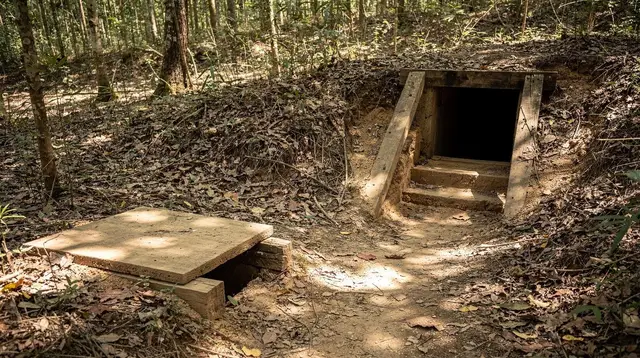
Cu Chi Tunnels and Mekong Delta Day Trip
Are the Cu Chi Tunnels and the Mekong Delta the same region?
No. Cu Chi is a district of Ho Chi Minh City to the northwest, while the Mekong Delta lies to the southwest around towns such as My Tho and Can Tho. A combined day trip visits both by driving in one direction in the morning and the other in the afternoon, not by touring a single area.
Two Regions in Opposite Directions, One Long Day
Among the day trips sold from Ho Chi Minh City, few combinations get mixed up as often as this one. The Cu Chi Tunnels sit to the northwest of the city, inside Ho Chi Minh City’s own administrative limits, while the Mekong Delta begins to the southwest, a separate region entirely.
They are not neighbors, they are not part of the same landscape, and a map of the two makes the point instantly: one arrow points inland toward flat farmland and old tunnel networks, the other points toward a web of rivers and canals running out to the coast. What makes them appear related is not geography but logistics — both are reachable from the same city in a single day, and a visitor with limited time often wants a taste of both rather than a deep look at just one.
This page is about the logic of combining the two, not about what to see once you arrive at either. For the tunnels themselves, including the difference between the two visitable sites, see the dedicated guides linked below; for what the delta town portion actually involves, its own guides cover the boats, the orchards and the markets in detail.
Why These Two Get Paired at All
The pairing exists because of where Ho Chi Minh City sits relative to its surroundings. The city is ringed by day-trip territory in several directions: Cu Chi and Tay Ninh to the northwest, the Mekong Delta to the southwest, the coast to the southeast, Mui Ne to the northeast, and Cat Tien inland to the north. A traveler on a single free day, or a cruise passenger routed through Phu My port with only a matter of hours ashore, has to choose how to spend that day. Combining Cu Chi with a Mekong Delta town lets an operator offer a war-history morning and a river-and-countryside afternoon in the same itinerary, which is appealing precisely because the two experiences feel so different from each other.
The trade-off is honest and worth stating plainly: because the tunnels and the delta lie in opposite directions from the city, a combined day spends real time retracing routes back toward Ho Chi Minh City before heading back out the other way. Neither region is visited at the unhurried pace that a dedicated day trip to just one of them would allow. What the combined format buys is coverage, not depth — two very different sides of southern Vietnam sampled in one outing rather than one side explored fully.
The Geography Behind the Route
Understanding why the combination works logistically starts with where each region actually sits. Cu Chi is roughly northwest of central Ho Chi Minh City and is, administratively, one of the city’s own districts — closer to downtown than most first-time visitors expect. The Mekong Delta gateway towns, by contrast, sit to the southwest, on the far side of the city from Cu Chi. A traveler visiting both in one day is not moving in a loop through one contiguous area; they are effectively completing two separate out-and-back legs from the same base, one to the northwest and one to the southwest, on either side of a midday stretch back through or around the city.
This is also why Cu Chi is far more often paired with Tay Ninh — home to the Cao Dai Holy See — than with the delta on tours built around the northwest alone. Cu Chi and Tay Ninh share a direction, so a day trip combining them stays on one side of the city all day. A Cu Chi–Mekong Delta combination crosses from one side to the other, which is a different kind of day and a different kind of itinerary logic. Travelers deciding between the two combinations should be clear about which region they actually want to see more of, since the direction of travel — not the sites themselves — is what defines each format.
| Combination | Direction(s) covered | Character of the day |
|---|---|---|
| Cu Chi + Mekong Delta | Northwest, then southwest | Two contrasting regions, more time in transit |
| --- | --- | --- |
| Cu Chi + Tay Ninh (Cao Dai, Black Virgin Mountain) | Northwest only | One region, less backtracking |
| --- | --- | --- |
| Mekong Delta alone (My Tho, Ben Tre, or further to Can Tho) | Southwest only | Focused river and delta time |
What a Combined Day Actually Involves
A combined itinerary typically front-loads the tunnel visit, since Cu Chi is the closer of the two regions, then moves on toward a Mekong gateway town for the river and orchard portion of the day. Some itineraries reverse this order, but the underlying shape is the same: one region in the morning, a transfer back through or near the city, and the second region in the afternoon.
Because the guide’s role on this page is limited to the logic of the pairing, what happens at each stop — the tunnel sections open to visitors, the boat routes, the specific markets and orchards — belongs to the dedicated pages for Cu Chi Tunnels and for the Mekong Delta day trip from Saigon on their own.
What is worth knowing here is which Mekong Delta town a combined day is likely to include. Because the day already spends a meaningful stretch getting to and from Cu Chi, combined itineraries lean toward the closer delta gateways rather than the furthest ones. Towns such as My Tho and Ben Tre sit closer to the city than Can Tho, which is the delta’s main city but far enough away that reaching it and returning in the same day as a Cu Chi visit is a tall order.
A combined itinerary that also tries to include Can Tho’s Cai Rang floating market — which trades at dawn — runs into a scheduling conflict with an early departure toward Cu Chi in the opposite direction, so most combined-day products stay with the nearer delta towns instead.
a Cu Chi Tunnels and Mekong Delta combined day trip is the most direct way to see both regions without organizing the transfers separately, and it follows the northwest-then-southwest shape described above.
Choosing Between a Combined Day and Two Separate Trips
The honest comparison is between breadth and depth. A one-day Cu Chi Tunnels itinerary on its own allows more time inside the tunnel network and at the surrounding exhibits, without the pressure of a second region waiting in the afternoon.
A dedicated two-day Mekong Delta itinerary reaching Can Tho and the Cai Rang floating market goes further into the delta than a same-day return from a combined tour ever could, including the dawn market that a single day trip from the city cannot realistically time around. Travelers with two or three days available sometimes prefer a structure like a three-day Saigon–Cu Chi–Mekong classic itinerary, which keeps the two regions as separate days rather than merging them into one.
The combined day trip earns its place for a specific traveler: someone with exactly one day free, who wants to leave with an impression of both the tunnel network and the delta’s river life rather than a complete picture of either. For that traveler, a guide to a one-day Mekong Delta trip by bus paired the same afternoon with a tunnel visit covers the ground efficiently, even if it does not go as deep into either region as a dedicated visit would.
Anyone unsure which structure suits them can weigh it against the arguments in is a Mekong Delta day trip worth it and against a straightforward comparison of My Tho versus Can Tho for the Mekong Delta.
An Alternative Worth Naming: Cu Chi Paired With Tay Ninh Instead
Because Cu Chi and Tay Ninh share the northwest direction, a Cu Chi and Cao Dai Temple day trip is a genuinely different product from the one described on this page, even though both start with the same tunnel visit. A traveler drawn to the Cao Dai Holy See’s midday ceremony or to the cable car up the Black Virgin Mountain is often better served by a Ho Chi Minh City tour combining Cu Chi Tunnels with the wider region structured around the northwest rather than crossing to the opposite side of the city for the delta.
The two combinations are not interchangeable, and the guide to combining Cu Chi Tunnels with the Cao Dai Temple lays out that pairing on its own terms. Choosing between a Mekong-facing combined day and a Tay Ninh-facing one really comes down to whether the delta’s rivers or Tay Ninh’s temple and mountain interest you more, since a single day cannot comfortably include both directions plus the delta.
Practical Notes Before Booking
A few points are worth confirming before choosing a combined itinerary over separate day trips, without straying into figures that change too often to print reliably here. First, check which delta town the itinerary actually names — a listing that only says “Mekong Delta” without naming My Tho, Ben Tre, or another specific gateway is worth a direct question to the operator, since the delta is large and the experience differs meaningfully by town, a distinction covered in choosing a Mekong Delta departure point.
Second, confirm which of the two Cu Chi tunnel sites the itinerary visits, since the difference between them is covered in Ben Duoc versus Ben Dinh at Cu Chi and matters for how busy the tunnel portion of the day feels. Third, remember that this is a full day built around two out-and-back drives in opposite directions, so it suits travelers comfortable with a longer day in a vehicle more than those wanting a relaxed pace throughout.
Southern Vietnam’s two seasons also shape how comfortable the day feels rather than whether it runs at all: the dry season from roughly December to April is more predictable underfoot at both the tunnel sites and the delta’s boat landings, while the wet season’s short, heavy afternoon downpours are unlikely to cancel a well-run combined itinerary but are worth planning around when choosing footwear and rain protection for a day that spends real time outdoors in both regions.
FAQ: Combining Cu Chi Tunnels and the Mekong Delta in One Day
Are the Cu Chi Tunnels part of the Mekong Delta?
No. Cu Chi is a district of Ho Chi Minh City in the northwest, while the Mekong Delta is a separate region to the southwest. They sit on opposite sides of the city and are commonly confused only because both are popular day trips from the same starting point.
Why are Cu Chi Tunnels and Mekong Delta tours sold as one combined day?
Both sites are reachable by road from central Ho Chi Minh City in a single day, and pairing them lets a visitor with only one free day see a war-history site and a river-and-orchard landscape without choosing between them. The two regions are in opposite directions, so the day is built around one direction in the morning and the other after lunch.
Which direction do combined tours usually travel first?
Most combined itineraries head northwest to Cu Chi first, since it is the closer of the two, then backtrack through or near the city before continuing southwest toward the Mekong Delta town used for the river portion of the day.
Is a combined day trip better than two separate day trips?
It depends on priorities. A combined day covers both regions when time is short, but each region has enough on its own to fill a full day at a slower pace. Two separate day trips allow more time at each site; a combined day suits a visitor with one available day rather than two.
Which Mekong Delta town do combined tours typically visit?
Combined itineraries generally use one of the delta’s closer gateway towns, most often around My Tho or Ben Tre, rather than the more distant towns further into the delta, since the return drive to Cu Chi and back to the city already takes up a large part of the day.
Can the Cao Dai Holy See at Tay Ninh be added instead of the Mekong Delta?
Yes, and it is a common alternative pairing. Cu Chi and Tay Ninh are both to the northwest and combine naturally into a single northwest-focused day, which is a different itinerary from the Cu Chi and Mekong Delta combination described here.
Is the combined Cu Chi and Mekong Delta day physically demanding?
It involves more time in a vehicle than either site visited on its own, since the two regions lie in opposite directions from the city. Walking inside the tunnel sections and around the delta stops is generally at a manageable pace, but the overall day covers more ground than a single-region trip.
War History: Cu Chi Tunnels and the War Remnants Museum
Verified deep-linked GetYourGuide tours. Book through these links and we earn a small commission at no cost to you.
GetYourGuide does not provide a product photo for this activity — the image shows the meeting point, photographed by us.