Two Days in the Mekong Delta: Can Tho and Cai Rang Floating Market
Most visitors to the Mekong Delta see Cai Rang the way a tour bus lets them: arriving from Ho Chi Minh City mid-morning, well after the boats that matter have already sold out and turned home. This plan does it differently. It puts a night in Can Tho itself, so the market is reached at the hour it actually trades, and it stays narrow on purpose — no detour through My Tho, no stretch onward to Chau Doc or Ca Mau. Those places belong to longer routes through the Mekong Delta; this one has a single, clear job.
Why an overnight in Can Tho beats a day trip
A same-day round trip from Ho Chi Minh City to Can Tho and back is a long day on the road at either end, and it arrives at the water only once the earliest trading is over. Staying overnight removes that trade-off entirely: the boat leaves from a Can Tho pier before the city itself is properly awake, and there is no return drive hanging over the morning. It also leaves room the next day for the countryside around the city — canals, orchards and rural roads that a day-tripper never sees.
This is also the point to be clear about geography, because it trips people up constantly: Can Tho is not a district of Ho Chi Minh City. It is the Mekong Delta’s own regional capital, a separate city reached by road, with its own riverfront, markets and neighbourhoods. And the floating market itself is at Can Tho, not at My Tho — a mix-up worth clearing up before booking anything, since the two towns are often confused in trip planning.
If you would rather weigh this overnight against a single-day version, our comparison of a Mekong day trip against a two-day trip lays out the trade-offs in full, and this guide to choosing a departure point in the delta explains why Can Tho, rather than My Tho or Cai Be, is the right base for this particular goal.
Day 1: Ho Chi Minh City to Can Tho
The morning starts in Ho Chi Minh City, and the whole first half of the day is simply the road out of the city and into delta country. Once you’re past the sprawl, the landscape changes fast: rice paddies, fruit orchards, roadside stalls selling whatever is in season, and increasingly frequent glimpses of canals running parallel to the highway.
Travellers coming straight from a hotel in District 1 sometimes pair this leg with a short stop that gives a first taste of canal life before the highway proper begins — a version of this appears in the Ho Chi Minh City tour that includes a canal outing on the edge of the city, useful context for what the delta itself will look like on a larger scale.
Arrival in Can Tho typically falls around the middle of the day, which leaves the afternoon free rather than eaten up by travel. This is deliberate: the point of day one is to get settled, get oriented, and get an early night, because day two starts before dawn.
Settling in and a first look at the city
Can Tho’s own riverfront is worth a slow walk once you’ve checked in — a working delta city rather than a resort town, with its own market rhythms, ferry crossings and a night market that comes alive after dark. If you have appetite for it, an afternoon or early-evening food walk is a good way to get a feel for the local kitchen before the trip’s main event tomorrow; the Can Tho foodie walking tour covers exactly this ground on foot, stall by stall.
For anyone weighing whether to fold in the towns along the way — Ben Tre’s coconut country, the orchards around Cai Be, the flower fields near Sa Dec — this trip intentionally leaves them out. They’re well covered in itineraries built for a longer loop, and squeezing them in here would only crowd the one thing this plan protects: an unhurried, well-timed morning on the water in Can Tho.
An early dinner and an early night
Because the market runs at first light, the sensible move is a modest dinner and bed well before midnight. Alarms for a pre-dawn pickup are not a formality here — missing the window means missing most of the boat traffic that makes Cai Rang worth the detour in the first place.
Day 2: Cai Rang floating market at dawn, then the Can Tho countryside
On the water before sunrise
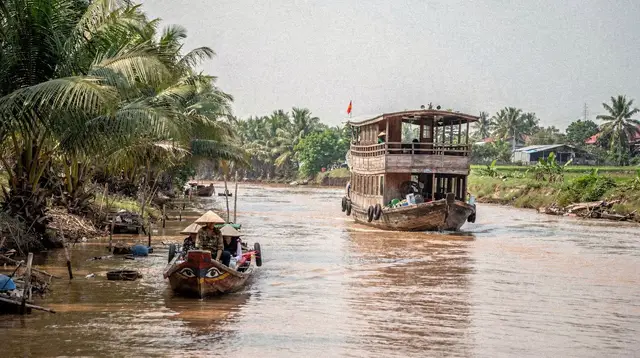
The boat leaves the pier while it’s still dark, or close to it, gliding down the river as the sky starts to lighten. Cai Rang itself comes into view as a cluster of boats, each hung with a long pole displaying a sample of what it’s selling — pineapples, watermelons, cabbages, whatever fills the hold that morning.
It’s a genuine wholesale trade, not a show staged for visitors, which is exactly why timing matters so much: arrive too late and the boats have already thinned out and moved on. The half-day tour of Cai Rang floating market is built around this early departure, moving through the market while it’s still properly trading before returning to the smaller canals nearby.
Once the market itself has quieted, boats typically continue along narrower waterways lined with stilt houses and fruit trees, a much slower and greener contrast to the open-river market scene. For a deeper look at how this sunrise routine is usually structured, and what a typical departure time looks like, see our dedicated guide to Cai Rang at sunrise.
Back on land: cycling, food, or the wetlands
By mid-morning you’re back in Can Tho with most of the day still ahead — this is where the overnight pays off a second time. A few directions to take it, depending on pace and interest:
| Option | What it covers | Good for |
|---|---|---|
| Countryside cycling | Quiet lanes past orchards and canals outside the city | Travellers who want to move at their own speed |
| --- | --- | --- |
| Motorcycle exploration | A wider loop with a local rider, further afield | Those short on time who still want reach |
| --- | --- | --- |
| Bird sanctuary visit | Wetland habitat with resident and migratory birds | Nature-focused travellers, especially outside peak heat |
The Can Tho countryside cycling route is the gentlest of the three, weaving through the same kind of orchard land seen from the boat, but on quiet paved and dirt lanes at a walking-adjacent pace. Anyone drawn instead to wetlands and birdlife rather than markets and canals has a more specialised option in the Can Tho nature and bird sanctuary excursion, which trades the river commerce of the morning for a quieter, greener register in the afternoon.
Heading back
The return to Ho Chi Minh City typically happens in the afternoon or early evening of day two, retracing the same road but in the opposite direction, arriving back in the city as the delta gives way once more to traffic and high-rises. Because the itinerary is built around one clear goal — the market at the right hour — there’s no sense of having rushed past everything else; what’s left out (My Tho, Ben Tre, Cai Be, and destinations further south such as Chau Doc or Ca Mau) is left out because it belongs to a different, longer trip, not because it was missed.
Making this fit a longer trip
This two-day block slots easily into a bigger loop through the south. Travellers with more time sometimes extend it into the fuller four-day route through the deep Mekong Delta to Chau Doc, which picks up exactly where this one stops, or fold it into the broader five-day grand tour covering the delta and the coast at Mui Ne.
Others treat these two days as a stand-alone segment, bookended by city time in Ho Chi Minh City and perhaps a separate outing such as the one-day trip to the Cu Chi Tunnels on another day of the same visit — though as noted above, that pairing rarely fits well inside these same two days, since Cu Chi lies in the opposite direction.
Anyone still deciding between staying overnight in Can Tho or basing the whole trip out of My Tho instead should read our comparison of My Tho versus Can Tho as a Mekong Delta base, and travellers curious about staying with a local family rather than a hotel can look at Mekong Delta homestay options, several of which sit close enough to Can Tho to work with this same schedule.
For the wider canal network beyond the market itself, this guide to the delta’s sampan canals is a useful companion read, and for a general sense of when to travel, our guide to the best time to visit Ho Chi Minh City applies just as well to the delta leg of the trip. A broader look at everything Can Tho itself offers is gathered on the things to do in Can Tho page.
Frequently asked questions about this Can Tho and Cai Rang itinerary
Is Cai Rang floating market in Can Tho or in My Tho?
Cai Rang is at Can Tho. My Tho has its own river life but no comparable floating market, which is why this two-day plan is built around Can Tho and not My Tho.
Is Can Tho a district of Ho Chi Minh City?
No. Can Tho is an independent city in the heart of the Mekong Delta, well outside Ho Chi Minh City. The two are connected by road, not by any shared city boundary.
Why spend a night in Can Tho instead of doing this as a day trip?
Cai Rang trades early in the morning, and a same-day round trip from Ho Chi Minh City reaches the river only once the market has largely wound down. Sleeping in Can Tho puts you on the water at the right time.
Does this itinerary cover My Tho, Ben Tre or Cai Be?
No, those towns sit along the way and are covered by longer itineraries that string several delta stops together. This plan is deliberately narrow: Ho Chi Minh City, Can Tho, and the market.
Does this trip continue to Chau Doc or Ca Mau?
No. Chau Doc, near the Cambodian border, and Ca Mau, at the southern tip of the country, both lie further into the delta and belong to longer itineraries, not this two-day plan.
What should I pack for an early start on the river?
A light layer for the cool air before sunrise, a hat and sunscreen for once the sun is up, and a dry bag or plastic sleeve for a phone or camera near open water.
Can this two-day plan be combined with the Cu Chi Tunnels?
They are usually kept separate. Cu Chi sits north-west of Ho Chi Minh City in the opposite direction from Can Tho, so combining both into two days means very little time at either.
Mekong Delta Cruises and Floating Markets
Verified deep-linked GetYourGuide tours. Book through these links and we earn a small commission at no cost to you.
GetYourGuide does not provide a product photo for this activity — the image shows the meeting point, photographed by us.