Hidden Saigon Motorbike Tour: The City Beyond the Landmarks
What makes a hidden Saigon motorbike tour different from a city tour?
It skips the big landmarks in favor of residential lanes, neighborhood markets and small temples that most visitors never see. It still stays entirely within Ho Chi Minh City's urban area, just off the routes that group buses and walking tours follow.
Most first-time visitors experience Ho Chi Minh City through a fairly narrow lens: District 1’s main boulevards, Ben Thanh Market, the Reunification Palace, maybe a walk down Dong Khoi. It is a real and worthwhile slice of the city, but it is also a small one. A hidden Saigon motorbike tour is built around the idea that the more interesting version of the city sits a few streets back from that route, in the residential lanes, neighborhood markets and small temples that a coach tour has no reason to enter.
What “hidden” actually means here
The word hidden causes more confusion than almost any other term used to describe Saigon’s motorbike tours, so it is worth being precise about it. These tours are not trips out of the city. They do not head toward Cu Chi, the Mekong Delta or the coast. Everything happens inside the same urban area covered by Ho Chi Minh City itself — the difference is which streets within that area get used.
A conventional city tour moves between fixed points: a market, a palace, a cathedral, a rooftop bar. A hidden-lanes motorbike tour instead threads through the alleys that connect those points, the ones lined with family homes, small workshops, corner shrines and neighborhood eateries that have no reason to appear on a map aimed at tourists. The destination matters less than the route itself. Riding pillion through a residential lane at a walking pace, weaving past someone repairing a motorbike, a woman selling herbs from a basket, kids playing badminton across the alley, gives a far more immediate sense of daily life than standing in front of a monument.
This distinction also explains why these tours pair so naturally with a driver rather than a self-drive rental. Saigon’s back lanes are narrow, often unmarked, and navigated by residents on instinct rather than street signs. A local driver who already knows a given lane’s rhythm, where it opens onto a market, where it turns into a dead end, where the quiet temple is tucked behind a gate, is doing something a visitor with a rental scooter and a map simply cannot replicate on a first visit. For more on that distinction, see self-drive versus a chauffeured motorbike.
The neighborhoods where these routes tend to run
Because the appeal is residential texture rather than named sights, routes vary by operator and by night, but they draw from a consistent pool of districts.
District 1’s quieter edges. Even within District 1, away from Dong Khoi and Nguyen Hue, there are older residential blocks with a completely different feel from the tourist core a few hundred meters away.
District 3. Known for tree-lined streets, colonial-era villas converted into cafés, and a slower pace than District 1. It rewards riding through rather than walking, since the interesting details are spread across a wider area. See the District 3 neighborhood guide.
District 4. Tightly packed and food-driven, with narrow lanes that open onto some of the densest street-food clusters in the city. It sits just across a canal from District 1 but feels like a different city. The District 4 street food guide covers the food side in more depth.
Cholon. The historic Chinatown spanning Cholon, District 5 and District 6, built around older shophouses, incense-making workshops and temples that see far more local worshippers than tourists. A motorbike route through Cholon’s lanes shows a different layer of the area than a walk to Binh Tay Market and Thien Hau Temple alone. The Cholon neighborhood guide and the dedicated Cholon pagodas tour go into the district’s temple circuit specifically.
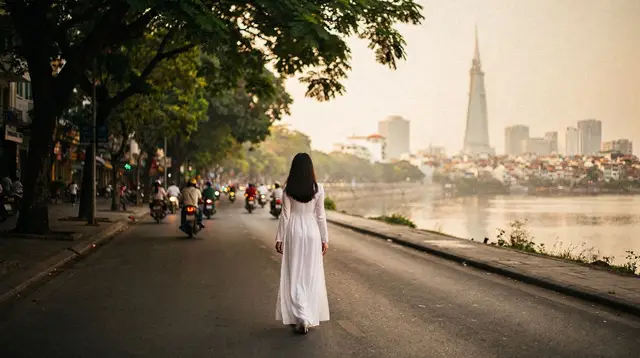
Binh Thanh, along the canals. Away from Landmark 81’s tower, Binh Thanh has stretches of waterside housing and small canal-front markets. The Binh Thanh canal guide covers this side of the district.
Thao Dien, across the river. Now part of Thu Duc City, Thao Dien mixes newer expat cafés with older residential pockets, and a route through it looks and feels different from the denser lanes on the west bank of the Saigon River. See the Thao Dien guide.
A single evening’s route typically threads through two or three of these areas rather than covering all of them, and which ones depend on the operator and the time of day.
What a typical route touches on
Rather than a fixed monument list, these tours tend to build around a handful of recurring elements, mixed and matched by the driver depending on the night.
-
Residential lanes. The core of the experience: narrow alleys where daily life plays out in the open, from cooking to laundry to impromptu street games.
-
Neighborhood markets. Smaller and later-running than Ben Thanh, these serve locals rather than visitors, and a stop here often means fresh produce, cheap snacks and a much less transactional atmosphere than the central tourist market. The Jade Emperor Pagoda guide and other small-temple write-ups on this site cover some of the quieter religious sites that fit into this kind of route.
- Small temples and shrines. Modest, actively used places of worship rather than the grand set-piece temples aimed at tour groups.
-
Local food stalls. Often the highlight for many riders — a coffee stop, a snack from a stall with no sign in English, or a herbal tea break that only exists because a driver already knows where to find it. Related options include the motorbike food crawl tour and the broader evening vespa tour format.
-
A river or canal glimpse, since much of the city’s older residential fabric grew up along the water rather than along the main roads.
None of this is meant to be exhaustive or fixed. The appeal of this style of tour is precisely that the route adapts to the night, the driver, and what is happening in a given lane at the time.
How this differs from a generalist city tour
| Generalist city tour | Hidden Saigon motorbike tour | |
|---|---|---|
| Focus | Named landmarks (Ben Thanh, Reunification Palace, Notre-Dame) | Residential lanes, local markets, small temples |
| --- | --- | --- |
| Typical area | District 1 core | District 1’s edges plus District 3, District 4, Cholon, Binh Thanh, Thao Dien |
| --- | --- | --- |
| Pace | Stop-and-photograph at each site | Continuous riding with shorter, informal stops |
| --- | --- | --- |
| Best paired with | A first visit to Saigon | A repeat visit, or alongside a landmark tour on a separate day |
| --- | --- | --- |
| Driving | Walking or coach | Local driver, passenger seat |
A first-time visitor with limited time is usually better served by a straightforward landmark tour or the one-day Ho Chi Minh City highlights itinerary. A hidden-lanes motorbike tour makes more sense as a second layer, either later in the same trip or on a return visit, once the main sights are out of the way and there is appetite for something less structured.
Choosing between the available options
The tours bookable on this site cover slightly different emphases within the same idea. The Ho Chi Minh Motorbike Combo City and Hidden Gems Tour pairs a few better-known stops with the back-lane style of riding, which suits a first-time visitor who still wants a taste of both. The Hidden Gems Motorbike Tour with Herbal Tea leans further into the local-market-and-tea-stop side of things.
For a version built around food specifically, the Unseen Culture Coffee Hidden Gems Motorbike Tour centers the ride on coffee culture and small local stops. And the Koi Fish Cafe Hidden Gems Tour adds one distinctive, well-loved local stop into the same style of route.
None of these routes are announced with a fixed stop count or a published minute-by-minute schedule, and that is by design rather than an omission — the value is in the driver’s ability to adjust based on what a given lane or market looks like on a given night, not in following a checklist.
Wheels for the days between night rides
Whichever motorbike tour you pick, the driver handles the lanes, the markets and the tea or coffee stops, so you never need your own vehicle for the ride itself. Evenings spent hopping through back lanes with a local driver are a poor match for a rental car, which would mostly sit in a parking spot while you ride pillion.
A car makes more sense on a different day, if you want to leave the city at your own pace rather than follow a route that changes with each lane. Keep that day apart from your tour evening, so you are not driving tired after a late ride. Check the pick-up point, the fuel policy and what is included before paying, and you can look at Localrent rental options for a Ho Chi Minh City pick-up.
Practical notes specific to this style of tour
Because the whole appeal rests on going somewhere other than the standard sights, a few practical points matter more here than they would on a landmark-focused outing.
Traffic and safety. Ho Chi Minh City has some of the densest motorbike traffic in the country, and narrow residential lanes add another layer of unpredictability, from parked scooters to sudden turns. Riding as a passenger with an experienced local driver is the standard and sensible approach; see renting a scooter and the license question if self-driving is under consideration instead, and crossing the street and traffic in Saigon for the general pattern of how traffic behaves here.
Weather. Southern Vietnam runs on a dry season and a wet season rather than four seasons. In the wet months, a short, heavy downpour in the late afternoon is common but usually brief, so an evening tour scheduled around it is often unaffected for long. Dressing for humidity year-round, rather than for a particular season, is the more useful frame.
Language. English is common in central hotels and tourist-facing businesses, but a residential lane’s food stall or market vendor is unlikely to speak it. The driver typically bridges this, which is one more reason this style of tour works better guided than self-navigated.
Getting around otherwise. For the logistics of moving around the wider city outside of a booked tour, see getting around Saigon, which covers ride-hailing apps, the new metro line and buses.
Who this suits, and who it does not
This style of tour suits travelers who have already seen, or plan separately to see, the major landmarks and want a different texture of experience: slower, less curated, closer to how the city’s residents actually live day to day. It also suits photography-minded visitors, since residential lanes and local markets offer a very different visual palette from the postcard shots of Notre-Dame or the Bitexco Tower.
It suits less well a traveler with only a single day in the city who has not yet seen District 1’s core sights, since those still anchor most people’s mental map of what Saigon looks like. It is also not the right choice for anyone expecting a fixed list of famous stops; if that is the goal, a walking tour or a private city tour built around named landmarks is the better fit. Anyone drawn to the same off-the-radar spirit but preferring two feet to two wheels can also look at the Saigon cyclo tour as a slower, quieter alternative that covers some of the same ground.
Hidden Saigon Motorbike Tours: Frequently Asked Questions
Is a hidden Saigon motorbike tour the same as an out-of-town excursion?
No. Despite the name, these tours stay inside the city’s urban perimeter. The word hidden refers to lanes and corners that ordinary sightseeing misses, not to distance from the center.
Do these tours still visit District 1?
Some routes pass through the edges of District 1 or start there, but the emphasis shifts quickly toward residential districts and lanes that a walking tour of Ben Thanh or Dong Khoi would never reach.
Do I need previous motorbike experience?
No. On nearly every version of this tour, an experienced local driver handles the motorbike and you ride as a passenger, which is also the safer option given how dense Saigon traffic is.
Is this tour suitable for someone who dislikes crowds?
Yes, that is largely the point. The routes favor quiet residential streets and small local markets over the crowded stretches around the main tourist sites.
What kind of food is involved?
Tours in this category typically stop at small stalls and family-run spots inside residential lanes rather than at restaurants set up for tourists, often pairing a few tastings with a coffee or tea break.
Can this replace a visit to the well-known Saigon landmarks?
It complements rather than replaces them. Most travelers pair a hidden-lanes motorbike tour with a separate visit to District 1’s landmarks, since the two cover different sides of the city.
Are these tours run during the day or at night?
Both exist. Daytime versions focus more on markets and residential life, while evening versions lean into food stops and the change in atmosphere once the lanes light up.
Vespa Tours and Street Food by Night
Verified deep-linked GetYourGuide tours. Book through these links and we earn a small commission at no cost to you.
GetYourGuide does not provide a product photo for this activity — the image shows the meeting point, photographed by us.