A Walking Tour of Central Ho Chi Minh City
Can central Ho Chi Minh City really be explored on foot?
Yes. District 1 packs Ben Thanh Market, the Reunification Palace, Notre-Dame Cathedral Basilica, the Central Post Office, Dong Khoi and the riverfront into one compact grid, so a single walking loop links most of the centre's landmarks without needing a taxi or a ride-hailing app between stops.
District 1 Is Smaller Than It Looks
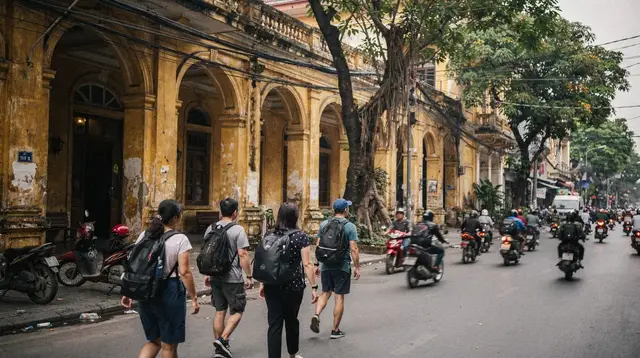
Ho Chi Minh City has a reputation, among travelers who haven’t yet arrived, as a sprawling, traffic-choked metropolis where everything worth seeing sits far from everything else. That reputation is true of the wider city — the Ho Chi Minh City metro area stretches across districts that genuinely do require a taxi, a ride-hailing app or a motorbike to link. But it is not true of the historic centre. District 1, the part of the city most visitors actually spend their days in, is a tight, walkable grid, and its main landmarks sit close enough together to be strung into a single, unhurried loop on foot.
This confusion — treating the whole city as if it were one undifferentiated sprawl, then concluding that the centre needs a car — is one of the more persistent misreadings of Ho Chi Minh City among first-time visitors. It usually comes from looking at a city map at the wrong zoom level: at city scale, District 1 is a small dot next to Binh Thanh, Thu Duc and the outer districts. At street scale, it is a dense, walkable core built on a colonial-era grid that has changed little in its footprint since it was laid out.
This guide covers that central walking route: what it links together, why the pieces fit naturally into one walk, and how it differs from a themed route built specifically around the city’s war history, which is covered separately as its own itinerary.
What This Walk Covers, and What It Deliberately Skips
A central walking loop through District 1 typically threads together a handful of landmarks that sit inside the same compact grid: Ben Thanh Market and its clock tower as a natural starting or finishing point, the Nguyen Hue walking street running toward the riverfront, Dong Khoi with its shopfronts and older colonial buildings, Notre-Dame Cathedral Basilica of Saigon and the Central Post Office facing each other across their shared square, and a stretch along the Saigon River itself.
What this route is not is a themed history walk. The Reunification Palace and the War Remnants Museum sit within reach of the same grid, and a visitor with a strong interest in the war years may reasonably want to build a route around them specifically. That’s a different walk with a different pace and a different set of stops, and it’s covered on its own as a dedicated war-history walking route rather than folded into this one.
Combining the two into a single outing is possible, but it changes the character of the day from a relaxed loop through markets and colonial architecture into something closer to a history-focused itinerary, and the two are worth keeping conceptually separate even when a visitor chooses to link them in practice.
This route also deliberately leaves out Cholon, the historic Chinatown quarter spread across Districts 5 and 6. Cholon has its own dense street pattern, its own market in Binh Tay, and its own temples, and it rewards being treated as a separate outing rather than being tacked onto the end of a District 1 loop, where it would arrive already tired. Anyone drawn to both is better served reading the Cholon neighborhood guide and planning it as its own leg of a trip, possibly on a different day.
Why the Centre Works So Well on Foot
The reason District 1 lends itself to walking has to do with how it was built. The core grid around Dong Khoi, Nguyen Hue and the cathedral square dates to the city’s colonial-era planning, when blocks were laid out at a pedestrian scale, with buildings fronting directly onto narrow streets rather than set back behind car parks or wide boulevards. That grid has been built up and modernized since, but its basic geometry hasn’t changed, which is why landmarks from very different eras end up within easy reach of each other: a nineteenth-century cathedral, a French colonial post office, a 1960s-era palace, and Bitexco Financial Tower’s contemporary skyline can all fall within the same short loop.
This is also why a walking route through District 1 doesn’t need to be planned with much precision. Because the grid is small and dense, most reasonable orderings of the same handful of stops work about equally well, and the route can flex to accommodate a market that’s more interesting than expected, a cafe worth lingering in, or simply the direction the light is falling. A route built around a single narrow objective, like the war-history walk, benefits from being planned more deliberately; a general loop through the historic core is far more forgiving.
That forgiveness matters for how the day actually feels. Nothing about a central walking loop asks a visitor to commit to a fixed schedule or a rigid sequence of transfers. It’s closer to wandering with a loose sense of direction than to executing an itinerary, and that looseness is only possible because the underlying geography supports it.
A Loop Through the Landmarks
Starting at Ben Thanh Market makes sense for most visitors, since its clock tower is one of the most recognizable orientation points in the city and its stalls offer an easy first taste of the centre’s energy. From there, the walk typically heads toward Nguyen Hue, the wide pedestrian street that runs down toward the river and functions as a kind of public living room for the city, especially in the early evening when it fills with families, street performers and food vendors.
From Nguyen Hue, Dong Khoi runs roughly parallel and connects toward the cathedral square, where Notre-Dame Cathedral Basilica of Saigon and the Central Post Office face each other. The cathedral has been under a long-running restoration, and its exterior shouldn’t be expected to look freshly revealed or fully scaffold-free; the point of including it in the walk is less about a pristine photograph and more about the square itself, which remains a genuine gathering point in the centre. The guide to Notre-Dame Cathedral Basilica and the Central Post Office covers both buildings in more depth.
From the cathedral square, a short detour leads to the Jade Emperor Pagoda, a quieter, incense-filled counterpoint to the grander colonial buildings nearby, covered separately in the Jade Emperor Pagoda guide. Looping back toward the river brings the walk past Bitexco Financial Tower, whose observation deck is detailed in its own Bitexco Tower Skydeck guide for anyone wanting to end the walk with a view over the grid they’ve just crossed on foot.
A stretch along the Saigon River itself makes a natural close to the loop, whether that’s simply a walk along the promenade or a transition into one of the river’s boat trips. For visitors who’d rather end the day on the water than on foot, a dinner cruise adds a different vantage point on the same city centre just walked through.
a Saigon River dinner cruise with a buffet spread, timed to follow an afternoon spent on foot in the centreGuided Options for the Same Ground
Independent walking suits District 1 well precisely because the grid is forgiving, but a guided walk adds context that’s easy to miss when wandering alone — why a particular building survived, what a market stall’s specialty actually is, which side streets are worth a detour. Guided city walks generally cover the same compact core described above, just with narration and a fixed meeting point.
a guided walk through the centre’s newer public spaces alongside its older landmarks a guided highlights walk covering the main District 1 landmarks with a local guideSome visitors prefer a guided walk tailored to a particular travel style or community; a few operators run a sightseeing walk through the centre led by a guide known for an inclusive, welcoming approach covering much of the same ground with a different atmosphere.
Best Time of Day to Walk the Loop
Timing changes the walk more than route order does. Midday heat and humidity turn even a modest loop into a slog, so most visitors do better splitting the walk across the cooler edges of the day: a morning stretch from Ben Thanh Market toward the cathedral square, then a break through the heat, then a return to Nguyen Hue and the riverfront once the light softens in the late afternoon. Crossing streets in the middle of a hot afternoon also feels more draining than it does in cooler hours, and the guide to crossing the street and traffic in Ho Chi Minh City is worth a quick read before setting out for the first time regardless of when the walk happens.
Evening changes the character of the loop rather than just the temperature. Nguyen Hue in particular transforms after dark, filling with families, skateboarders, street performers and vendors in a way that has little in common with its daytime rhythm, and the cathedral square and Dong Khoi’s shopfronts take on a different mood once their facades are lit. Visitors who’d rather have that context narrated than discover it on their own can join a night walking tour of the centre led by a local guide, which covers much of the same ground as the daytime loop but timed for the evening crowds and cooler air.
Extending the Loop: District 4 Street Food and the Riverside After Dark
For visitors with an appetite for more than a single afternoon, the District 1 loop connects naturally into two extensions rather than being padded out on its own. Just across the canal, District 4 is packed with dense street-food lanes that reward a dedicated, hungrier outing rather than a quick detour squeezed into the main walk; the District 4 street food guide lays out the neighborhood in more depth, and a guided version of the same ground is available as a District 4 street food walking tour for anyone who’d rather follow a local than guess which stalls are worth the stop.
The other natural extension runs later into the night, toward the backpacker energy of Bui Vien street, covered separately in the Bui Vien nightlife guide, or upward, toward one of the centre’s rooftop bars looking back down over the grid just walked, as detailed in the Saigon rooftop bars guide. Neither needs to be decided in advance; both simply extend a day that started with Ben Thanh Market’s clock tower into an evening built around food and a view rather than more walking.
Where to Base Yourself for a Walking-First Trip
Anyone planning to explore the centre mainly on foot benefits from staying inside or very near District 1 itself, rather than in an outlying district that would reintroduce the transfers a walking-focused day is trying to avoid. The guide to where to stay in Saigon by neighborhood breaks down the tradeoffs between District 1’s convenience and quieter alternatives like Thao Dien across the river. For trips that do involve venturing beyond the walkable core, whether to Cholon, the riverfront docks or further afield, the guide to getting around Saigon covers the ride-hailing apps, buses and taxis that pick up where walking leaves off.
Fitting a Walking Loop Into a Wider Trip
A District 1 walking loop pairs naturally with a single day in the city before or after excursions further afield, since it doesn’t require a car, a driver or advance booking to execute. It slots easily into a first or last day of a longer stay, or stands alone as the anchor of a short city break. The one-day Ho Chi Minh City highlights itinerary builds a full day around this kind of central loop, layering in a market visit, a rooftop or riverside close to the day, and time left open for the wandering that the centre’s compact grid makes so easy.
Visitors extending their stay to Cholon, the war-history sites, or day trips to Cu Chi or the Mekong Delta should treat each as a separate leg rather than folding them into the central walk described here — the whole point of District 1’s scale is that it doesn’t need to be padded out with additions that belong elsewhere on the map.
FAQ: Walking Around Central Ho Chi Minh City
Is District 1 too spread out to walk?
No. District 1’s core sights sit inside a tight, walkable grid rather than being scattered across the city. The idea that the centre requires transport between landmarks comes from comparing it to the wider metropolitan area, not to the compact historic core.
What’s the difference between this walking route and a war-history walking tour?
This route strings together District 1’s markets, colonial-era architecture and riverfront blocks. A dedicated history-focused walk, covered separately, concentrates instead on the Reunification Palace and the War Remnants Museum as its own themed itinerary.
Do I need to plan the order of the stops carefully?
Not really. Because the centre is compact, most combinations of Ben Thanh Market, Nguyen Hue walking street, Dong Khoi, Notre-Dame Cathedral Basilica and the Central Post Office work in either direction, so the route can flex around opening hours or a change of pace.
Is Notre-Dame Cathedral Basilica worth including if it’s under restoration?
It’s still a landmark worth passing, though the exterior is under a long-running restoration, so it shouldn’t be expected to look freshly revealed. The surrounding square and the Central Post Office opposite remain fully part of the walk.
Can this walk be combined with Cholon or the riverfront?
Cholon is its own historic quarter with a different rhythm and is better treated as a separate leg or a different day, while a short stretch along the Saigon River fits naturally onto the end of a central loop.
Is the walk comfortable for families or older travelers?
The compact scale of District 1 is exactly what makes it manageable for a wider range of travelers, since it avoids long transfers between sights and allows pauses at cafes, markets or shaded squares along the way.
Should I worry about traffic while walking around District 1?
Motorbikes dominate the streets, and crossing is done at a steady, predictable pace rather than by waiting for a gap in traffic. Staying alert at intersections matters more than the length of the walk itself.
What’s the best time of day to walk the loop?
Early morning and early evening both work well, since the heat of the middle of the day makes the same distance feel far longer than it is. Evening also has the advantage of Nguyen Hue filling with families, food vendors and street performers, which changes the character of the walk from sightseeing to people-watching.
Can the loop be extended into District 4 or an evening on Bui Vien?
Yes, though both are better treated as an extension than as part of the same relaxed pace. District 4’s street-food lanes and the Bui Vien strip both sit within reach of the District 1 grid and suit a hungrier, later stretch of the same day rather than being folded into the morning walk.
Ho Chi Minh City and District 1 Tours
Verified deep-linked GetYourGuide tours. Book through these links and we earn a small commission at no cost to you.
GetYourGuide does not provide a product photo for this activity — the image shows the meeting point, photographed by us.