War Remnants Museum: Saigon's Living Memory of War
What is the War Remnants Museum in Ho Chi Minh City actually about?
It is Vietnam's principal museum of memory for the wars against France and the United States, documenting the human and material cost of those conflicts through photography, testimony and preserved military equipment. It functions as a site of national memory rather than a conventional history museum, and is treated that way by most Vietnamese visitors.
Beyond a Tourist Stop: A Site of National Memory
Most visitors arrive at the War Remnants Museum expecting an attraction like the others clustered around District 1: a building, a ticket, a set of exhibits to move through at a comfortable pace before moving on. That framing misreads what the place is for. In Vietnam, the museum is understood as a site of national memory, closer in spirit to a war memorial than to a conventional museum of objects and dates.
It exists to hold and transmit a specific, painful history — the wars against France and then the United States that shaped the country for three decades — rather than to entertain or to offer a balanced survey of competing narratives. Treating it as one more stop on a checklist of Ho Chi Minh City sights, alongside a market or a rooftop bar, misses both what it is trying to do and why it still matters to the people who built it.
This distinction is not a semantic quibble. It changes what a visitor should expect to feel, how they should read the exhibits, and what kind of visit is being offered. A theme park promises enjoyment. A memorial museum promises confrontation with something difficult, in the hope that confrontation produces understanding. The War Remnants Museum was built, expanded and repeatedly reorganized with that second goal in mind, and it is worth arriving with that expectation rather than the first.
What the Museum Documents
The museum’s subject is the human and material cost of the conflicts fought on Vietnamese soil across the twentieth century, with its heaviest emphasis on the American War, as it is known locally — the conflict that Western visitors more often call the Vietnam War.
Its galleries move through several linked themes: the mobilization of international opposition to the war, including the anti-war movement in the United States and Europe; the direct testimony of war photographers, several of whom died in the field documenting the fighting from multiple sides; the physical evidence of the conflict, from captured and retired military hardware displayed in the courtyard to smaller personal artifacts inside; and, in its most difficult rooms, the long-term human effects of chemical defoliants sprayed over vast areas of the country, effects that persisted for generations after the fighting ended.
That last theme is central to why the museum carries the weight it does. The chemical warfare exhibits are not a side note; they are one of the museum’s core arguments, presented through photography and documentation of birth defects and illness linked to wartime herbicide use. It is also the section most visitors describe as the hardest to walk through, and the one most responsible for the museum’s reputation as an unusually direct, unsentimental confrontation with the consequences of war rather than a triumphant account of victory.
The museum’s collection also includes material connecting the war in the south to the broader theater of conflict across Indochina — a reminder that the fighting around Saigon was one part of a longer, wider war whose roads and supply lines ran far beyond the city. Readers wanting that larger geography can look at how the Ho Chi Minh Trail shaped the war in the south, a subject the museum touches without making its central focus.
From War Crimes Exhibition House to War Remnants Museum
The institution did not open under its current name, and its history of renaming tells its own story about how Vietnam’s relationship to this history, and to the outside world, has shifted. In the years immediately following reunification in 1975, the museum operated under a more explicitly accusatory title, oriented squarely toward documenting what its founders described as war crimes committed during the conflict. As diplomatic and economic relations with the United States normalized through the 1990s, and as Vietnam opened more deliberately to international tourism, the institution was renamed to its current, more neutral-sounding War Remnants Museum.
The change in name did not mean a wholesale change in content. The core documentary material — the photography, the testimony, the physical remnants of war — remains largely continuous with the museum’s earlier incarnation. What shifted was framing and diplomacy: a name better suited to a country seeking foreign investment and millions of foreign visitors, sitting atop a collection that still makes an unambiguous case about the war’s costs. Understanding that history helps explain a tension some visitors notice: an museum that in presentation looks like an international, professionally curated institution, but that in substance retains the moral clarity of a memorial built by the side that endured the war on its own soil.
Reading the Exhibits: Photography, Testimony and Physical Evidence
The museum’s authority rests heavily on photography, and it is worth knowing why. Long before satellite imagery, drone footage or social media, photojournalists working with film cameras were often the only independent witnesses able to move between the front lines, refugee columns and bombed villages of the war. Several of the photographers whose work anchors the museum’s collections were killed while covering the conflict, and their negatives — recovered, printed and exhibited posthumously in some cases — form part of what makes the museum’s photographic record feel less like illustration and more like primary evidence.
Alongside the photography sits testimony: accounts from veterans, from families affected by chemical defoliants, and from international observers who visited Vietnam during and after the war. The courtyard’s displayed tanks, aircraft and artillery pieces, familiar from photographs of the museum, serve a different, more didactic function — they make the scale and mechanization of the conflict physically legible in a way that photographs alone cannot. None of these elements is meant to be read in isolation. The museum’s sequencing — from the international anti-war movement, through frontline photography, to the long tail of chemical harm — builds a cumulative argument rather than presenting a neutral timeline of dates and battles.
It is also worth reading the museum in relation to other memory sites nearby rather than as a self-contained stop. A short walk connects it to the Reunification Palace, and several operators combine the two into a single half-day route; the walking tour through Saigon’s war sites is one structured way to link them on foot through central District 1.
The Museum in the Landscape of Saigon’s Wartime Sites
Ho Chi Minh City carries the physical memory of this history in more than one location, and the War Remnants Museum sits at one end of a wider network. The Reunification Palace, formerly the Independence Palace, is the political counterpart: the building where the war in the south formally ended on 30 April 1975, when a tank breached its gates. Visitors often pair the two sites deliberately, treating the museum as the human and documentary register of the war and the palace as its political and military conclusion.
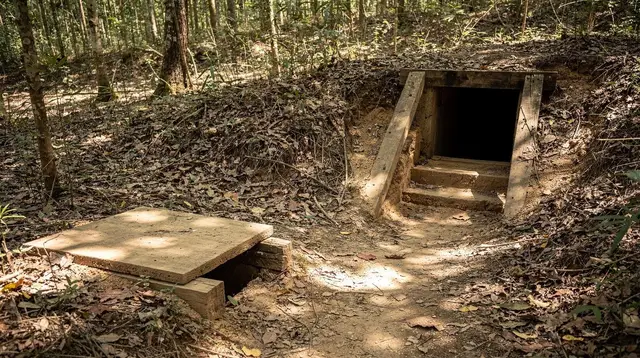
Further from the city center, the Cu Chi Tunnels offer a third register again: the physical, tactical infrastructure of guerrilla warfare, preserved and in places reconstructed for visitors to walk and crawl through. Tours built specifically around veteran guides, such as those covering the Cu Chi Tunnels with veteran-led commentary, add a further layer that the museum’s static exhibits cannot: first-person recollection.
Taken together, the museum, the palace and the tunnels form a loose triangle of wartime memory sites around the city, each documenting a different dimension of the same conflict — the human cost, the political end, and the underground war — rather than duplicating one another.
The city’s built environment carries quieter traces of this same period too, visible in the colonial-era architecture that survived the war largely intact, from the Central Post Office to Notre-Dame Cathedral Basilica, covered in more detail in a look at Saigon’s colonial heritage architecture and in a guide to the Cathedral and Central Post Office. None of these buildings are war memorials in the museum’s sense, but they frame the same city where this history unfolded.
Why the Visit Feels Different From Other Attractions
Visitors consistently describe the War Remnants Museum as one of the more emotionally demanding stops in southern Vietnam, and that is by design rather than accident. Where most of the attractions clustered around central Saigon are built for pleasure — a market to browse, a rooftop view to photograph, a river cruise at sunset — this museum is built for reckoning. Its photography of civilian casualties and its exhibits on chemical defoliants do not soften the material for a tourist audience, and some visitors, particularly those traveling with children, find sections of the museum genuinely difficult.
That difficulty is not a curatorial flaw to be smoothed over; it is close to the museum’s central purpose. A memorial that made its subject comfortable would fail at the task its founders set for it. Visitors who arrive expecting a straightforward historical overview sometimes come away unsettled by the intensity of the material, while visitors who arrive understanding they are entering a memorial space tend to describe the visit as one of the more meaningful things they did in the city, even when it was also one of the hardest.
This is also why comparisons to Western war museums, which often aim for curatorial neutrality between combatant perspectives, do not quite fit. The War Remnants Museum does not present itself as neutral, and does not claim to. It presents itself as a Vietnamese institution documenting a war fought on Vietnamese territory, with a clear point of view about what that war cost. Visitors who come prepared for that stance, rather than expecting the more distanced tone of a foreign war museum, generally find the experience easier to place in context.
Visiting With Context: Where to Go Next
Because this page focuses on what the museum represents rather than on the logistics of a visit, readers planning an actual trip should turn to the dedicated page on tickets and practical access, which covers what this page deliberately leaves out. Several tour operators also combine a museum visit with other central-Saigon wartime sites in a single guided outing, which can help with pacing and context on a first visit.
a standalone entry ticket to the War Remnants Museum covers a self-guided visit for travelers who prefer to read the exhibits at their own pace. For those who want the museum placed in a wider narrative on the day, a guided walking tour linking the museum with the Reunification Palace follows roughly the route described above.
Travelers arriving on a tight layover sometimes choose a half-day tour bundling the museum, the Independence Palace and a complimentary e-SIM, while those who prefer a guide dedicated to their group alone can book a private city tour built around the War Museum and Reunification Palace.
For planning the rest of a first day in the city, the one-day Ho Chi Minh City highlights itinerary shows how the museum fits alongside the city’s other central sights, while travelers building a longer route through the south can see how war-history sites are sequenced in the three-day Saigon, Cu Chi and Mekong classic itinerary. Whichever route brings a visitor here, the museum rewards being treated as what it is: not a curiosity on a sightseeing list, but the place where Ho Chi Minh City keeps its clearest, hardest record of what the war actually cost.
Frequently Asked Questions About the War Remnants Museum
Is the War Remnants Museum a war memorial or a museum of history?
Both, and the balance leans toward memorial. It presents a Vietnamese and international documentary record of the wars, but its purpose is remembrance and testimony as much as neutral historical narration, which is why the experience feels different from a conventional history museum.
Why does the museum focus so heavily on photography?
Much of its core collection comes from war photographers, including several who died covering the conflict, and from photojournalism exhibitions built around their negatives. Photography was one of the few forms of direct, unfiltered evidence available from the period, which is why it anchors the museum’s approach.
Was the museum always called the War Remnants Museum?
No. It opened under a different, more openly polemical name in the years immediately after 1975 and was renamed in the 1990s as diplomatic relations with the United States normalized, a change that reflects the broader shift in how the war has been presented to visitors over time.
Does the museum only present the Vietnamese perspective?
Its core narrative is Vietnamese, but a significant part of its material, particularly the photographic collections, comes from foreign photojournalists, and its themes of civilian suffering and the effects of chemical defoliants are widely corroborated by international scholarship and journalism from the period.
How does the War Remnants Museum relate to the Reunification Palace?
They cover different moments and registers of the same history. The Reunification Palace is the political and military site where the war in the south formally ended in 1975; the museum is the memorial and documentary record of what the war cost, and the two are usually visited as a pair rather than as substitutes for each other.
Is the museum appropriate for children?
Some sections contain unflinching photography of violence, injury and the effects of chemical defoliants, and families often find it heavier than other Ho Chi Minh City attractions. It is worth discussing in advance rather than treating it as a routine stop on a family itinerary.
Where can I find practical details like tickets and opening hours?
Practical visit information is kept on a separate, dedicated page so this guide can focus on context and meaning; see the linked attractions and tickets guide for current access details.
War History: Cu Chi Tunnels and the War Remnants Museum
Verified deep-linked GetYourGuide tours. Book through these links and we earn a small commission at no cost to you.
GetYourGuide does not provide a product photo for this activity — the image shows the meeting point, photographed by us.